
There are two kinds of options traders: those who buy options hoping for a big move, and those who sell them and collect income while they wait. A London Business School study found that retail options traders lost over USD 2 billion in options premium between 2019 and 2021 much of it concentrated in short-term options purchased speculatively. The buyers bore nearly all of that loss. The wheel strategy options approach sits firmly on the other side of that trade.
Instead of paying premium and relying on direction, traders systematically collect income by selling cash-secured puts and later covered calls if shares are assigned. The process then repeats, creating a structured and beginner-friendly options income strategy.
What is the Wheel Strategy
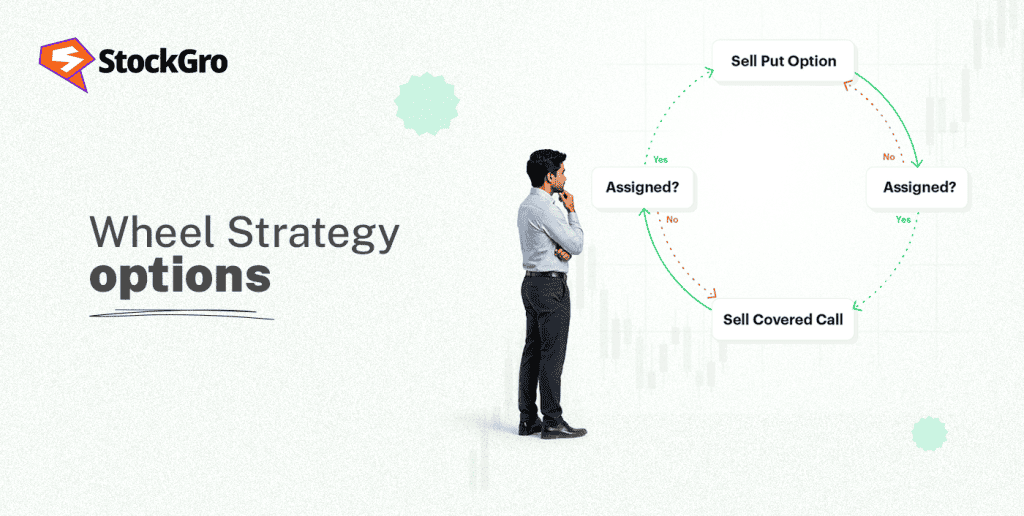
The wheel strategy is a trading technique that aims to generate steady income using a combination of option sales. Traders typically initiate the setup by writing secured puts on a stock you are willing to hold, while earning premiums until assignment occurs. Once assigned, you sell covered call options on the stock you now hold again collecting premiums until the calls are assigned at which point the cycle begins again.
The name reflects the mechanics exactly: the options trading strategy moves in a continuous, repeating loop. There is no complex directional bet involved, just a systematic process of selling options, collecting income, and managing the position at each stage.
How the Strategy Works Step by Step
The wheel moves through three clearly defined stages, and understanding the transition between them is important before you put any capital at risk.
In the first stage, you sell cash secured put options on a stock of your choice. In the second step of the strategy, assigned shares are retained and used for covered call writing. In the third stage, if your shares are called away, you return to stage one and begin again.
The wheel keeps turning as long as you stay disciplined about stock selection, strike prices, and position sizing. A trader running the wheel on a single stock can complete multiple cycles in a year, collecting a premium at each turn.
Selling Cash-Secured Puts
Through a put option, the purchaser can sell the underlying security at the specified strike price. Adequate cash must be maintained in the trading account to cover stock purchase obligations tied to a sold put. For example, selling a put with a ₹200 strike and the contract size is 100 shares, traders must keep ₹20,000 available to secure the position.
A common approach is selecting put options with strike prices below the current market value of the asset. This gives the stock room to decline before assignment is triggered, and the premium collected still reduces your effective purchase price if assignment does occur. Two outcomes are possible at expiry:
- Asset price finishes higher than the strike level at expiry: The put option loses all value. You keep the premium as profit and sell another cash-secured put to continue generating income.
- The put option expires unused: The put is assigned. You purchase the stock at the strike price but your effective cost is reduced by the premium already collected. You now move to phase two.
Owning the Stock After Assignment
Assignment is the middle phase of the wheel, and it is one of the most misunderstood. Many beginner options trading practitioners see assignment as a loss. In the wheel framework, it is a transition.
Being assigned is considered part of the process, as it allows the trader to shift into covered call selling while owning the stock.
Once assigned, your priorities shift. You now own 100 shares with a cost basis already reduced by the put premium collected. Your next task is to sell covered calls against those shares to continue generating income while you hold them and to wait for the stock price to recover toward your cost basis or above it.
At this point, careful handling of options risk management becomes especially important. If the stock falls sharply after assignment, you are exposed to a real paper loss. This is why stock selection before Phase 1 is the most important decision in the entire strategy, not the strike price, not the expiry.
Selling Covered Calls
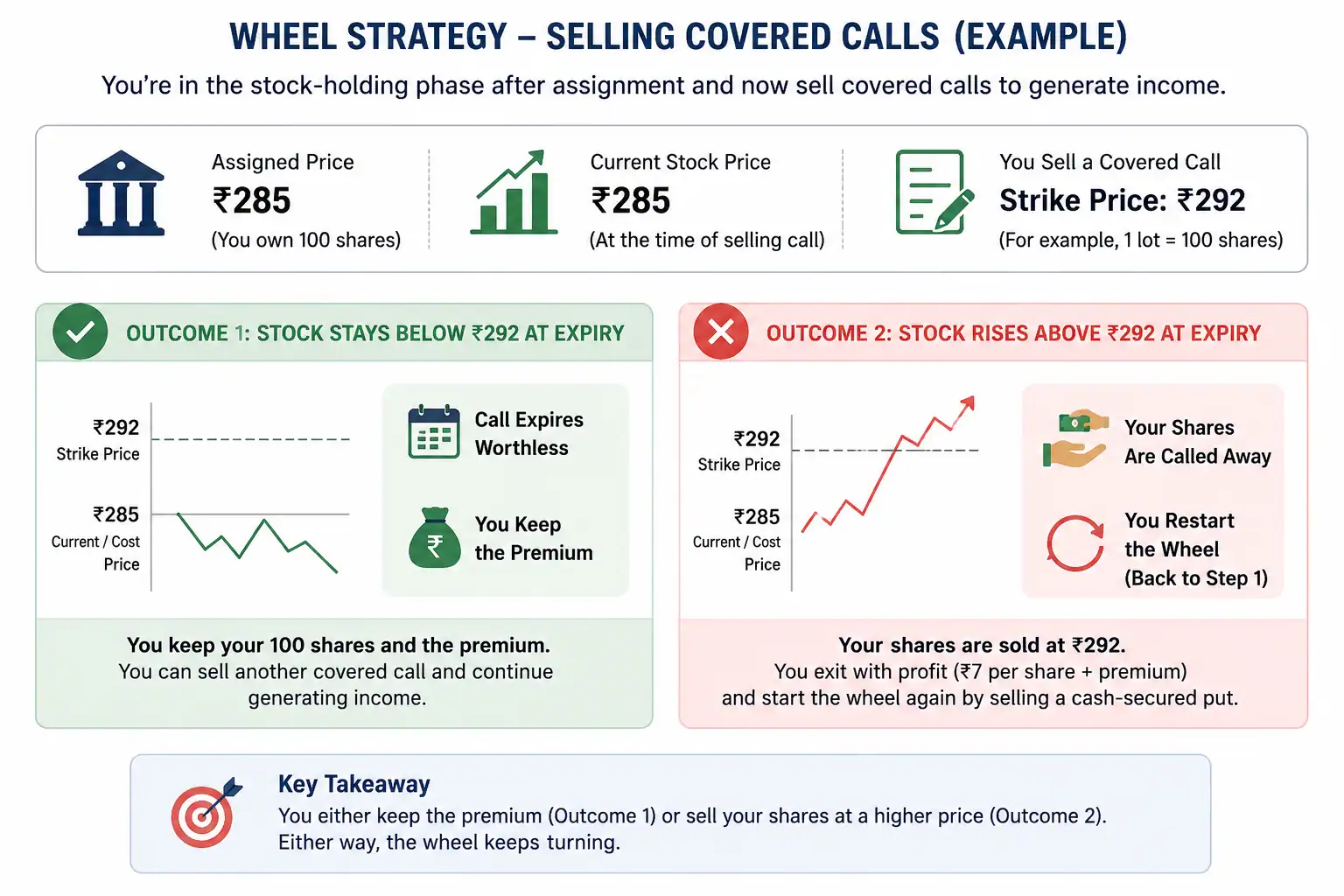
The covered call strategy is the income engine of the stock-holding phase. Once assigned the stock, you move to selling covered calls. You earn option premiums by writing calls on stocks already in your account. If the stock exceeds the exercise price, the position is closed out after which the strategy cycle is restarted.
Using the example from the Samco framework: if you were assigned at ₹285 and the stock is now trading at ₹285, you might sell a covered call with a strike price of ₹292. Should the stock remain under ₹292 at expiry, the call option expires without value and the premium is retained. If the stock rises above ₹292, the buyer exercises their right and your shares are called away leaving you free to restart the cycle from step one.
Benefits of the Wheel Strategy
The strategy focuses on generating recurring income by selling options at different stages of the strategy. The key benefits include:
- Continuous premium income: Every phase of the cycle generates premium income, whether the options are assigned or expire worthless. Income is not dependent on the stock moving in a particular direction.
- Lower effective stock purchase price: Selling cash-secured puts reduces the cost of purchasing the underlying asset; the premium collected offsets part of the acquisition cost if assignment occurs.
- Time erosion benefits your position: The effect of time erosion lowers option premiums over time, supporting the seller’s position. Since option premiums shrink over time, it enables the seller to keep the entire premium collected.
- Defined, manageable risk: In comparison to buying options where the trade can expire completely worthless, selling options in the wheel strategy always results in either premium income or stock ownership, both of which have a known risk profile from the outset.
Risks and Limitations
The wheel strategy is not risk-free. Understanding its limitations is essential before executing it with real capital.
- Capital intensity: As assigned puts convert into stock holdings, traders often need substantial capital for the strategy. The committed capital could limit flexibility for other market positions or investments.
- Downside risk on assignment: If a stock falls sharply after assignment, the premiums collected may not be sufficient to offset the capital loss. The strategy does not protect against a sustained decline in the underlying stock.
- Limited upside: The strategy carries limited profits, if a stock rallies strongly after assignment, selling covered calls caps your upside at the call’s strike price. You will not fully participate in a large unexpected move upward.
- Management requirement: Ongoing supervision is important in the wheel strategy, especially when reacting to changing market behaviour. The strategy may demand considerable time and a strong grasp of options concepts.
When the Strategy Works Best
The wheel strategy generally performs better in stable or mildly bullish market conditions where option premiums remain attractive without large price swings.
- Stocks moving within predictable price ranges
The strategy is commonly used when stocks move within a stable range or rise gradually over time. Such conditions may allow traders to repeatedly earn premium through cash secured put and covered call positions without frequent sharp drawdowns.
- Counters with heavy options participation
Stocks with strong liquidity and active options participation usually offer tighter spreads and smoother order execution. This can help improve pricing efficiency while entering or exiting wheel strategy positions.
- Premium-friendly volatility levels
Moderate implied volatility often supports better option premium collection while keeping price swings relatively manageable. Extremely high volatility may increase assignment frequency and expose positions to larger stock price movements.
- Businesses investors do not mind holding
The strategy is often applied to fundamentally established companies where traders may be comfortable owning shares if assignment occurs. In many cases, stock assignment is treated as a routine part of the wheel cycle.
- Trading setups backed by higher capital
Since selling a cash secured put requires maintaining sufficient funds to purchase shares upon assignment, the strategy is generally more suitable for traders with larger deployable capital.
- Approaches built around regular premium income
The wheel strategy is frequently preferred by traders focusing on recurring option income instead of depending only on directional stock movement. Several practitioner studies and strategy reports estimate annualised returns between 10% and 30%, depending on volatility levels, stock selection, and execution approach.
Final Takeaway for Traders
The wheel strategy options approach rewards consistency over cleverness. Consistent premium collection usually proves more effective than constantly targeting the largest payouts. The ones who stay selective, stay patient, and treat every cycle as a long-term process rather than a quick win are the ones that wins. The wheel does not just generate income. Done right, it builds investing discipline that carries across everything else you do in the markets.
FAQs
Yes, the wheel strategy can generate regular premium income in sideways or mildly bullish markets. Profitability depends on stock selection, strike prices, market conditions, and risk management.
The wheel strategy is considered lower risk than many options strategies, but beginners still need to understand assignment risk, stock ownership, and option mechanics before using it with real capital.
Capital depends on the stock price because cash-secured puts require enough money to buy 100 shares. Many traders start with ₹1–5 lakh equivalent for liquid, lower-priced stocks.
Stable, liquid stocks with strong fundamentals and active options trading are commonly preferred. Many traders avoid highly volatile or low-volume stocks because assignment risk and sharp price declines increase.
The biggest risk is holding a stock that falls sharply after assignment. Premium income may not offset large losses, leaving capital locked in underperforming shares for extended periods.

