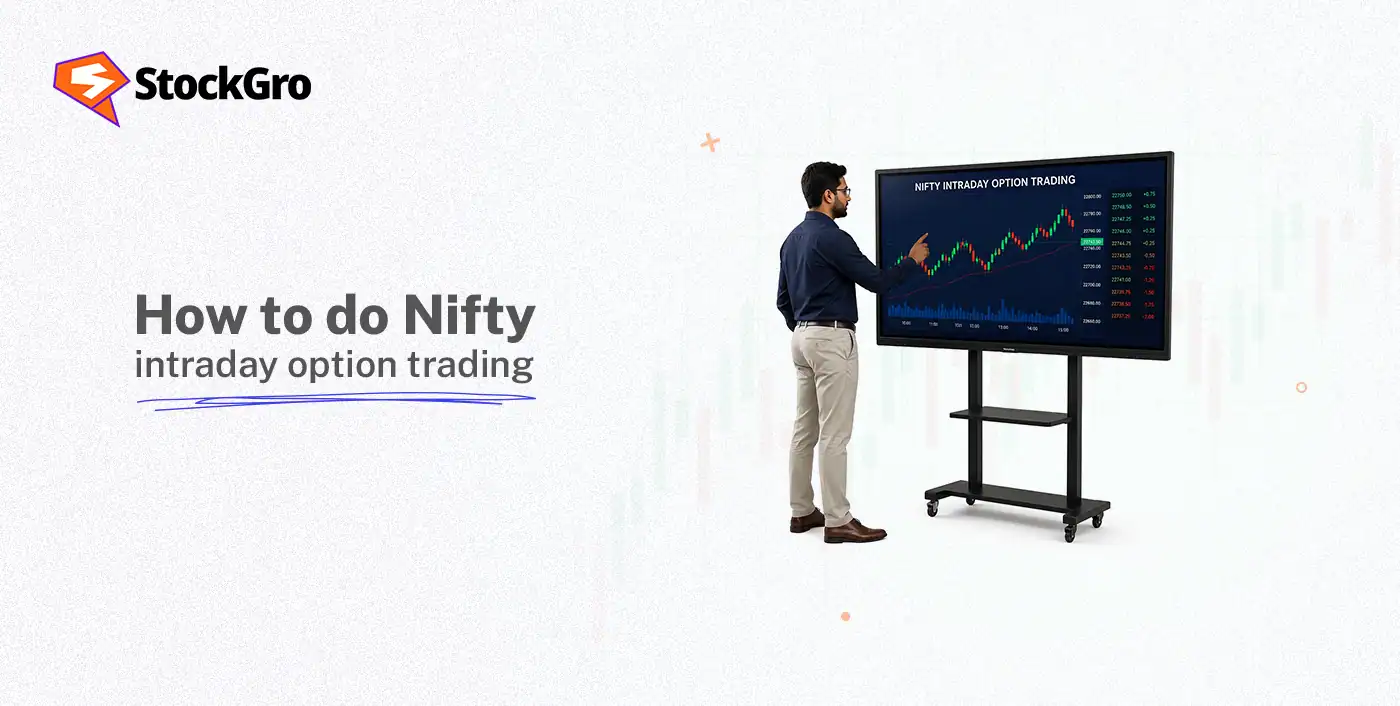
At first, the Indian stock market can be intimidating for beginners. Especially when you hear ‘calls’, ‘puts’, ‘options’, and ‘intraday’. But the truth is, learning the basics will help you participate in Nifty intraday option trading, which can help you optimise your investment journey. This blog decodes Nifty intraday trading, through its meaning, risks, strategies, and more.
How to do Nifty Intraday Option Trading?
The Nifty refers to the Nifty 50, which is a popular stock market index of India. The Nifty tracks the performance of top 50 companies of the stock market, based on market capitalisation. Companies such as TCS, HDFC Bank, Infosys, etc are listed on the NSE.
When you do intraday trading, you sell stocks on the same day. You do not keep what you bought overnight. Everything is closed before the market closes. On the other hand, options are like contracts that offer to buy or sell at a fixed price.
So when you put it all together, Nifty intraday option trading means buying or selling Nifty options within a single trading day. You do this to make money from the temporary price fluctuations in the Nifty. The Nifty intraday option trading is very popular in India. It is the basics of intraday trading that investors should be mindful of.
Understanding Nifty Options and Market Basics
There are two kinds of options you should know about:
Call Option (CE): A Call Option lets you buy Nifty at a fixed price. You choose to buy a Call Option when the market rises.
For example, let us say Nifty is currently at 22,000. You forecast the rise to reach 22,300 today. You invest in a Call Option at 22,100. If Nifty really goes up to 22,300, your Call Option becomes more valuable. You make a profit.
Put Option (PE): A Put Option lets you sell Nifty at a fixed price. You purchase a Put Option when the market declines.
For example, Nifty is at 22,000. You think there will be news today, and Nifty will fall to 21,700. You invest on a Put Option at 21,900. If Nifty really drops, your Put Option becomes more valuable.
The key terms are:
- Strike Price: This is the agreed price at which you can trade Nifty.
- Premium: This is the fee paid to acquire an option contract. It is like the price of a ticket to get in.
- Expiry: Options have a date. Weekly Nifty options expire every Thursday.
- Lot Size: Nifty options are bought and sold in groups. One group of Nifty is equal to 65 units.
So if the premium of a Nifty Call Option is ₹100, you pay ₹100 times 75, which is ₹7,500, for one group of Nifty Call Options.
As a beginner, you need to read the market analysis and the reasons behind the movements. Here are the key factors that influence the Nifty:
1. Global Markets: The Nifty does not work alone. If the US stock market, such as the Nasdaq or Dow Jones, falls overnight, the Nifty will probably open lower in the morning. Traders observe the Gift Nifty before the market opens to get an idea of where the Nifty might start.
2. News and Events: Big announcements can really move the market. For example:
If the RBI increases interest rates. The markets usually fall. But as soon as the government announces that it will encourage infrastructure, the markets immediately rise. A major company posts quarterly results, and the Nifty gets a boost.
3. India Volatility Index (VIX): The VIX acts as a sentiment indicator for the market. When the VIX is high above 20, the market is nervous and moving around a lot. This makes options more expensive. When the VIX is usually between 10-15. This makes options cheaper. As a beginner, it is safer to trade when the VIX is low, and the Nifty is behaving in a way that you can predict.
Step-by-step process of Intraday Option Trading
Here is a simple process that anyone can follow to start trading.
Step 1: The first step is to create a trading account. A registered broker is required to open both a Demat and trading account. There are popular options in India.
Step 2: Then check the market direction. Look at where the Nifty’s heading. Is the Nifty going up or down? You can check the market data, such as the Gift Nifty, previously known as SGX Nifty. GIFT Nifty refers to the future fluctuations in the Indian trade market as per the trade movements of the Singapore Exchange. The GIFT Nifty is a way to trade stocks when the Indian market is closed. It is like an extra platform for buying and selling Indian securities outside of the usual Indian market hours. Always check the key news events for the day.
Step 3: Then choose your option. If you think the market is going up, that means you are bullish, so you should buy a Call Option, which is also known as CE. If you think the market is going down, that means you are bearish, so you should buy a Put Option, which is also known as PE.
Step 4: Then, decide on the agreed price. It is an idea for beginners to stick to the At-the-Money options, which are the options where the strike price is closest to where the Nifty is currently trading. These options are more responsive and easier to understand.
Step 5: Then, enter the trade. Go to the F&O section on your trading app, search for NIFTY, select the expiry, choose CE or PE, enter the strike price, and place your order.
Step 6: Before you enter any trade, you have to set a target and stop loss. Your target is the profit level where you decide to close the trade. Your stop loss is the loss at which you will exit the trade to protect yourself. For example, if you buy a Call Option at a ₹100 premium, you can set a target of ₹140, which is a 40% gain, and a stop loss of ₹75, which is a 25% loss.
Step 7: Finally, make sure to exit before market closing time. Always close your intraday positions before 3:15 PM. Never hold options overnight unless you specifically intend to. This is a rule to follow when you are trading the Nifty.
Popular Intraday Strategies for Nifty Options
These are some strategies that a beginner can consider:
1. Trend Following: Trend following strategy is really simple. If Nifty is going up, clearly making highs, then buy Call Options. If Nifty is going down, making lows, then buy Put Options. This method simply follows where the market is moving.
2. Opening Range Breakout (ORB): Opening range breakout simply explained as observing the market from 9:15 AM to 9:30 AM. Note the market’s high and low prices during this time. If Nifty goes above the price, then choose the call option. If it goes below the price, choose the put option.
3. Buying Call Options for Rise: When there’s good news like a strong GDP report or good corporate earnings, you can buy call options because Nifty is likely to go up. This is a way to trade during the day.
4. Analyze Market Sentiment: Before you start trading, look at market data like the India Volatility Index (VIX). If VIX is high, the market is nervous and moving a lot. If VIX is low, the market is calm. New traders should be more careful when VIX is above 20.
Risk Management and Common Trading Mistakes
Many beginners lose money not because they do not understand options, but because they do not manage their risk.
Here are the Golden Rules of Risk Management:
- Limit your risk to only 2% to 3% of your capital per trade. For example, if you have ₹50,000, do not risk more than ₹1,000-1500 per trade.
- Always use a stop loss. Options can lose value quickly, so a stop loss is like a safety net.
- Do not try to average a losing trade. If the trade is not in your favour, it is preferred not to buy more to recover it. This is not appreciated in trading.
- Avoid trading during news events, like when the RBI announces its policy or when the Union Budget is released, unless you are very experienced.
The common mistakes made by beginners are as follows:
- Buying options that’re very cheap but lack real value.
- Staying in losing position with the expectation of recovery
- Over-trading, which means making many trades in one day.
- Overlooking the daily decline in option value near expiry.
Tools, Indicators, and Practice Platforms
You do not need a lot of tools to begin with.
Here are some useful indicators:
- Moving Averages (9 EMA, 20 EMA): 9EMA refers to the indicator that checks trade prices over the last 9 periods, which can be minutes, hours, or months. This is a suitable indicator for short-term trades. Similarly, 20EMA refers to the indicators for checking trade price fluctuations for 20 periods. This is suitable for short-to-moderate trades. These help you figure out the direction of the trend.
- Relative Strength Index (RSI): The Relative Strength Index (RSI) is a trade indicator that shows the magnitude of price movements and the speed of the movement, between the range of 0-100. This tells you if the market is getting too high (overbought) or too low (oversold).
- Volume-Weighted Average Price (VWAP): The Volume-Weighted Average Price (VWAP) refers to the trade price at which trading has been done and the volume of trades, through the day. This shows you the average price based on how people are buying and selling. Many traders use this strategy during intraday trading.
- Support and Resistance indicator: The support and resistance indicator says about the highest and lowest levels of a trade price. The resistance level refers to the highest stage from which the price can only come down. The support level refers to the lowest stage from which the price can only go up. These are the prices at which Nifty usually turns around or stops moving.
To practice, always go for paper trading platforms before using your real money. Many brokers, like Sensibull, Opstra, and the NSE website, have tools that let you practice trading with money. This lets you gain experience without risking your capital.
It is very important to know when to get out of a trade, just as important as knowing when to get in. Whether you have made the money you wanted or you need to stop losing money. Learning this skill takes time and practice. It is essential for long-term success.
Real World Trading Scenarios and their Cause
Scenario 1. Budget Day Play
When the Union Budget day comes around, the markets get really crazy. A trader who knows what they are doing might buy a Call and a Put, which is called a Straddle, to make money from the change. Market direction is not important here. The trader is trying to profit from the Budget Day volatility.
On Union Budget day, the markets tend to be very volatile. This means the trader can make money from a Straddle. The Union Budget day is a day for the markets.
Scenario 2. RBI Policy Day
If the RBI says they are cutting interest rates when nobody expected it, the markets usually go up. A trader who thought this might happen could have bought Nifty Call Options the day before and earned sufficient profit when the market opened higher the following day.
The RBI Policy Day is important for the markets. The RBI announcement can make the markets rally.
Scenario 3. Beginners First Trade
Rohan is a 25-year- salaried professional, and he has ₹30,000 to invest. He does not just pick stocks randomly. Instead, Rohan studies and analyses the trade prices. He buys one lot of a Nifty Call Option for ₹80 premium, which costs him ₹6,000 in total.
Rohan sets ₹120 as the target price and ₹60 as the stop loss. By noon, Nifty goes up. His option hits ₹120. He sells his option. Makes a profit of ₹3,000, which is a 50% return on that trade.
Rohan made money from his Nifty Call Option trade and is satisfied with the result.
Trading Psychology and Advanced Tips
The biggest enemy of a trader is their emotions, not the market. Fear makes you exit a trade before reaching the target. Greed can prevent you from exiting a profitable trade that might turn adverse soon. After multiple wins, overconfidence can push traders to take bigger risks beyond their risk appetite.
To avoid such errors, here are some mindset tips for traders:
- Keep a trading journal. Write down every trade, why you entered it, and what you learned from it.
- Losses are unavoidable in trading. Even top traders face losses in nearly half of their trades. Rather than giving up, aim for consistency.
- Follow a routine. Study the market before it opens. Plan your trades. Stick to your plan.
- Take breaks. If you have two or three losing trades in a row, step away from trading. Emotional trading leads to bigger losses.
Final Thoughts
Nifty intraday option trading is not a way to get rich quickly. It is a skill that requires practice. You need to practice and be disciplined to get good at it.
Start small. Gain knowledge of intraday trading, along with option concepts. Understand strike prices and premiums, along with other basics. Practice on a simulator to begin with might be beneficial. Learn about risk management. Move to trades with a small amount of money when you are consistent in your practice.
FAQs
Yes, you can make money at it. You need to know what you are doing. It takes work. A good plan to limit your losses. Most people who lose money usually do not have a plan. You can make profits if you do it the right way and with patience.
You can start trading with an amount of money, like ₹5,000 to ₹10,000, to buy one lot of a Nifty option. It is better to have ₹25,000 to ₹50,000 because this gives you more flexibility to manage the risk of a Nifty option properly. When you are trading an option, never put all your money into a single trade of a Nifty option.
Neither a call option nor a put option is inherently better. A call option works well when the market is rising. On the other hand, a put option is better suited when the market is falling. The key here is to read the market trend before making a choice. You must choose wisely based on market direction. Call options and put options serve purposes based on market movement.
Yes, a beginner can do intraday option trading. But before that, they should begin by learning the basics of trading. They should practice on a simulator to get a feel for what it’s like. When they actually start trading, they should use small amounts of money at first. The biggest mistake that a beginner in trading can make is rushing in without knowing what they are doing with trading, because they lack experience.