What is Passive Investing?
Passive investing is an investment approach where the goal is to match an index’s returns. The investments are held for years to ride out the volatility and capture long-term market growth.
Unlike active investing, where there is constant shuffling to chase returns, passive strategies maintain stable allocations. There’s minimal trading. No attempts to time entries or exits. You’re essentially saying: the market will rise eventually, and I want my share of that rise.
Even after temporary declines, markets have historically recovered and continued growing over time. Passive investing banks on this reality. Staying invested gives compounding the time it needs to grow your wealth.
How Passive Investing Works
The mechanics of passive investing are simple. Here’s how it works in practice:
Index Replication
The investment portfolio mirrors the index by investing in securities in identical proportions. Every stock, every weight, replicated precisely. This synchronisation ensures your returns closely track the benchmark.
Automatic Rebalancing
Indices evolve. Their composition changes over time based on liquidity and company size. The investments are adjusted to stay aligned with the index.
Staying Invested
Forget frequent trading. You invest once and hold for years, sometimes decades. Time does the heavy lifting here. Patience becomes your biggest asset.
Low Turnover
Since passive investing involves fewer trades, their turnover ratio is also lower. This keeps costs down and improves net returns over time.
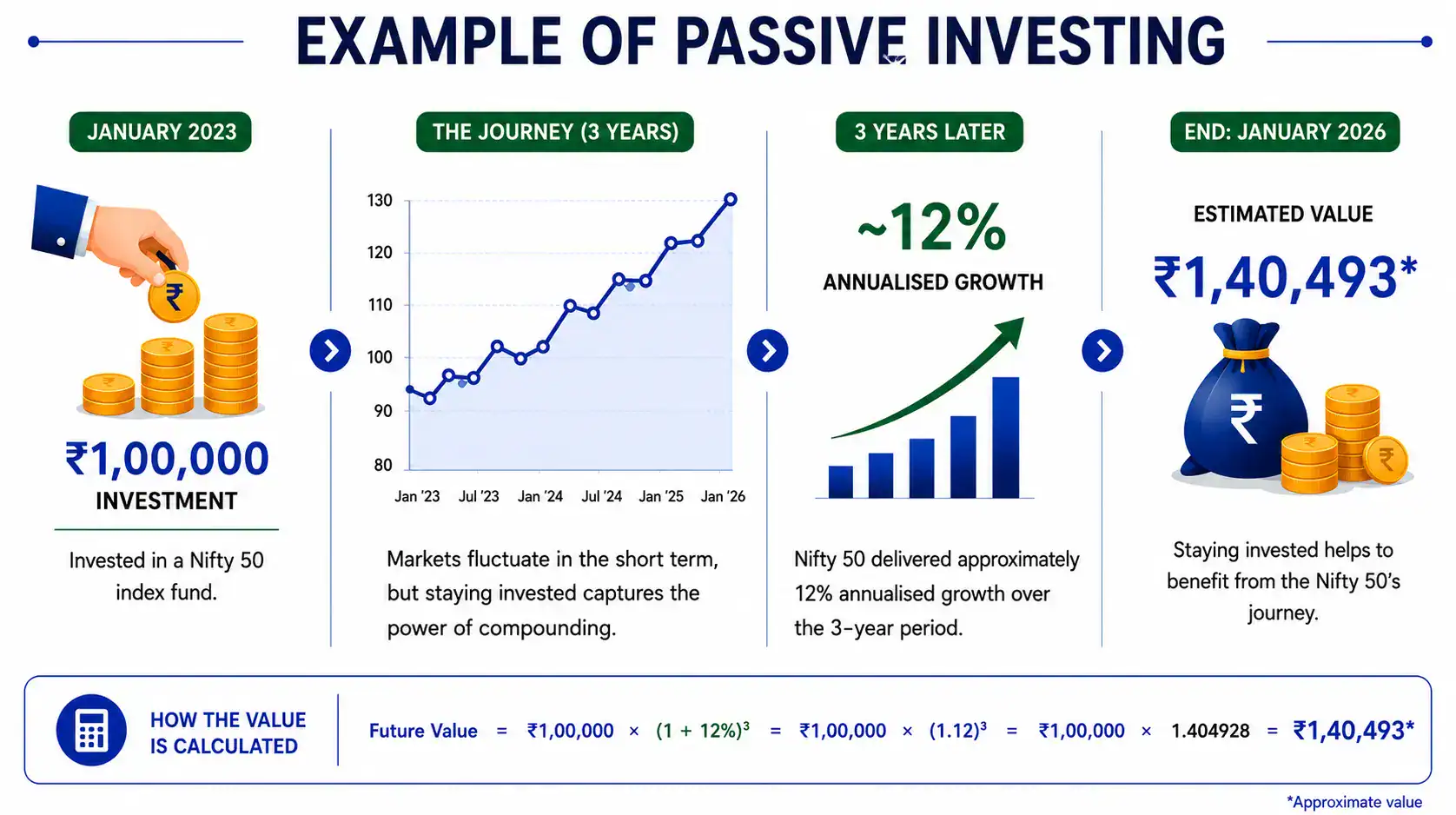
Example: In January 2023, you put ₹1,00,000 into a Nifty 50 index fund. The fund owns all 50 constituents proportionally. Fast forward three years. The Nifty 50 delivers roughly 12% annualised growth.
Your investment grows to about ₹1,40,493. No stock analysis. No portfolio reshuffling. Just straightforward market tracking that captured the index’s entire journey.
Types of Passive Investing Strategies
Not all passive approaches look identical. Different instruments serve different needs.
- Index Funds
Index funds are a type of mutual fund built to replicate a particular market index. As they simply follow the index, you get broad diversification without overthinking stock selection. - Exchange-Traded Funds (ETFs)
Think of ETFs as index funds that can be traded on stock exchanges. You get the same diversification benefits, but with the added freedom of buying or selling at live market prices anytime during trading hours. - Buy and Hold Strategy
Buy and hold strategy means you buy stocks, bonds, or other assets and leave them alone for years, sometimes decades. Markets wobble constantly, but this approach bets on one simple truth: good assets tend to be worth significantly more many years down the line. - Rupee-Cost Averaging
Rupee-Cost Averaging method, you invest at regular intervals without exception. Lower prices allow you to accumulate more units, while higher prices result in fewer units being purchased. This smooths out volatility and takes emotion out of investing.
Passive vs Active Investing Key Differences
Both strategies have distinct characteristics. The following table draws a comparison between active investing and passive investing:
| Criteria | Passive Investing | Active Investing |
| Investment Approach | Tracks market indices | Attempts to beat market indices |
| Cost | Low cost | Higher cost |
| Risk | Moderate, mirrors market | Higher, depends on strategy and decision-making |
| Returns | Matches market performance | Aims for higher returns, often variable |
| Time Commitment | Minimal monitoring required | Regular analysis needed |
- Investment Approach: Passive investing closely follows the chosen index religiously. Active investing focuses on generating higher returns by exploiting market inefficiencies.
- Cost: Here’s where passive investing really shines. It has a lower cost due to the lower number of trades and research involved. Active investing is expensive due to more frequent trading and the compensation paid to analysts and fund managers.
- Risk: Passive investing carries market risk. If the index falls, your fund falls too. Active investing carries the same market risk, plus additional layers tied to strategy and stock selection decisions.
- Returns: Active investing can give better returns, but the outcomes are varied. Passive investing delivers returns in line with the index.
- Time Commitment: Passive investing is ideal for busy people. Active investing never really switches off; it constantly pulls you back in with decisions to make and markets to track.
Benefits of Passive Investing
Many gravitate toward this approach because the advantages it offers are compelling.
- Low Cost
High fees can quietly drain your returns over time. Passive investing has a lower cost which leaves a larger portion of your capital to remain invested for longer, supporting compounding growth. - Simplicity
No stock screening. No sector analysis. Pick an instrument matching your goals, invest regularly, and you’re done. Beginners find this especially appealing because of the simple learning curve. - Diversification
A single Nifty 50 index fund spreads your money across 50 companies spanning multiple sectors. Small downturns barely dent your portfolio. You’re not betting on individual winners. You’re betting on the economy’s overall growth. - Tax Efficiency
Lower trading frequency in passive funds helps reduce taxable transactions. This means you defer taxes longer, allowing more money to compound. - Consistent Performance
Passive investing is not trying to outsmart the market, but simply match it. It makes sure you are not left behind by keeping your investments aligned with the market returns.
Risks, Limitations & Common Mistakes to Avoid
Before you put your money to work, get familiar with the risks passive investing carries.
- Market Risk: When the market drops, your investment drops with it. There is no safety option during crashes. You ride every downturn completely.
- Index Concentration: Indices can grow heavily weighted toward certain sectors. When this happens, passive investors carry that concentrated exposure whether valuations make sense or not.
- Tracking Error: Small gaps always exist between your fund and the actual index. Fees and timing delays create these differences, which quietly compound over decades.
Beyond risks, passive investing has structural boundaries that simply cannot be worked around, no matter how experienced you are.
- No Outperformance: Passive investing matches the market, never beats it. If outsized returns through smart stock selection are your goal, this approach will disappoint you.
- Limited Flexibility: When an index becomes overweighted in one sector, your fund cannot adjust. You follow the index methodology entirely, surrendering all discretion permanently.
- Not Ideal for Short Horizons: Passive investing needs years to deliver. A sudden downturn close to your withdrawal date leaves little recovery time and potentially significant losses.
Even within a simple strategy like passive investing, a few behavioural errors can erode your returns.
- Ignoring Rebalancing: Portfolios drift during bull runs without you noticing. Your risk exposure rises beyond comfortable levels. A simple annual rebalancing check is genuinely all it takes to stay on track.
- Chasing Performance: Last year’s top-performing asset rarely repeats that success. Jumping between them based on recent results is a costly habit. Pick your investment and stay put through thick and thin.
- Overlooking Expense Ratios: Two funds following the identical index can charge very differently. That small fee difference feels harmless today, but it eats into your returns over longer periods.
How to Start Passive Investing
Passive investing is very simple to begin with. You can follow this step-wise approach:
Step 1: Clarify Your Goals
Start by asking yourself the reasons behind investing. This can be retirement, a house, or your child’s education. This helps you choose the right time horizon and asset allocation.
Step 2: Gauge your risk tolerance honestly
If you can watch your portfolio go through massive drops without panicking, then equity-based instruments work well. If that thought terrifies you, stick with debt-oriented options initially.
Step 3: Pick your benchmark
The degree of diversification varies from one index to another. Select the benchmark that offers the market exposure you are looking for.
Step 4: Research investment options
Compare expense ratios first. Then check the tracking error over three or five years. Also, look at Assets Under Management (AUM) because small funds might face liquidity issues.
Step 5: Set up accounts as needed
For index funds, invest directly through fund house websites or distributors. ETFs require a demat and trading account. Opening these takes a day or two with online brokers.
Step 6: Decide between SIPs or a lump sum
Systematic Investment Plans help build financial discipline and smooth out market fluctuations. A lump sum works fine if you’re comfortable investing everything at once.
Step 7: Invest and forget
Check annually if you must. Resist the urge to tinker based on quarterly performance. Only rebalance if needed, otherwise leave your investments alone.
Final Thoughts
Passive investing is not meant to make you rich overnight. What it offers is participation in long-term market growth at a lower cost, with less stress and minimal time commitment. You get diversification, transparency, and returns that keep pace with the broader economy.
Matching the market performance while minimising costs is often enough to support long-term investment growth. That’s exactly what passive investing delivers.
FAQs
Passive investing suits investors seeking lower costs, diversification, and minimal monitoring, while active investing may suit those aiming to outperform the market through research-driven decisions.
Common examples include Nifty 50 index funds, Sensex ETFs, buy-and-hold investing, and SIPs in diversified mutual funds.
Yes, passive investing is beginner-friendly because it requires minimal market monitoring, lower research effort, and offers diversified exposure.
You can start passive investing with a small amount. Many index funds and SIPs allow investments starting from ₹100 to ₹500.