- Summary
- Commercial real estate investing in India is still supported by strong office demand despite AI-led concerns around headcount. While 93% of surveyed occupiers are already adopting AI, 77% still expect their India office portfolios to grow over the next two years.
- Flex workspace is no longer just an alternative to the office; it is becoming part of how enterprises plan, manage and scale their workplace, with its leasing share rising steadily.
- GCC expansion is becoming a durable source of flex office demand. GCCs already made up around 40%-45% of enterprise flex-seat demand in 2025, while India’s GCC workforce is projected to rise from over 1.9 million in 2025 to around 2.8-2.9 million by 2030.
- Developers, office REITs and flexible workspace platforms like Wework India capture the same demand differently, each with its own benefits of investing through listed stocks.
Commercial real estate investing in India faces a new tension as AI begins to alter the arithmetic of white-collar work. If fewer people are required to do the same work, the corollary seems obvious. Companies should eventually need fewer desks and, by extension, less office space.
The WEF’s Future of Jobs Report 2025 found that around 41% of employers expect to reduce their workforce where AI can automate tasks. Yet that logic is not playing out neatly in India. AI adoption is already under way at 93% of surveyed office occupiers, while 77% still expect their India office portfolios to expand over the next two years (CBRE). The two trends are advancing together rather than cancelling each other out.
That overlap is most interesting in flex: flexible and managed workspaces, ready and serviced, that a platform designs and runs for its clients. WeWork India, for instance, positions itself as a workplace infrastructure platform powering flexible and managed workspaces for enterprises across India. AI-led hiring could account for nearly 31% of flex-seat leasing by 2030 (Redseer Strategy Consultants).
For commercial real estate investing in India, the more pertinent question is therefore not whether AI will change employment. It already is. The question is why companies are still taking more office space, and why flex is becoming a normal part of how they plan it.
Flexible Workspace Market Is Taking a Larger Share of Office Leasing
JLL data shows flex operators accounted for 19.8% of India’s gross office leasing in 2024. By H1 2026, that share had reached 27%, with Q2 alone at 28.4%.
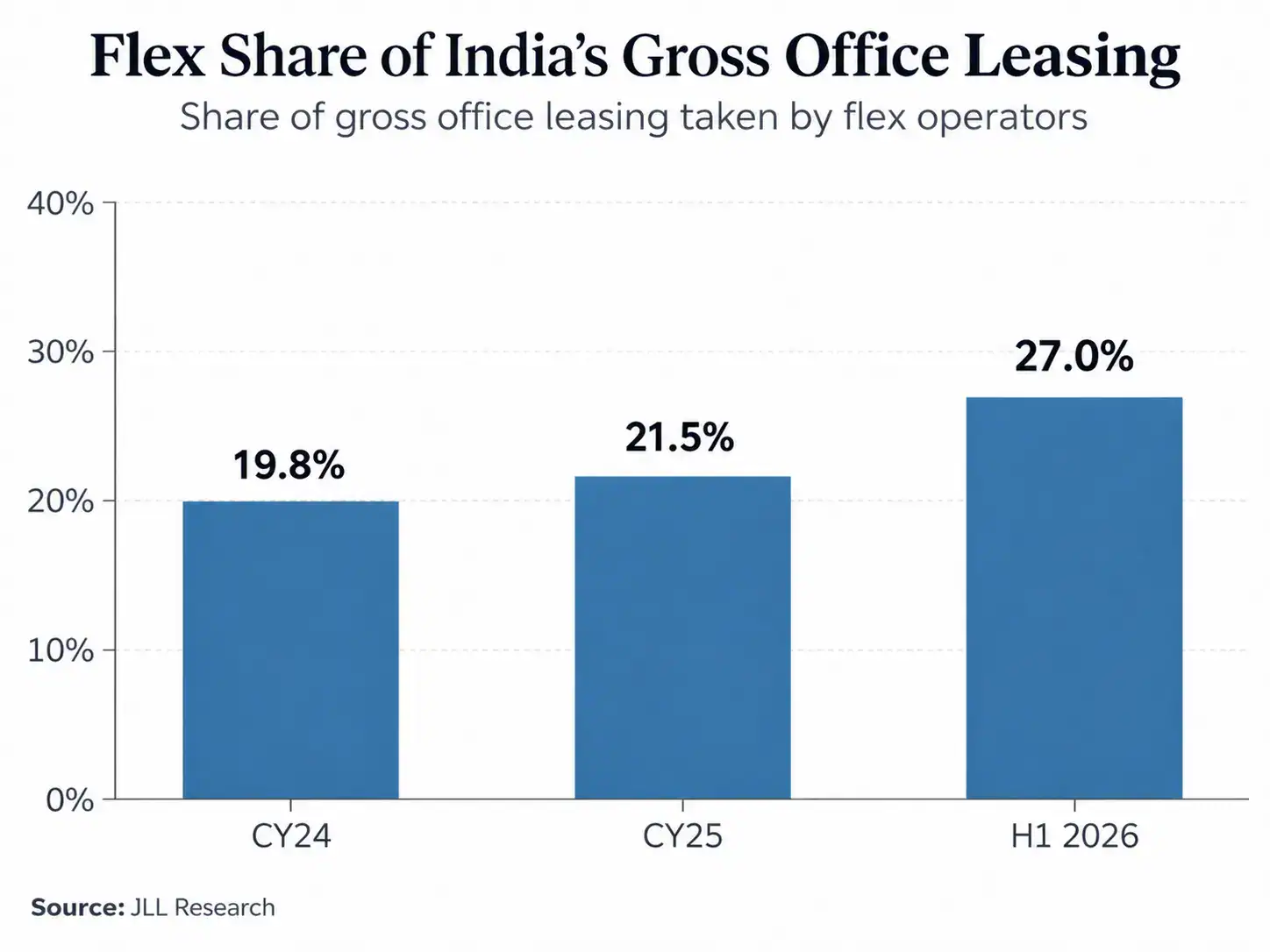
That progression has made flex one of the largest occupier segments in India’s office market. It also led leasing for two consecutive quarters in H2 2025.
By 2027, 52% of large occupiers expect flex to account for 10%+ of their office portfolios, up from 33% in 2025 (CBRE). What began as the coworking space market, once known for hot desks and start-ups, now sits within planned office procurement rather than at the margins as a stopgap.
Demand of that kind pulls supply behind it. Colliers note Grade-A flex stock across India’s top seven cities is projected to rise from 72.3 million sq ft in 2025 to more than 100 million sq ft by 2027. For the flexible workspace market, that expansion only works if companies continue arriving to fill the space. India’s GCC ecosystem is becoming one of the strongest sources of that demand.
The GCC Engine Behind Commercial Real Estate Investing in India
India’s GCC story began with a simple advantage: a deep talent pool at lower labour and real estate costs than most developed markets. What began largely as back-office work has since widened into engineering, analytics, R&D and AI. India’s GCC workforce is projected to grow from more than 1.9 million professionals in 2025 to around 2.8-2.9 million by 2030 (JLL).
A “Fortune 500 opens India centre” headline has another implication for this market. Someone has to house that team, increasingly through flex. JLL also notes GCCs took about 42% of India’s office leasing in H1 2026, giving their expansion considerable weight in the commercial real estate industry.
The space requirement is rarely clear at the outset. A centre may open around one function and absorb others as its India remit broadens. A growing number of GCCs therefore build their footprint around flex rather than treating it as a stopgap: a managed office for the core team, flexible capacity for functions still being tested, and room to scale with the same partner.
GCCs made up roughly 40% to 45% of enterprise flex-seat demand in 2025 (Colliers). That fits the way these centres expand. More functions in India bring larger teams, those teams absorb Grade-A space and give commercial real estate investing another route through flex.
How to Invest in Commercial Real Estate: Three Listed Routes
Think of an office building as a value chain: a developer builds it, a landlord or REIT owns it, and a flexible workspace platform runs it end to end for the enterprises inside. Each earns from a different link in the wider investments in the commercial real estate chain. Flex sits closest to the tenant, which makes it the most direct listed read on occupier demand.
| Route | How the model earns | Economic profile |
| Developers | Develop commercial assets and earn through leasing or other property income | Land and construction exposure, with the longest development cycle |
| Office REITs | Own completed office assets and collect rent | Rental and distribution-led, with occupancy and rent driving income |
| Flex platforms | Lease space and run it as ready workplaces, earning from memberships, managed offices and services | No land or construction risk; occupancy-led, so earnings rise quickly as centres fill |
These three models sit within commercial real estate investing, although the economics behind them are markedly different.
Real Estate Stocks in India: The Listed Players Across Each Route
The listed market reflects those distinctions across real estate stocks (India):
| Route | Listed player | Business exposure |
| Developers | DLF | A diversified developer with a sizeable commercial office and rental portfolio, including business districts and office campuses. |
| Prestige Estates Projects | Develops commercial offices alongside residential, retail and hospitality projects. | |
| Brigade Enterprises | Has office and technology-park assets within a broader residential and hospitality portfolio. | |
| Office REITs | Embassy Office Parks REIT | Owns office parks and commercial assets across major Indian office markets. |
| Mindspace Business Parks REIT | Owns Grade-A business parks and offices across Mumbai, Hyderabad, Pune and Chennai. | |
| Brookfield India Real Estate Trust | Holds Grade-A commercial office assets across several major cities, with rental income at the core of the model. | |
| Knowledge Realty Trust | Owns and manages a multi-city portfolio of Grade-A office properties. | |
| Bagmane Prime Office REIT | Holds a portfolio of Grade-A+ business parks concentrated in Bengaluru. | |
| Flex platforms | WeWork India Management | A workplace infrastructure platform powering flexible and managed workspaces for enterprises across India. |
| Smartworks Coworking Spaces | Runs managed office campuses focused largely on mid-sized and large enterprises. | |
| IndiQube Spaces | Operates managed workspaces for start-ups, GCCs and larger enterprises across multiple cities. | |
| Awfis Space Solutions | Offers flexible workspaces, managed offices, design-and-build services and other workplace solutions. | |
| Dev Accelerator | Operates enterprise-focused managed workspaces across Tier-I and Tier-II markets. |
Developers remain the broadest part of this universe, with commercial assets sitting alongside residential, retail and hospitality, giving them several earnings levers.
The REIT universe is more compact. India has six listed REITs, of which five are primarily office-oriented, while Nexus Select is predominantly retail (Indian REITs Association).
Flex adds another dimension to commercial real estate investing via listed markets, and today’s backdrop suits it. When AI makes headcount harder to predict, companies grow weary of locking capital into long leases and fit-outs. That uncertainty tends to push demand towards flex, not away from it.
The listed route also shrinks the ticket: owning part of a Grade-A office directly takes crores and months to exit, while a share in any of these businesses costs far less and trades daily. Enterprise-focused platforms add a further lever, as clients add seats and buy more services in centres already running.
What Will Test the Flexible Workspace Growth Story
A few numbers can show whether office space real estate growth is turning into real demand rather than simply more capacity.
Flex Share of Office Leasing
This shows how much of overall office demand continues to flow through flexible workspaces. Flex accounted for 27% of gross leasing in H1 2026. If that share broadly holds or rises, flex is retaining its place in corporate space planning.
GCC Leasing
New-centre announcements show intent, but actual leasing is stronger evidence. Tracking GCC leasing therefore gives a clearer read on whether a main demand engine for Grade-A offices is still expanding.
Occupancy Versus Break-even
Occupancy shows how much available capacity is filled. Break-even occupancy shows roughly how much needs to be filled before a centre covers its operating economics.
Suppose a company reports 84.9% overall occupancy and breaks even at about 54.8%. That means occupancy is roughly 30 percentage points above break-even, giving the business a healthier buffer before centre economics come under pressure.
Net Desk Additions
The useful question is whether demand keeps pace with new desks. If desks rise while occupancy falls materially, capacity may be running ahead of demand. If both rise together, the additional space is being absorbed.
Much coworking space industry analysis stops at counting desks; these metrics separate expansion from absorption. That distinction becomes especially pertinent for flex, where capacity can be added quickly but its economics depend on how efficiently that space is filled.
FAQs
It can be worth considering if the listed business is converting property demand into earnings at a reasonable valuation. For a flexible workspace platform, that would mean healthy occupancy alongside disciplined capacity growth.
A listed route avoids the large capital requirement of buying a property outright. The main options are developer stocks, REITs and flexible workspace platforms. Developers offer broader property exposure, REITs are centred on rental assets and flex platforms offer the most direct exposure to how enterprises use office space.
A major risk is that strong property demand may not translate into strong company performance. Even when leasing is growing, company-specific factors such as overexpansion, weak occupancy or higher costs can still weigh on earnings and stock performance.
Listed markets provide access to commercial property growth without owning the underlying building. For example, flexible workspace stocks offer exposure to rising office demand through occupancy, pricing and capacity expansion without land or construction risk.