
Can We Buy Unlisted Shares in India?
Yes, unlisted shares can be bought in India. They are not listed on the National Stock Exchange (NSE) or the Bombay Stock Exchange (BSE). There is no exchange in between. Transactions happen directly, between buyers and sellers, through intermediaries or over-the-counter (OTC) platforms.
The market for unlisted shares has grown steadily over the years. Pre-Initial Public Offering (IPO) investing, in particular, has gained traction with investors looking to enter promising companies before public listings drive valuations higher.
What Are Unlisted Shares?
Unlisted shares represent ownership in businesses that are either not ready to list, have chosen not to, or are actively preparing for an IPO down the line. There is no live price feed you can check. What someone paid last month, the most recent funding round number, and what a buyer today is willing to pay, that is how the price gets established.
The participants in this segment are founders, employees sitting on Employee Stock Ownership Plans (ESOPs), venture capital funds, and retail investors interested in the pre-IPO space.
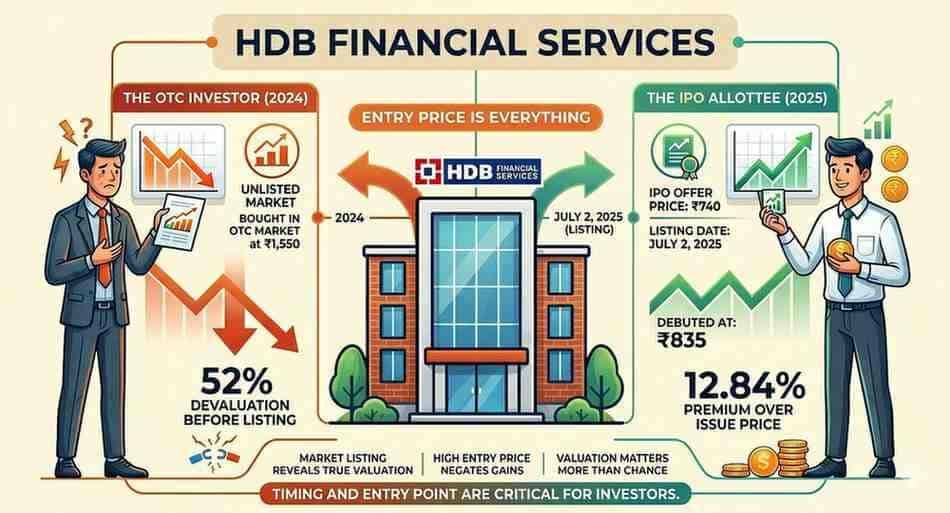
HDB Financial Services is a telling example of how entry price defines everything in this market. Investors who bought in the OTC market at ₹1,550 in 2024 were sitting on a 52% devaluation before the stock even listed, after the IPO priced at ₹740. The company was the same. The outcomes were not.
When it was listed on July 2, 2025, the stock debuted at ₹835, a 12.84% premium over the issue price. A decent gain for IPO allottees. Cold comfort for anyone who had paid ₹1,550 in the unlisted market a year earlier.
Is It Legal to Buy Unlisted Shares in India?
Completely. The Securities and Exchange Board of India (SEBI) does not regulate unlisted shares the same way it does listed markets. Still, Know Your Customer (KYC) compliance, stamp duty, and demat-based transfer rules are applicable.
There is one important restriction. SEBI mandates a six-month lock-in after a company lists. If you bought shares before the IPO, you cannot sell them on the exchange on the day the listing happens. Beyond that specific constraint, nothing legally prevents anyone from buying or selling unlisted shares.
How to Buy Unlisted Shares
There is no single door into this market. How you enter depends on what you want to invest, how much involvement you want in the process, and what kind of company you are after.
- Pre-IPO Platforms and Intermediaries
Most retail investors start buying unlisted shares through structured platforms that handle KYC, connect buyers and sellers, and manage the demat transfer. Cleaner process, more traceable paper trail than going it alone. - Directly from Employees via ESOPs
A lot of startup employees sit on equity for years waiting for something liquid to happen. Some decide not to wait. Brokers connect these sellers with interested buyers, and the deal is struck directly between the two parties at a price both agree on. - From Promoters via Private Placement
Larger investment amounts sometimes go straight to the promoter level. An investment bank or wealth manager makes the introduction, and what follows is a private placement, a negotiated deal entirely outside any exchange mechanism. - Through PMS and AIF Schemes
- Category I and II Alternative Investment Funds (AIFs) channel their capital into unlisted companies. They are regulated by the SEBI and require a minimum investment of ₹1 crore.
- Similarly, some Portfolio Management Services (PMS) also give their investors exposure in the pre-IPO phase, and require an investment of at least ₹50 lakh.
These routes are used by high-net-worth and institutional investors.
How Unlisted Share Transactions Work (Off-Market Transfer)
Once buyer and seller agree on a number, the actual mechanics of moving shares start. This is where a lot of first-time investors get surprised, because nothing here works like a listed trade. Here is what each part of the process actually involves.
- Off-Market Transfer
Shares move directly from the seller’s demat account to the buyer’s, with no exchange involvement. Settlement runs through either the National Securities Depository Limited (NSDL) or the Central Depository Services Limited (CDSL), and the entire thing is classified as an off-market transaction. - Negotiated Pricing
Nobody is looking at a live screen. Price is anchored to the company’s most recent funding round, financial performance, or comparable OTC deals. Both parties negotiate, and whatever they land on becomes the transaction price. - Role of Intermediaries
Specialised brokers and online platforms do more than just matchmaking. They verify KYC, guide documentation, and often oversee the transfer. For investors dealing in this category for the first time, working through a recognised intermediary is far safer than attempting a direct bilateral deal. - Documentation
Two key documents govern the transaction:- A Share Purchase Agreement (SPA) is signed between both parties, laying out the terms.
- A Delivery Instruction Slip (DIS) authorises the actual share movement from the seller’s depository account.
CDSL users submit the DIS digitally through the Easiest portal; NSDL account holders use Speed-e.
- Payment
Payment is settled separately, not simultaneously with the share transfer. First, the buyer confirms that shares have been credited to their demat account. Then, funds are released to the seller via National Electronic Funds Transfer (NEFT) or Real Time Gross Settlement (RTGS).
How to Sell Unlisted Shares
Selling unlisted shares runs the same off-market process in reverse. You need the buyer’s depository participant (DP) ID, Client ID, the company’s International Securities Identification Number(ISIN), and a bank account linked for receiving funds.
Physical certificates still technically work, but almost nobody uses them.
Step 1: Find a Buyer
Pre-IPO platforms, broker networks, and direct negotiation with fellow shareholders are the main channels. Each one has a different speed and risk trade-off.
Step 2: Agree on Price and Quantity
No live feed exists to anchor this. Both sides reference recent funding round data or comparable OTC transactions and work from there.
Step 3: Execute SPA and Initiate Transfer:
The SPA gets signed, DIS is processed through CDSL Easiest or NSDL Speed-e, and shares are credited to the buyer’s demat account within one to three working days.
Step 4: Receive Payment
Funds arrive via NEFT or RTGS once the buyer confirms shares are sitting in their account.
Risks of Investing in Unlisted Shares
The returns potential is real. So are the risks, and neither deserves to be understated.
Illiquidity: Days can pass before a buyer appears at your price. Sometimes weeks. Capital committed here should be capital you genuinely do not need in the near term.
- No Exchange Oversight: SEBI does not directly regulate unlisted share trading. That absence amplifies counterparty risk, particularly outside established and verified platforms.
- Pricing Opacity: You are not looking at a real-time price. Sellers work from funding round data or demand estimates, and buyers have limited independent tools to check whether the ask is reasonable.
- Risk of No IPO: Companies raise pre-IPO capital with listing as an implied goal. But filings get delayed, market conditions shift, and promoters change direction. If no listing ever materialises, the only exit route is back through a thinly traded OTC market.
- Concentration Risk: Minimum investment amounts here tend to run far higher than listed markets. One position going wrong carries much more weight when ticket sizes are large, and liquidity is thin.
Should You Invest in Unlisted Shares?
There is no clean universal answer. It depends on who you are as an investor.
The time horizon comes first. Most meaningful exits from unlisted positions generally need a longer duration. If a goal sits closer than that, this market is likely the wrong tool for it.
Risk appetite matters too. Valuations in this space are not independently verified in real time. Due diligence on financials, promoter credibility, and IPO timelines falls entirely on the investor. That work is non-negotiable.
Portfolio fit also needs thought. Given the illiquidity and concentration involved, most financial advisors treat unlisted share exposure as a defined, bounded portion of a broader portfolio rather than a primary allocation.
Entry timing relative to a listing event, and the quality of the business itself, ultimately determine whether the upside materialises.
Conclusion
Buying unlisted shares in India is legal, and the market is now genuinely accessible to retail investors. But accessibility does not mean it is straightforward. The companies that reward early investors tend to reward those who did the work upfront, understood their exit, and kept their position sized sensibly.
Do the groundwork seriously, or bear the cost of skipping it.
FAQ‘s
Yes, investors can buy unlisted shares in India through OTC platforms, brokers, or private deals, with transactions settled via demat accounts.
Unlisted shares carry a higher risk due to illiquidity, pricing opacity, and limited regulation, making thorough due diligence essential for investors.
Yes, buying unlisted shares is legal in India, provided investors follow KYC norms, demat procedures, and applicable regulations such as stamp duty and transfer rules.