- Summary
- Commodity prices can affect inflation by changing the cost of fuel, food, transportation and production.
- Higher commodity prices can push consumer prices up, but the effect may take time to reach consumers.
- Crude oil, food prices and exchange rates can influence how strongly commodity prices affect inflation in India.
- Commodity investments may help diversify your portfolio during inflation, but they can also carry significant price risk.
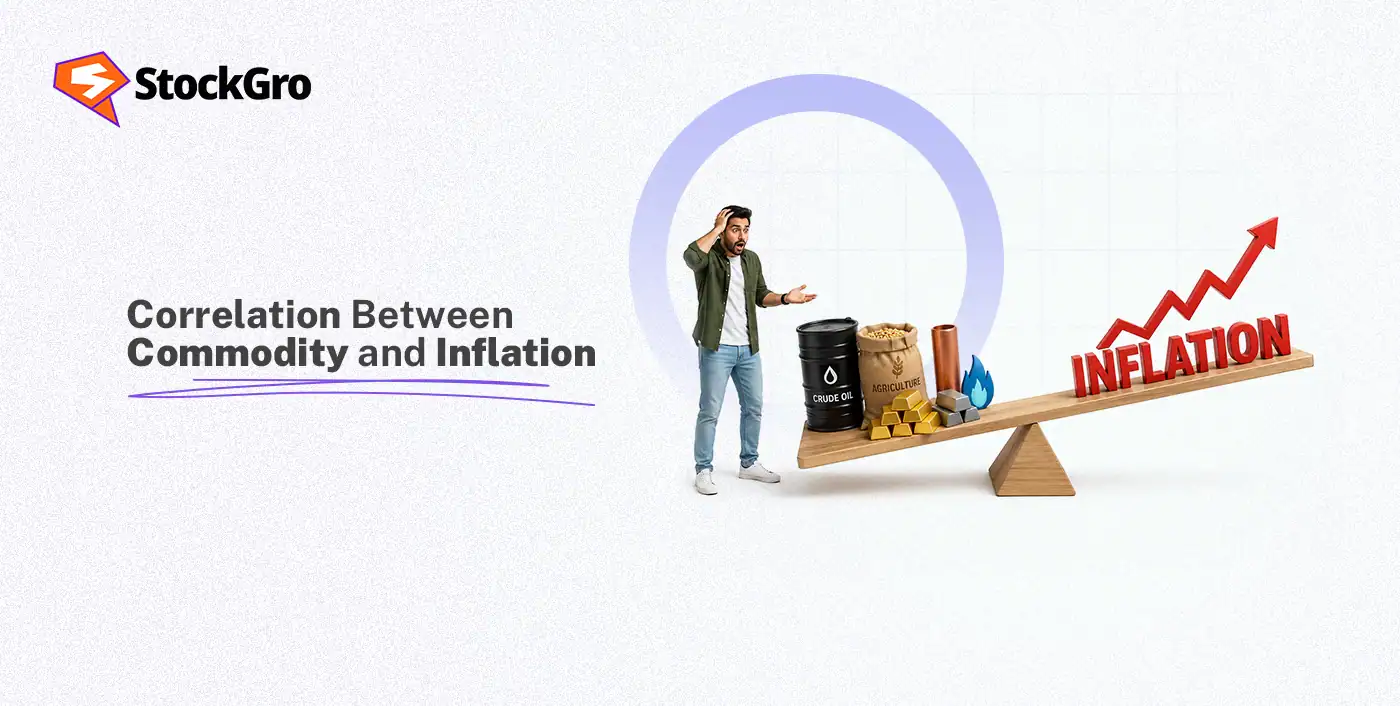
The relationship between commodities and inflation starts with the cost of raw materials. When the prices of commodities, whether oil, gas or precious metals like gold, can increase business costs. When these higher costs reach consumers through more expensive goods and services, they can contribute to higher inflation.
The sections ahead explain the link and its market impact.
What is a commodity?
A commodity is a basic good, raw material or agricultural product that you can buy, sell and trade in the financial markets. Commodities are generally interchangeable. This means one unit can be replaced by another unit of the same grade or quality without significantly affecting its use.
They are broadly classified into hard commodities, including metals and crude oil and soft commodities, such as agricultural products and livestock.
Commodities can also be traded on commodity exchanges. They are traded as underlying assets for derivative contracts like futures and options contracts. Investors can use these contracts as a hedge against inflation, as the prices of commodities can rise when the cost of goods and services increases.
What is inflation?
Inflation is the increase in the prices of goods and services across an economy over time. This naturally lowers the purchasing power of consumers.
So, when there is inflation, the same amount of money allows you to buy fewer goods and services than before. The inflation rate is commonly measured using the Consumer Price Index (CPI). It tracks the changes in the prices of a basket of goods and services, which includes food, housing, clothing, transport, healthcare and other household expenses.
The main causes of inflation can result from demand-pull or cost-push factors. Demand-pull inflation occurs when demand for goods and services exceeds supply. Cost-push inflation arises when higher costs of raw materials, labour or other inputs lead businesses to raise prices.
Why Commodities Are Closely Linked to Inflation
Commodities and inflation are connected because raw materials form the foundational building blocks for nearly all consumer goods and services.
Commodities, including crude oil, natural gas, metals and agricultural products, influence the cost of manufacturing, transportation, electricity and food production. When these input prices increase, the cost of production rises, leading businesses to increase the selling prices of their products and services. This ultimately passes the higher costs on to consumers.
The relationship is visible in recent markets, with Brent crude approaching $100 a barrel on 9 September 2026 amid concerns over supply disruptions in the Middle East.
Ashish Rajodiya, Commodity Research Analyst at PL Capital, said, “Elevated oil prices tend to stoke inflation-hedge demand for gold and silver even as they raise input costs across industry, particularly for silver given its heavy industrial usage in solar, electronics and semiconductors”.
This highlights the two-way relationship between commodities and inflation. The rising commodity prices can add to inflationary pressure and inflation concerns can also increase demand for certain commodities.
Correlation Between Commodities and Inflation
Commodity prices and inflation generally have a moderate-to-high positive correlation with consumer inflation metrics like the CPI. But the relationship is not constant.
The impact on consumer inflation depends on how long the price increase lasts, the strength of demand and how much of the higher cost businesses pass on to consumers.
Commodity prices are also affected by factors such as supply disruptions, weather, geopolitical events and currency movements.
How Commodity Prices Influence Inflation Dynamics
The key dynamics of the correlation are:
- Time Lag Effect
The changes in commodity prices may take time to reach consumers as they move through the supply chain. A July 2026 IMF study shows that fuel prices usually affect domestic prices faster than food prices, while wheat and rice can take longer to reflect changes in global prices.
- Food and Fuel Sensitivity
The relationship is strong for commodities that directly affect household expenses. In India, food has a significant weight in the CPI basket. For instance, retail inflation in India rose to 4.45% in July 2026. Compared to that, food inflation stands at 5.52%. This shows the importance of food prices in overall inflation.
- Exchange Rate Factor
Global commodities such as crude oil are largely priced in US dollars. So, a weaker currency can increase the cost of imported commodities in India even when their international prices stay unchanged. This can add to domestic inflationary pressure, particularly for an oil-importing economy.
- Asymmetric Pass-Through
Commodity price increases do not always have the same effect as price decreases. The same IMF study shows that increases in fuel and food prices tend to be passed through more strongly than decreases. This creates a ratchet effect in domestic prices.
Historical Market Examples & Case Studies
These examples show how different commodities can affect inflation at different times.
- Commodity Price Pressures, 2026
India’s consumer inflation likely rose to a 20-month high in August 2026, with CPI inflation forecasted at 4.80% from 4.45% in July.
The uneven monsoon conditions disrupted food supplies, driving up prices of essentials such as sugar, cereals, milk, edible oils, eggs and meat. The sugar prices rose amid concerns over sugarcane supply and its diversion towards ethanol production.
Global crude prices, meanwhile, moved close to $100 a barrel, while higher cooking gas prices added to inflationary pressure.
- Crude Oil Shock, 2022
When Russia invaded Ukraine in February 2022, it disrupted the global energy markets and led the crude oil prices higher, reaching a 14-year high in March 2022. Since India imports a large share of its crude oil, higher global prices increased concerns about fuel costs and inflation.
The RBI raised its 2022–23 inflation forecast from its earlier estimate to 5.7% in April 2022 and later to 6.7% in June 2022 as inflationary pressures continued.
- Food Price Shock, 2024
In 2024, extreme heat affected crop production in several parts of India. The supply disruptions then pushed up the prices of vegetables, pulses and other food items. As food prices increased, food inflation rose to 8.69% in May 2024, adding to overall inflationary pressure.
Investment & Trading Strategies During Inflation
You can spread your investments across assets that may respond differently to rising prices and interest rates.
- Gold Investments: Gold ETFs and other regulated gold products provide exposure to gold without buying physical gold, jewellery, or bullion.
- Inflation-Resilient Stocks: The stocks of companies with pricing power may manage rising input costs better by passing higher costs to customers.
- Short-Duration Debt: Short-duration, high-quality debt can reduce sensitivity to interest-rate changes that often accompany higher inflation.
- Commodity Exposure: The commodity-linked investments can benefit when rising raw material prices drive inflation, but commodity prices can also be highly volatile.
- Portfolio Diversification: A mix of equities, debt, gold and commodities can spread risk when inflation, interest rates and commodity prices fluctuate.
Risk Management & Common Mistakes
Commodity prices can be volatile and their relationship with inflation can change with market conditions. Investors should consider these risks before using commodities as part of an inflation strategy.
- Overconcentration: Investing too much in one commodity removes the benefit of diversification. If that specific market crashes, it can significantly impact your portfolio.
- Ignoring Volatility: You may face sharp price changes due to weather, supply disruptions, geopolitical events, currency movements and global demand.
- Using Excessive Leverage: If you use leverage in commodity trading, a small price movement against you can result in significant losses.
- Assuming Perfect Protection: You should not rely on commodities alone because their prices may not always rise when inflation increases.
- Ignoring Local Factors: You should consider India-specific factors such as import duties, taxes, exchange rates, government policies and domestic supply.
Final Thoughts
Commodity prices can give you an early clue about inflation. But they do not tell the whole story. A rise in crude oil, food or metal prices can affect costs differently across the economy.
The key is to understand why prices are rising, how long the pressure may last and how much of it reaches consumers. This can help to you assess both market trends and investment risks.
FAQs
Commodity prices may rise during inflation when strong demand, higher production costs or supply shortages push up the prices of raw materials. However, commodities can also rise because of factors unrelated to inflation, such as weather or geopolitical events.
No. Gold can sometimes perform well during periods of inflation or economic uncertainty, but it does not always rise when inflation increases. Its price is also influenced by interest rates, the US dollar, investor demand and global events.
High crude oil prices increase fuel, transportation and production costs. Due to this, businesses may raise prices across several goods and services. The impact depends on domestic fuel pricing, taxes and government policies.
Commodities can sometimes help diversify a portfolio during inflation because their prices may rise when raw material costs increase. However, commodity prices are volatile and do not always move in line with inflation.
You can gain commodity exposure through futures, commodity-focused mutual funds, ETFs and other market-linked products, depending on the commodity and product available in India. Each option has different risks, costs and liquidity.
No. Different commodities respond differently to inflation because their prices depend on factors such as supply, demand, weather, production costs, global trade and geopolitical conditions. Food and fuel can also reach consumers at different speeds.