
The financial market offers an enormous platter of varied securities to investors. There is a unique kind of security for every investor – stocks for those investors who wish to own the shares of companies, debentures and bonds for investors looking for stable income, currencies for investors who wish to be part of foreign markets, and so on.
Through this article, we intend to shed light on currency futures, features of currency futures contracts and the impact of investing in foreign market futures.
What are currency futures?
Currency futures, as the name suggests, are future contracts with underlying assets as currencies.
Currency futures are derivative contracts entered by two parties to exchange currencies on a future date at predetermined exchange rates. The execution of these future contracts takes place on regulated stock exchanges, similar to all other futures contracts.
Components of a currency future contract
- Futures contract – It is a derivative contract to settle the trade on a future date at a predetermined rate or price. Traders enter into future contracts to hedge themselves from the risk of price/rate fluctuations due to market uncertainties.
- Derivative contract – A derivative contract is a financial agreement whose value depends on an underlying asset.
- Underlying asset – In the case of currency futures, the currency is the underlying asset based on which the contract’s price stands.
Features of currency futures
- Currency futures contracts involve two parties to trade, dealing in two different currencies.
- The settlement or the expiration date is a significant feature of a futures contract. It is the date on which the futures contract gets executed, i.e., the date on which the two currencies are exchanged.
- The spot rate is the current exchange rate of currencies in the forex market.
- The future rate is the predetermined rate at which the futures contract will be executed on the settlement date.
- Currency futures, like other future contracts, require traders to maintain margin accounts. Margins are deposits by futures traders to keep the futures contract open and running.
- The lot size of currency futures contracts is usually fixed.
The functioning of currency future contracts
Exchange rates of currencies are subject to high degrees of fluctuations. Currency futures are a risk hedging and speculation tool used by investors who deal with currencies.
An investor who wants to buy foreign currencies on a future date may enter a futures contract today if the exchange rate seems more suitable. Similarly, an investor who speculates an increase in exchange rates on a future date can enter a currency futures contract to benefit from the difference.
Currency futures can follow two modes of settlement:
Cash settlement or physical delivery.
Marked-to-market is an important concept, especially for cash settlement of currency futures. It is where the margin accounts of traders are adjusted on a daily basis with debits and credits, based on the market movement of exchange rates. The final balance is settled in cash on or before the expiry date, as decided by the traders.
Cash settlements are more common in currency futures. However, those who prefer physical delivery of securities, hold the contract till expiry and physically exchange currencies on the settlement date.
Currency futures in India
Currency futures contracts were introduced in August 2008 in India on the National Stock Exchange. Today, currency futures are traded on the National Stock Exchange (NSE), Bombay Stock Exchange (BSE) and Multi Commodity Exchange (MCX).
The rules of trading in currency futures in India are as follows:
- The currency pairs available for trading in India are USD-INR, EUR-INR, GBP-INR and JPY-INR.
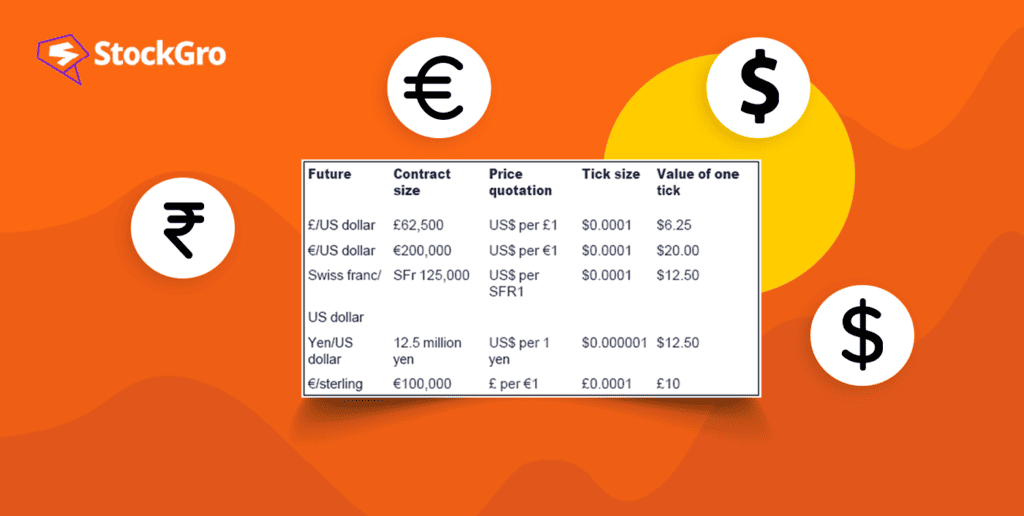
- The lot size for contracts with currencies USD, EUR and GBP are 1,000, and the lot size for JPY contracts is 1,00,000.
- Currency futures contracts in India must mature within 12 months.
- The Reserve Bank of India (RBI) has a crucial role in determining rates for the exchange of currencies in India.
The stock market also allows cross-currency futures contracts in India. It is where traders deal with two international currencies without involving INR (Indian Rupees). Cross-currency pairs available in India are EUR-USD, GBP-USD and USD-JPY.
Pros and cons of investing in currency futures
Benefits of trading in currency futures:
- Investing in currency futures is one of the ways of holding a diverse portfolio. It gives investors access to global markets.
- Currency futures hedge the risk of exchange rate fluctuations, which can save investors from losses.
- Speculations based on currency futures can result in heavy profits for investors.
- The forex market is highly active, making these securities liquid. Buying and selling currencies is easy in the secondary market.
- Since these trades take place on the exchange, the environment is thoroughly under regulation at all times. It reduces the risk of defaults and fraud.
The major disadvantages of trading in currency futures are a lack of flexibility and high price fluctuations.
Since these transactions take place on the exchange, with the exchange itself being the counterparty at times, the rules are standardised. The room for customisation in trade is rare, making these contracts rigid.
Another limitation is the volatility of these securities. Though future contracts are a hedging tool, the rate fluctuations are so high that they can still lead to loss at times.
Example
An Indian trader wants to buy USD after 3 months. The current exchange rate of USD to INR is ₹ 83.25. He believes that the exchange rate will go up to ₹ 90 in 3 months. So, he enters into a futures contract to exchange currencies after 3 months at ₹ 84.
After 3 months, the exchange rate is at ₹ 88, so he executes the futures contract and earns a profit of ₹ 4 per unit.
Lot size: 1,000
Contract rate: ₹ 84
Contract value: 84*1000 = ₹ 84,000
Without the futures contract, he would have to spend ₹ 88,000.
Types Of Currency Futures
Currency futures are standardised contracts traded on exchanges where participants agree to buy or sell a specific currency at a fixed price on a future date.
Common types include:
- USD/INR Futures – Most actively traded in India.
- EUR/INR Futures – Euro against Indian Rupee.
- GBP/INR Futures – British Pound against Indian Rupee.
- JPY/INR Futures – Japanese Yen against Indian Rupee.
Globally, currency futures can also include pairs like EUR/USD or GBP/USD, but in India, contracts are mainly quoted against INR.
How Do Currency Futures Work?
Currency futures allow traders to lock in an exchange rate today for a transaction that will happen in the future.
For example, if USD/INR is trading at ₹83 and you expect the dollar to strengthen, you can buy a futures contract at ₹83. If the rate rises to ₹84 before expiry, you profit from the price difference.
These contracts are:
- Standardised
- Traded on exchanges
- Settled daily through mark-to-market adjustments
They are commonly used for hedging foreign exchange risk or for speculative trading.
Currency Derivatives Examples
Currency derivatives are financial contracts whose value is derived from currency exchange rates.
Examples include:
- Currency Futures
- Currency Options
- Forward Contracts
- Currency Swaps
For instance, an exporter expecting USD payments in three months may use a currency future to hedge against a falling dollar.
How To Trade In Currency Futures
To trade currency futures in India:
- Open a trading and demat account with a broker offering currency derivatives.
- Activate the currency segment.
- Maintain required margin as per exchange rules.
- Select the currency pair and expiry month.
- Place buy or sell order through the trading platform.
Currency futures are leveraged instruments, meaning you only pay a margin instead of the full contract value.
Risk management is crucial because leverage can amplify both gains and losses.
Bottomline
Currency futures and options are derivative contracts that help traders hedge the risk of exchange rate fluctuations.
These securities help traders maintain a diverse portfolio and get access to global markets. They also offer attractive returns, given the rate fluctuations. Hence, currency futures are suitable for those investors looking to trade in a market that is highly liquid, volatile and regulated.
FAQ’s
To buy currency futures, open a trading account with a broker that offers currency derivatives, activate the currency segment, maintain margin funds, select the desired currency pair and place a buy order for the futures contract.
In India, the standard contract size for USD/INR futures is typically 1,000 US dollars per lot. Other currency pairs have predefined lot sizes as specified by the exchange.