

What Dividend Yield Means
Dividend yield shows the percentage of a stock’s present price that a company returns to shareholders through annual dividends. It is expressed as a percentage and is one of the most widely used metrics by investors seeking passive income stocks and regular dividend income from their equity holdings.
In simple terms, it answers one question: for every rupee you invest in a stock, how many paise are you earning back annually through dividends?
Dividend yield meaning describes the proportion of a stock’s value distributed to shareholders in the form of yearly payouts. People focused on steady portfolio income often use it to evaluate expected cash returns from a stock.
Dividend yield is most commonly associated with mature, established companies in sectors like utilities, FMCG, and public sector undertakings, which tend to distribute a consistent share of their profits rather than reinvesting everything into growth.
How Dividend Yield Is Calculated
The dividend yield formula is one of the simplest in investing basics. Its formula depends on two values alone: the dividend declared for one share over a year and the share’s existing market rate.
The Formula Explained
Dividend Yield (%) = (Annual Dividend Per Share ÷
Current Market Price Per Share) × 100
This yield calculation tells you the return you are earning purely from dividends, independent of any capital appreciation or loss on the stock price itself.
Two things to note. First, most companies in India pay dividends quarterly or annually, so always use the total annual dividend figure. Second, dividend yield changes every time the stock price moves, even if the dividend amount stays the same. A rising stock price lowers the yield, and a falling stock price raises it.
Simple Example of Dividend Yield
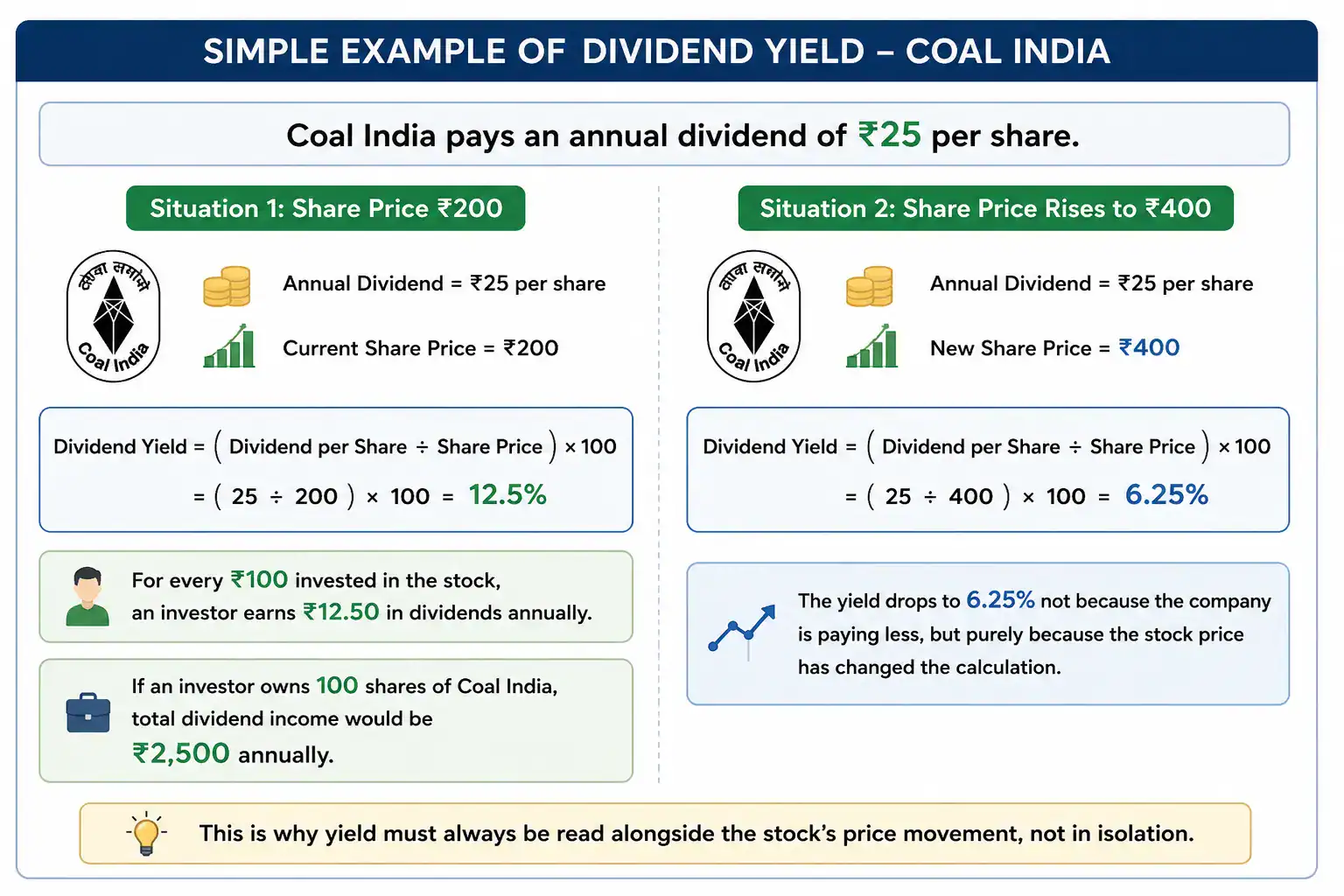
Suppose HCL Technologies offers ₹25 as annual dividend per share and the market price stands at ₹200, investors can calculate the yield accordingly. Using the formula:
Dividend Yield = (25 ÷ 200) × 100 = 12.5%
This means for every ₹100 invested in the stock, an investor earns ₹12.50 in dividends annually. If someone possesses 100 company shares, the annual payout from dividends would amount to ₹2,500.
Now consider what happens if Coal India’s share price rises to ₹400 while the dividend stays at ₹25. The yield drops to 6.25% not because the company is paying less, but purely because the stock price impact has changed the calculation. This is why yield must always be read alongside the stock’s price movement, not in isolation.
Why Dividend Yield Matters
Dividend yield is not just a number on a stock screener, it serves several practical purposes for investors at every level. Here is why it deserves attention:
- It quantifies your income return: Yield calculation tells you precisely how much cash income you are earning on your investment today, making it easy to compare across different stocks and asset classes, including fixed deposits and bonds.
- It helps identify income-generating stocks: People who use investments as a source of regular earnings often evaluate dividend yield to find stocks that can support their required cash inflow. In such cases, investors often prefer shares offering better yields, provided the company’s finances and profits comfortably support those dividends.
- It signals valuation shifts: A yield that sharply differs from sector averages or the company’s earlier range can highlight valuation gaps and may even point toward underlying business concerns.
- It makes stock comparison easy: This ratio makes it easier to compare shares based on dividend income prospects and overall return priorities.
- It supports passive income planning: For retirees or investors building a cash-flow portfolio, knowing the yield upfront allows you to estimate annual dividend income from any position size before you buy.
High vs Low Dividend Yield
Understanding the difference between high and low dividend yield helps you interpret what a stock is actually signalling before you invest. Here is a quick comparison:
Factors That Affect Dividend Yield
Several forces move dividend yield up or down. Some driven by the company, others by the market:
- Stock price movement: Higher market prices typically push dividend yields lower unless the business boosts its payout amounts as well. This is the most frequent cause of yield fluctuations and has nothing to do with the company’s dividend policy changing.
- Company growth stage: Businesses in mature stages of growth are typically more capable of maintaining dividend payments than smaller developing companies. Expansion-driven firms usually retain earnings for scaling activities, and dividend yields are not uniform across sectors.
- Industry trends: Yields vary considerably across sectors. Utilities, consumer staples, and PSUs typically offer higher yields; technology and healthcare companies typically offer lower ones or none at all.
- Company fundamentals: Weak financial performance or pessimistic market perception may push a stock price lower, which can mechanically increase dividend yield. Certain companies attempt to attract shareholders through larger dividend payments even when underlying business conditions may not support those payouts sustainably.
- Dividend policy decisions: A board can increase, cut, or suspend dividends at any time depending on profitability and business priorities, directly altering the yield overnight.
Limitations of Dividend Yield
The main limitations of dividend yield are as follows:
- Companies can reduce or stop dividends anytime
Unlike fixed-interest instruments, dividends are not guaranteed. Businesses may lower payouts during weak earnings periods, expansion phases, or economic slowdowns. During the 2008 financial crisis, many global banking companies maintained high dividend yields initially but later suspended or cut dividends when financial stress increased.
- Companies offering high yields are not always financially strong or fundamentally secure
Some companies continue paying dividends even when profits weaken. In such cases, the dividend may not remain sustainable for long. A well-known example is General Electric, where the dividend yield crossed 5% as the stock price declined. The company later reduced its dividend significantly due to business and cash flow issues.
- Special dividends can distort the yield
Some companies issue one-time special dividends that temporarily increase the dividend yield. Investors looking only at the percentage may assume the payout is regular, even though it may not continue in future years.
- High dividend yield can sometimes be misleading
High yields are not always denotation of positive, as they may simply reflect a major fall in market price. This situation is often called a dividend trap. For example, in 2026, The Campbell’s Company saw its stock fall nearly 48% over one year after weak sales and lower business guidance. As the share price dropped, the dividend yield rose sharply above 6%, making the stock appear attractive mainly because of falling prices rather than stronger business performance.
- Different sectors have different average yields
Comparing dividend yields across industries may not give accurate conclusions. Utility companies and REITs often have naturally higher yields, while growth-focused sectors such as technology generally maintain lower payouts. What appears to be an unusually strong dividend yield in one industry may represent a common range in another segment.
Final Takeaway for Investors
Investors should view dividend yield as one factor in evaluation instead of the final conclusion about a stock. The real work begins after you find an attractive number, verifying whether the payout is sustainable, whether earnings support it, and whether the company has a consistent history of rewarding shareholders. Used alongside fundamentals, it becomes a genuinely powerful tool for building income-driven wealth over time.
FAQs
A good dividend yield generally ranges between 2% and 6%, depending on the industry and company stability. Extremely high yields may require deeper analysis before investing.
No, a high dividend yield is not always good. Sometimes the yield rises because the stock price falls sharply due to weak business performance or financial concerns.
Dividend yield itself is not paid directly. Companies pay dividends quarterly, half-yearly, or annually, and the yield percentage changes based on dividend amount and stock price.
Yes, dividend yield changes regularly because it depends on both the company’s dividend payout and current market price of the stock.
Beginners can consider dividend-paying stocks, but they should also evaluate company fundamentals, payout sustainability, debt levels, and long-term business performance instead of focusing only on yield.