
Summary
This blog explains what share pledging is, how it works, and whether investors should view it as a positive or negative signal.
It covers the mechanics of pledging shares as collateral, the reasons promoters and investors use it, and the key risks associated with it.
The blog also tells how to identify pledged shares, recognise potential warning signs, and compare pledging with share sales.
Is Pledging of Shares Good or Bad?
Pledging of shares is neither inherently good nor bad. At modest levels and tied to a clear business purpose, pledging shares is perfectly reasonable. It lets promoters raise funds without selling their stake or diluting ownership. Done this way, it is neither alarming nor unusual.
Where things can go wrong is when the percentage is high, the trend is rising, and the reason is not expansion but debt management. A promoter pledging their holdings to service personal liabilities is a very different situation from one pledging to fund a new plant. Both are using the same method, but their risk profiles are completely different.
So, pledging should not be viewed as positive or negative; investors should understand the context and purpose behind it.
Understanding Share Pledging
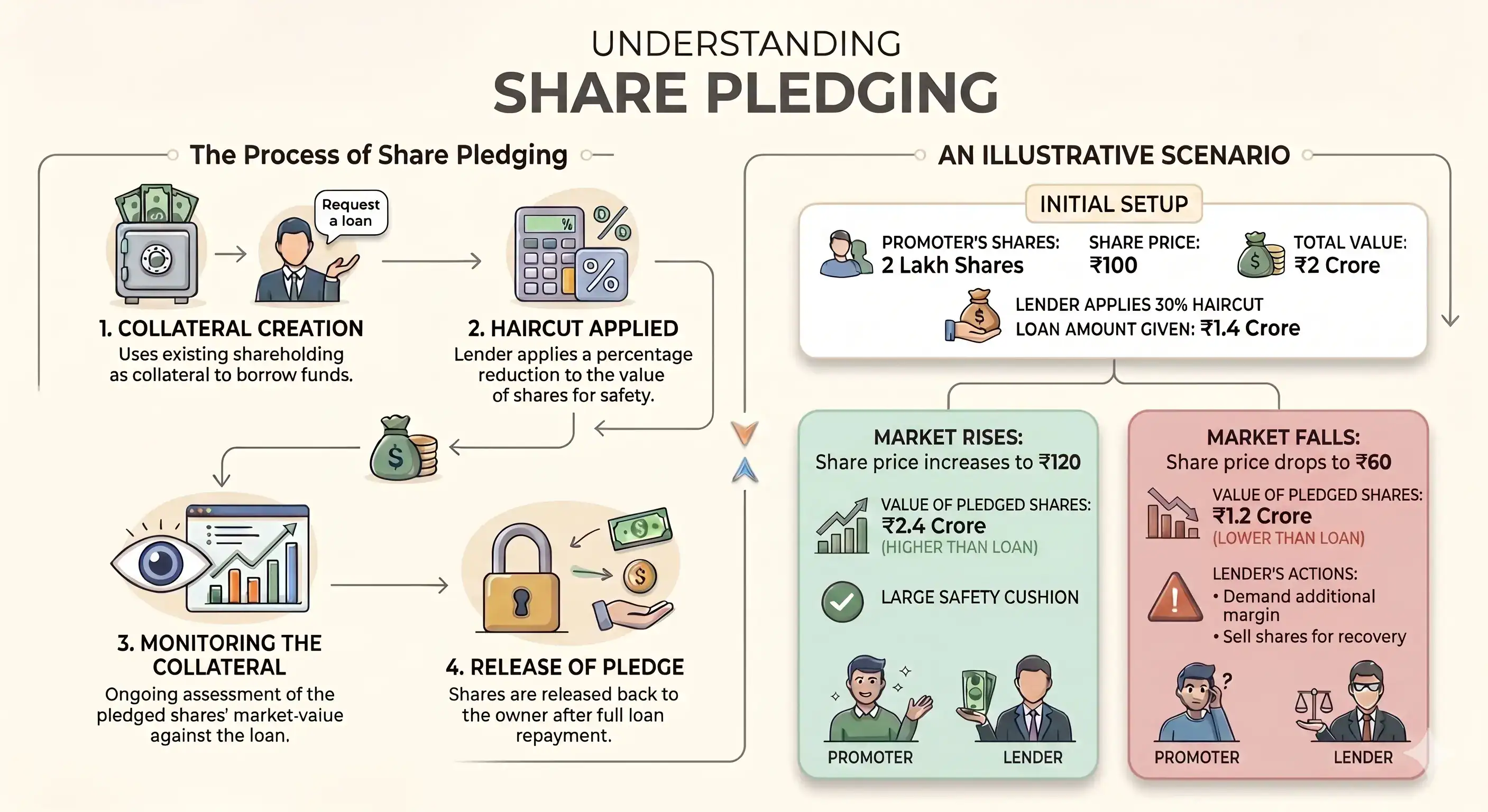
When you’re pledging in the stock market, it means you’re using your existing shareholding as collateral to borrow funds. Here is how it works:
Collateral Creation
The borrower approaches a bank or NBFC and requests a loan against their shares. The shares are marked as pledged in the demat account, but ownership remains unchanged.
Haircut Applied
The lender does not offer the full market value of the pledged shares. A percentage, called the haircut, is deducted to account for price fluctuation risk.
Monitoring the Collateral
The value of pledged shares is tracked continuously. If prices fall, the borrower may receive a margin call, asking them to either add more collateral or partially repay the loan.
Release of Pledge
Once the interest and loan amount are repaid in full, the pledge is lifted. The shares return to free status in the demat account.
Let’s take an example: Suppose a promoter holds 2 lakh shares at ₹100 each. The total value is ₹2 crore. He approaches a lender to pledge his shares. The lender applies a 30% haircut and gives out a loan of ₹1.4 crore.
If the share price rises to ₹120, the value of the pledged shares increases to ₹2.4 crore. Since the collateral value is much higher than the loan, the lender has a safety cushion.
If the share falls to ₹60, the pledged shares’ value becomes ₹1.2 crore, which is lower than the loan amount. In this case, the lender may ask for additional margin or start selling shares to recover dues.
Why People Pledge Their Shares
There are several practical reasons why promoters or individual investors turn to pledging. Understanding this motivation helps in reading between the lines during stock analysis.
- Business Expansion: Promoters raise funds through pledging for funding new projects, scaling existing operations or acquiring other businesses.
- Working Capital: Companies may pledge shares to meet their quick liquidity needs. This path provides access to capital without going through lengthy loan processes.
- Trading Margin: Many investors pledge their shares to obtain collateral margin for futures and options trading.
- Avoiding Dilution: By pledging shares, shareholders retain their voting rights and avoid diluting their ownership stake in the company.
- Bridging Finance: In some cases, pledging acts as a short-term bridge while waiting for other funds or asset sales to come through.
Where the Risks Come In
Pledging becomes a concern when large amounts are borrowed, the share price is volatile, or the promoter’s financial health is uncertain. Here are the three core risk areas every investor must know.
Falling Prices and Margin Calls
This is the most immediate risk. A falling stock price can lower the value of pledged collateral. If it goes below the required margin, then the lender issues a margin call, demanding either more collateral or partial repayment. If the borrower cannot comply, the lender invokes the pledge. This means they sell the shares in the open market.
Market Sentiment Impact
Even without an actual default, news of high pledging can hurt market sentiment. The moment investors or intraday news platforms report rising pledge levels, it tends to trigger retail selling. Markets are forward-looking, and risk management investing demands that participants account for scenarios where promoter desperation, not business logic, is driving decisions.
Overuse of Leverage
When a promoter pledges shares not for business growth but to service existing debt, it becomes a sign of financial stress. High leverage in the promoter group, with pledging as the tool to manage it, is one of the more concerning situations.
How to Spot Pledged Shares in a Company
Before making any investment, checking for pledge data should be part of your standard process. Here is where you can find it:
- NSE Corporate Filings Portal
The National Stock Exchange (NSE) maintains a dedicated section for pledged data under corporate filings. It shows company-wise pledging details, updated regularly based on promoter disclosures. - BSE Pledge Data Section
Bombay Stock Exchange (BSE) website has a pledge data page that gives company-wise pledge status, including the number of pledged shares and the percentage of promoter holding pledged. - Quarterly Results
Listed companies publish shareholding data in their quarterly reports. The promoter section shows the number of shares pledged or otherwise encumbered, making it a reliable source for trend tracking. - Stock Research Platforms
Platforms like Stockgro display pledge data alongside other promoter holding details. This is among the easiest ways for retail investors to quickly gauge pledge exposure during their stock screening process.
Should You Avoid These Stocks?
Not necessarily. The presence of pledged shares does not automatically make a stock a bad investment. What matters is context.
When It’s a Red Flag
If a high percentage of the promoter’s shares are pledged, that is a signal worth investigating. A company with a high and rising pledged promoter shares, especially when accompanied by low or falling operating cash flow, carries real downside risk.
A rising trend in pledge data across consecutive quarters is one of the clearest warning signs of compounding returns erosion for existing shareholders.
When It May Be Acceptable
A low level of pledged promoter holding in a fundamentally strong company with good cash flows and manageable debt is generally not alarming. If the operating cash flow and profits are consistently growing, even relatively higher pledge levels may be acceptable, provided the promoter’s track record is strong.
The key is that the pledging must be tied to a business purpose, not financial distress.
Pledging vs Selling: What’s the Difference?
Both pledging and selling give the promoter access to funds, but they work very differently and have different implications for investors.
| Criteria | Pledging | Selling |
| Ownership | Retained by promoter | Transferred to buyer |
| Voting Rights | Remain with promoter | Pass to new holder |
| Capital Gains Tax | Not triggered | Triggered at point of sale |
| Market Signal | Neutral to cautious | Can indicate reduced conviction |
| Reversibility | Pledge can be released on repayment | Sale is permanent |
- Ownership: With pledging, the promoter keeps legal ownership throughout. A sale ends it permanently.
- Voting Rights: These stay with the pledgor until the pledge is invoked. Once shares are sold, the new holder controls those votes.
- Capital Gains Tax: Pledging creates no taxable event. Selling does, immediately and at the prevailing rate.
- Market Signal: Promoter selling is often viewed as a confidence issue. Pledging is more ambiguous, as it could mean growth financing or financial stress.
- Reversibility: Once the loan is repaid, the pledged shares are released. A sale is permanent and cannot be reversed.
Key Trade-offs
When a promoter chooses pledging over selling, or the other way around, something is always being prioritised at the expense of something else.
- Control vs Clean Exit
Pledging keeps the promoter in control of their shares but attaches a condition to it. The moment markets turn, and the lender calls margin, that control becomes fragile. Selling removes the condition entirely but also removes the stake. - Tax Efficiency vs Simplicity
Choosing to pledge rather than sell defers the tax burden, which looks efficient on paper. But if the pledged position eventually gets invoked at a lower price, the promoter loses both the shares and the benefit they were trying to preserve. - Transparency vs Hidden Exposure
Selling is visible and final. Pledging, particularly at the promoter level through holding companies, can obscure how much total debt is actually sitting against the stock. For retail investors, this asymmetry is the harder risk to price in.
Conclusion
Pledging of shares is a financial tool, and like most tools, it works well in the right hands and can cause damage when misused. At modest levels and for genuine business purposes, it is a reasonable way for promoters to raise capital. At high levels or as a substitute for sound financial management, it is a warning sign that warrants caution. Always check pledge data before committing to any position, and watch for trends, not just levels.
Frequently Asked Questions
No. Share pledging is not automatically risky. Low pledge levels tied to business expansion or working capital are generally viewed differently from pledging linked to financial stress.
Yes, it can. Rising pledge levels may weaken investor confidence, especially if markets fear margin calls or forced selling during sharp price declines.
Yes. Individual investors can pledge shares as collateral for loans or to obtain margin funding for trading derivatives.
If the share price falls significantly, the lender may issue a margin call asking for additional collateral or repayment. Failure to comply can lead to the forced selling of pledged shares.
Not necessarily. Investors usually evaluate the pledge percentage, the reason behind it, promoter credibility, and the company’s financial strength before making a decision.