
What is a reverse stock split?
A reverse stock split is a company measure that combines several shares into one, lowering total shares and increasing the price per share in the same ratio. Company value in terms of market cap does not change, making it the reverse of a standard stock split. While a stock split expands share quantity, whereas a reverse split compresses it to increase price per unit. What changes is the packaging, not the underlying value.
The ratio in which shares are merged is decided by the company’s board of directors. Common ratios include 1:2, 1:5, and 1:10. Under a 1:10 ratio, 10 shares convert into 1 share while the price increases proportionately. Your total holding value does not change on the day of the action.
Reverse stock splits are less common in India compared to the United States, where they are used frequently by companies trading on NYSE and Nasdaq to maintain minimum price thresholds.
How does reverse stock split work?
Understanding how a reverse stock split works requires knowing how the stock market handles corporate actions of this nature. When a company’s board approves a reverse stock split, it sets a ratio and a record date. On the record date, the registrar or depository automatically consolidates shares held by eligible shareholders. No action is required from individual investors.
The stock exchange adjusts the share price upward on the ex-date to reflect the consolidation. Even after consolidation, overall market value is unchanged, but face value rises in line with the split ratio.
For example, if a stock has a face value of ₹1 and a 1:10 reverse split is carried out, the new face value becomes ₹10. The market price adjusts upward by a factor of 10. Fractional shares that result from an uneven split may be rounded off or settled in cash depending on the company’s decision.
Reverse stock split example (before vs after)
To thoroughly grasp the before and after effect of a reverse stock split on, let’s look at an example to make the concept concrete:
Original image:
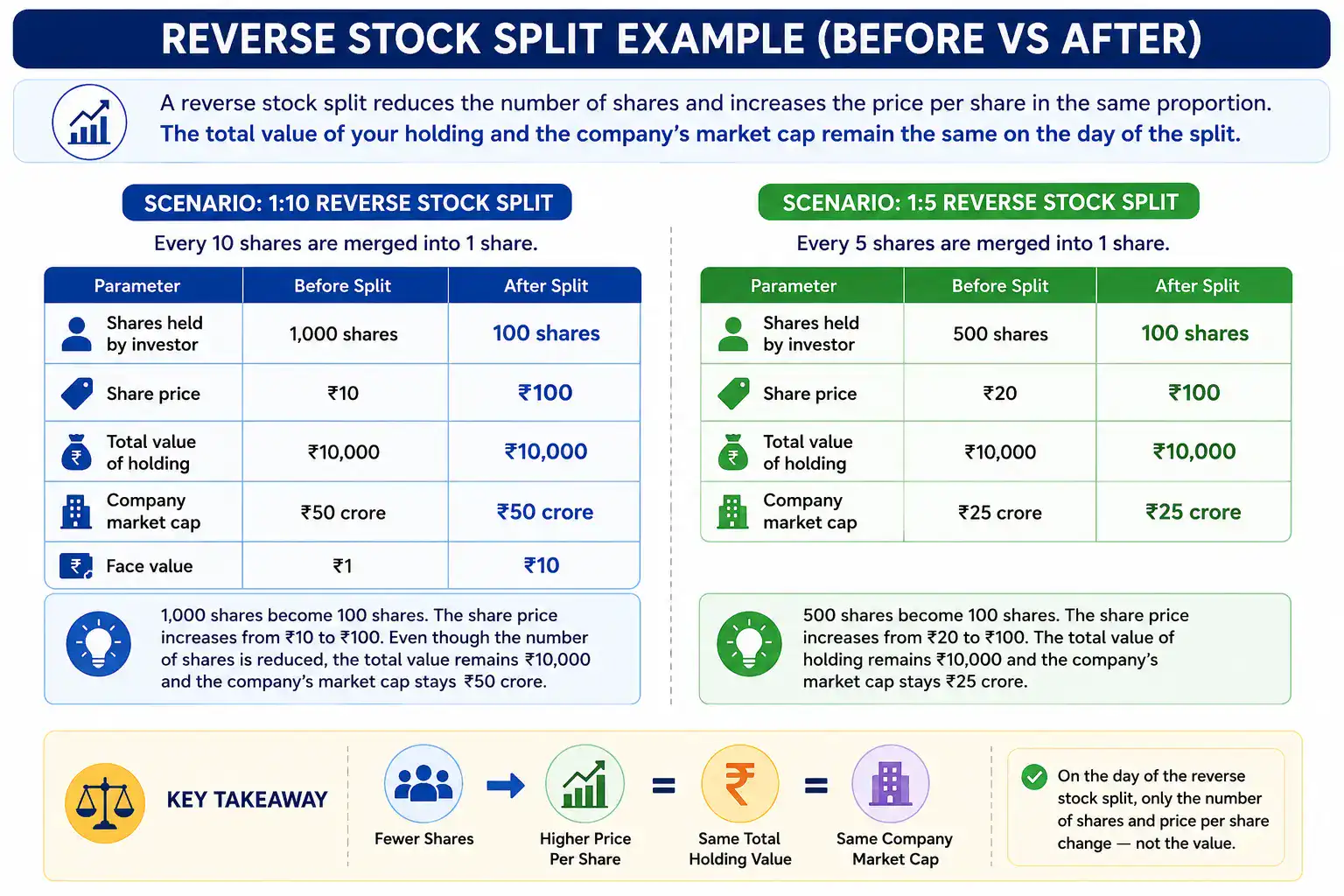
Scenario: 1:10 Reverse Stock Split
| Parameter | Before split | After split |
| Shares held by investor | 1,000 shares | 100 shares |
| Share price | ₹10 | ₹100 |
| Total value of holding | ₹10,000 | ₹10,000 |
| Company market cap | ₹50 crore | ₹50 crore |
| Face value | ₹1 | ₹10 |
In this case, every 10 shares are merged into 1 share. So, 1,000 shares become 100 shares. To balance this, the share price increases from ₹10 to ₹100. The reduction in shares does not affect the total value, which remains ₹10,000. Additionally, the company valuation is not impacted.
Scenario: 1:5 Reverse Stock Split
| Parameter | Before split | After split |
| Shares held by investor | 500 shares | 100 shares |
| Share price | ₹20 | ₹100 |
| Total value of holding | ₹10,000 | ₹10,000 |
| Company market cap | ₹25 crore | ₹25 crore |
Here, every 5 shares are merged into 1. So, 500 shares become 100 shares, and the price increases from ₹20 to ₹100. Again, the total holding value remains the same at ₹10,000, and there is no change in the company’s market capitalisation.
In both cases, the investor’s total holding value is unchanged on the day of the reverse split. Share quantity reduces and price adjusts upward in the same ratio.
Why companies do reverse stock split
Companies carry out reverse stock splits for several strategic reasons, which are as follows:
- Avoiding delisting
Listed securities must meet minimum price criteria set by exchanges such as BSE and NSE to remain compliant. A reverse split assists firms complying with exchange-mandated price criteria. If a stock remains below the required price for too long, it may face delisting proceedings. This technique raises the stock price artificially to meet exchange requirements temporarily.
- Attracting institutional investors
Institution investors generally don’t prefer the low-value shares. Higher post-split prices align with mandates of institutional investors who avoid penny stocks.
- Improving market perception
A stock trading at ₹2 per share carries a strong penny stock stigma. Consolidating shares to bring the price to ₹20 or ₹50 changes how the stock is perceived by the market, even if the underlying financials are unchanged.
- Reducing administrative burden
Managing a very large number of low-value shares creates administrative costs for the company including record keeping, communication, and compliance. Reducing share count through consolidation simplifies operations.
- Price stabilisation
Shares trading at low prices are generally more volatile. Consolidation can reduce trading fluctuations and administrative complexity.
Reverse stock split vs stock split
These two corporate actions are often used interchangeably because both change the number of shares and the share price. To understand the stock split clearly, we must comprehend how it differs from the reverse stock split.
| Parameter | Stock Split | Reverse Stock Split |
| Effect on shares | Increases shares outstanding by dividing existing shares into multiple units | Decreases shares outstanding by merging multiple shares into one |
| Effect on price | Price decreases proportionally, making shares more accessible | Price increases proportionally, making shares appear higher in value |
| Effect on market cap | Unchanged, as only the share structure is altered | Unchanged, as only the share structure is altered |
| Face value | Decreases in the same ratio as the split | Increases in the same ratio as the consolidation |
| Common signal | An increased share price may be interpreted as stronger market positioning | Indicates the stock price has fallen to very low levels |
| Investor perception | Generally viewed as a positive signal of growth and accessibility | Typically seen as a cautionary signal linked to weak price performance |
| Liquidity impact | Improves liquidity due to more shares being available for trading | Can reduce liquidity due to fewer shares being available |
| India examples | Infosys, TCS, HDFC bank | Standard Batteries, Inter Globe Finance Ltd. |
Impact of reverse stock split on share price
On the day a reverse stock split takes effect, the share price adjusts upward automatically on the stock exchange. This is a mechanical adjustment, not a reflection of improved business performance or how stock prices are determined. The adjusted share price is calculated as follows:
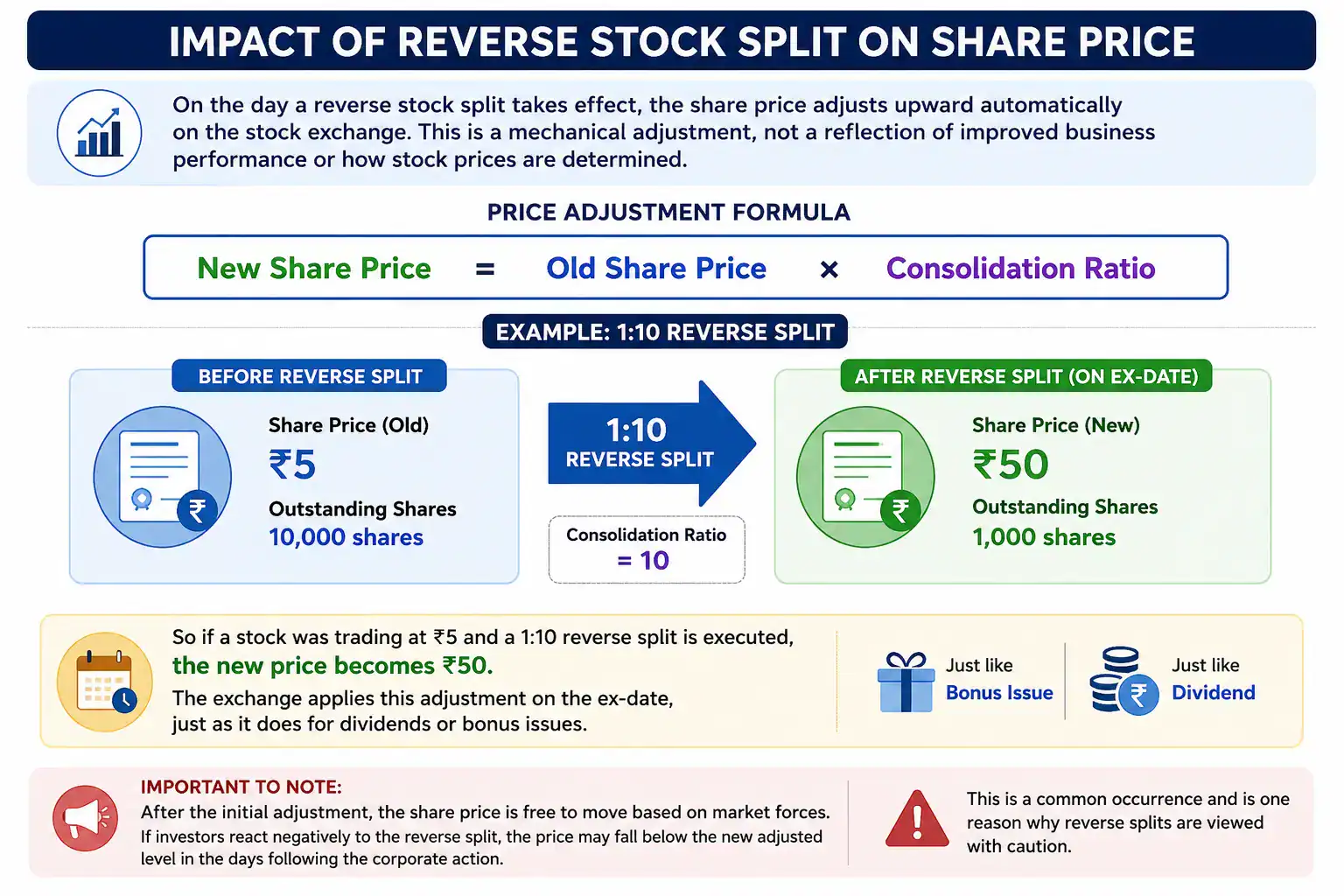
New Share Price = Old Share Price × Consolidation Ratio
So, for example, if a stock was trading at ₹5 and a 1:10 reverse split is executed, the new price becomes ₹50. The exchange applies this adjustment on the ex-date, just as it does for dividends or bonus issues.
However, after the initial adjustment, the share price is free to move based on market forces. If investors react negatively to the reverse split, interpreting it as a sign of distress, the price may fall below the new adjusted level in the days following the corporate action. This is a common occurrence and is one reason why reverse splits are viewed with caution.
Impact on investors: profit or loss
On the day of the reverse split, there is neither a profit nor a loss. Your total holding value remains identical. However, the longer-term impact on investors depends entirely on why the company carried out the reverse split and what happens to the business afterwards.
- If the company recovers and grows: Investors who hold on after a reverse split benefit from owning shares in a company that has stabilised and improved. The fewer, higher-priced shares appreciate further.
- If the company continues to decline: The reverse split provides only temporary relief. Without business improvement, post-split gains may not sustain. Some companies carry out multiple reverse splits over several years, each time buying a brief reprieve before declining again.
- Tax implications: In India, a reverse stock split does not trigger a capital gains tax event at the time of consolidation. The cost of acquisition is recalculated according to the revised number of shares. Capital gains tax applies only when you eventually sell the shares.
Advantages of reverse stock split
The main advantages of a reverse stock split for companies and investors under specific circumstances are as follows:
- Prevents delisting: Brings the share price above exchange minimum thresholds, allowing the company to remain listed.
- Attracts institutional capital: Price adjustment can make the stock eligible for institutional portfolios with price floor mandates.
- Risk moderation: Fewer shares at a higher price leads to more stable price movements and a more orderly market.
- Improves earnings per share (EPS) optics: The reduction in share count improves EPS calculations. While this does not reflect a real improvement, it can make financial ratios look more favourable.
- Builds up credibility: For fundamentally sound companies temporarily affected by market conditions, a reverse split can restore perception and attract fresh investor interest.
Disadvantages of reverse stock split
Despite the advantages listed above, reverse stock splits come with significant drawbacks that investors must understand. Some of stock market risks explained below are associated with reverse stock split:
- Does not fix underlying problems: The core reason a stock falls to low levels is usually weak financials, poor management, or a deteriorating business. A reverse split changes only the price optics, not any of these fundamentals.
- Negative market signal: Most investors and analysts interpret a reverse split as a distress signal, often triggering selling pressure after the corporate action.
- Reduces liquidity: Lesser shares in circulation can reduce trading liquidity. Small investors might find it harder to buy or sell without affecting market price.
- Risk of repeated splits: Companies in long-term decline often carry out multiple reverse splits over years as the share price continues to fall after each consolidation.
- Can mislead retail investors: Reverse stock splits are often a ploy to attract naive investors who see a huge rise in share price as an indicator of the company’s quick growth without understanding the real reason for the rise.
Real-life example of reverse stock split
- L.G. Balakrishnan and Bros Limited (India)
L.G. Balakrishnan and Bros, a manufacturer of transmission chains and metal formed parts listed on BSE and NSE, carried out a reverse stock split in India in FY2010. The company consolidated its shares to bring the per-share price to a more institutionally acceptable level. This is one of the more cited examples of a reverse stock split by an Indian listed company.
- Citigroup
In 2011, Citigroup executed a 1:10 reverse split, merging 10 existing shares into a single share. The bank’s stock had fallen sharply during the 2008 financial crisis and was trading at very low levels. The reverse split was accompanied by a broader restructuring plan. Post-split, Citigroup’s stock traded at a more institutional price level and the company went on to recover operationally, making this one of the more successful examples of a reverse split serving its intended purpose.
These two examples show the two outcomes possible after a reverse split: a temporary fix that does not address fundamentals, and a genuine restructuring signal that precedes a recovery
Should you invest after a reverse stock split?
The answer is: it depends entirely on why the reverse split happened and the company’s fundamentals. When performing stock analysis for beginners, here is a simple framework for evaluating whether to invest after a reverse stock split:
Questions to ask before investing:
- Why did the share price fall in the first place? Is it a sector-wide downturn or company-specific mismanagement?
- Has the company published a credible turnaround or restructuring plan alongside the reverse split?
- Are revenues and profits improving, stable, or still declining?
- Has promoter shareholding increased, stayed flat, or declined in recent quarters?
- Has the company carried out previous reverse splits? Repeated splits are a serious red flag.
If the reverse split is accompanied by genuine business improvements, new management, asset monetisation, or debt reduction, there may be a recovery thesis worth evaluating. If the reverse split appears to be solely a compliance measure with no accompanying business changes, the risk of further price decline is high.
Common misconceptions about reverse stock split
The most common misconceptions about a reverse stock split are as follows:
- Post-split price increase alone is not a sign of company improvement.
It does not. The price increase is purely mathematical. The company’s revenue, profit, and debt position are exactly the same before and after the split.
- A reverse split creates wealth for shareholders.
No wealth is created on the day of the reverse split. Total holding value is unchanged. Wealth creation or destruction depends on what happens to the business in the months and years that follow.
- Reverse splits always signal failure.
Not always. When carried out by a fundamentally sound company that has been temporarily beaten down by market sentiment rather than business problems, a reverse split can mark the beginning of a recovery. Context and fundamentals matter more than the corporate action itself.
- The EPS improvement after a reverse split reflects real earnings growth.
Higher EPS post-reverse split is purely a result of dividing the same earnings across fewer shares. Unless the company’s actual profits increase, the EPS improvement is cosmetic.
- You lose money when a reverse split happens.
There is no immediate change in total portfolio value after the split. The risk of losing money comes from subsequent price movements if the company continues to underperform after the consolidation.
Conclusion
A reverse stock split should not be viewed as good or bad by default. It is a corporate tool that changes the packaging of your shares without changing their total value. The signal it sends and the impact it has depend entirely on the company behind it. For investors, the most important step after a reverse stock split announcement is not to react to the price change but to dig into the financials, understand why the split is happening, and assess whether the underlying business has a genuine recovery path. Post-split price increase should not be treated as a buying signal. An improving business with a realistic turnaround plan is.