
- Summary
- A trailing stop loss automatically adjusts the exit level as the market price moves in the trader’s favour.
- It can help protect unrealised gains while allowing a position to remain open if the price continues to move favourably.
- Trailing stops can be based on a fixed amount, percentage, moving average, or support levels, depending on the trading approach.
- The choice of trailing distance matters, as a tight stop may trigger during normal price fluctuations, while a wider stop may provide less protection.
What is Trailing Stop Loss?
A trailing stop loss is an order that moves with the market price when a trade moves in the investor’s favour. For a long position, the stop level moves upwards as the stock price rises. If the price then falls, the stop level stays at its last adjusted position. This can help protect part of the gains made during an upward move while still allowing the position to remain open if the trend continues.
A trailing stop does not guarantee an exit at the exact stop price. In a fast-moving market, the actual execution price can differ from the trigger price.
How Does a Trailing Stop Loss Work?
A trailing stop loss works by maintaining a specified distance from the market price. This distance can be a fixed amount or, where supported, a percentage. For a long position, the process generally works as follows:
- Set the initial stop: The trader chooses the starting stop level or trailing distance.
- Price moves up: If the stock rises, the trailing stop moves higher according to the chosen setting.
- Price reverses: If the stock falls, the trailing stop does not move back down.
- Stop is triggered: If the price reaches the trailing level, the order is activated according to its order conditions.
For example, a trader buys at ₹1,000 and sets a ₹50 trailing distance. If the stock moves to ₹1,100, the stop moves to ₹1,050. If the stock reaches ₹1,200, the stop can move to ₹1,150. A subsequent fall to ₹1,150 can trigger the exit.
The exact way a trailing order is triggered and executed can vary between trading platforms and order types.
Features of Trailing Stop Loss
Some of the main features of a trailing stop loss are:
- Moves with the price: The stop adjusts when the market moves in the trader’s favour.
- Maintains a set distance: The stop can follow the market by a fixed amount or percentage, depending on the order type.
- Does not move backwards: Once the stop moves in a favourable direction, it generally remains at that level during an adverse price move.
- Can protect unrealised gains: A rising stop can reduce the amount of profit given back if the price reverses.
- Can reduce manual adjustments: Where the feature is automated, the trader does not need to keep changing the stop level manually.
- Execution is not guaranteed at the stop price: A triggered stop may be executed at a different price in a rapidly moving market.
Trailing Stop Loss Example
A real example of a trailing stop loss can be seen for Ashok Leyland. The trade was entered at ₹123.45 on 8 August 2018, with an initial stop loss of ₹116.75. As the trade moved in the expected direction, the trailing stop was later raised to ₹123.75 on 16 August. The updated trailing stop was recorded as the level at which a profit would have been protected if the price subsequently reversed.
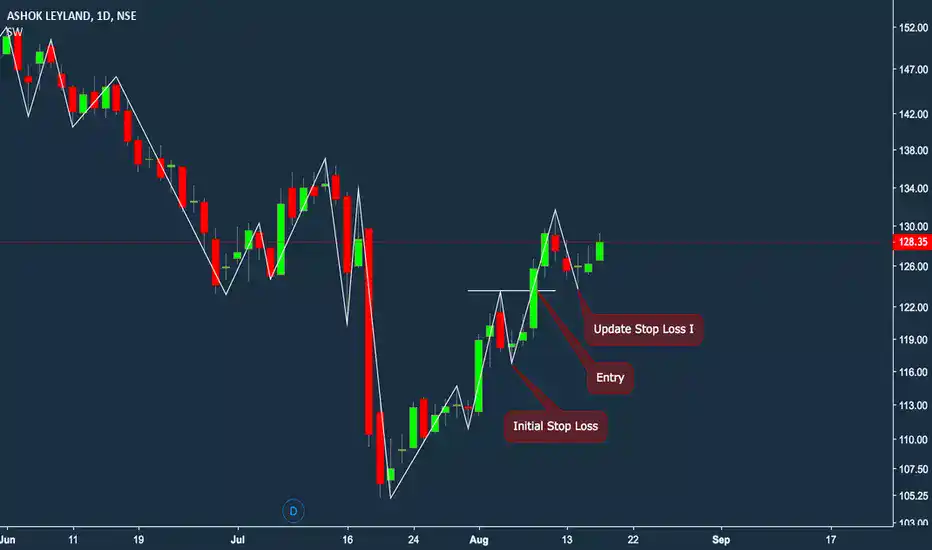
Alt text: Trailing stop loss in Ashok Leyland bounce uptrend trade
| Trade stage | Price |
| Entry | ₹123.45 |
| Initial stop loss | ₹116.75 |
| Updated trailing stop | ₹123.75 |
| Protected profit if TSL was hit | ₹0.30 per share |
The example shows the main difference between a fixed stop loss and a trailing stop loss. The original stop was below the entry price, but after the stock moved favourably, the stop was raised above the entry price. This meant that a subsequent reversal could trigger an exit while still protecting a small profit.
When Can Trailing Stop Loss be Used?
A trailing stop loss can be useful when a trader wants to stay in a position while the price is moving in the expected direction, but also wants the exit level to move with the trade. It may be considered for:
- Trending trades: The stop can follow the price during a sustained move.
- Swing trades: It can help manage a position held for several sessions.
- Intraday trades: It may be used when a position makes a strong move during the trading session.
- Breakout trades: It can help manage a position after a breakout if the price continues in the same direction.
- Short positions: The stop can move lower as the price falls and remain at its latest level if the price subsequently rises.
A clear exit plan becomes even more important when trading actively. According to a SEBI study, nearly 91% of individual traders in the equity derivatives segment incurred net losses in FY2024–25. The figure does not suggest that using a trailing stop would have avoided those losses, but it highlights the need to think about risk and exit levels before placing a trade.
The trailing distance also matters. If it is set too close to the market price, a normal short-term price movement may trigger the stop before the expected move develops.
Key Components of a Trailing Stop Loss
A few key elements determine how a trailing stop loss works:
| Component | What it means |
| Initial stop level | The starting level used to protect the trade. |
| Trailing amount | A fixed price distance between the market price and the stop. |
| Trailing percentage | A percentage-based distance from the market price, where supported. |
| Trigger price | The price at which the stop condition is met. |
| Order type | Determines how the order is placed or executed after the trigger. |
These settings are not necessarily the same across all platforms. Traders should check how the particular order works before using it.
Types of Trailing Stop Loss Strategies
A trailing stop can be set or managed in different ways depending on the trading approach.
- Fixed-Amount Trailing Stop
The stop remains a fixed rupee amount away from the market price. For example, with a ₹30 trailing distance, the stop can move ₹30 higher for every favourable ₹30 move in a long position.
- Percentage-Based Trailing Stop
Here, the stop follows the stock at a specified percentage. For instance, with a 5% trailing stop, a stock trading at ₹1,000 would have a trailing level ₹50 below the current price. If the stock rises, the trailing level moves higher as well.
- Moving Average-Based Trailing Stop
A trader can move the stop based on a moving average, such as the 20-day or 50-day moving average. This is a strategy for managing the stop rather than necessarily an automated trailing order.
- Support-Based Trailing Stop
The trader can move the stop below newly formed support levels as the trade develops. This approach follows the stock’s price structure rather than using a fixed rupee amount or percentage.
Difference Between Trailing Stop Loss and Stop Loss
The main difference is what happens to the stop level after the trade is placed.
| Factor | Stop Loss | Trailing Stop Loss |
| Stop level | Usually remains fixed | Moves when the price moves favourably |
| Profit protection | Depends on the original or manually changed level | Can increase as the price moves in the trader’s favour |
| Manual adjustment | May be required to raise the stop | Can adjust automatically where supported |
| Price reversal | Stop stays at its set level | Stop generally remains at its latest level |
| Primary purpose | Limit potential loss | Manage downside while allowing a favourable move to continue |
A regular stop order uses a specified stop price. A trailing stop instead uses a trailing amount or percentage that adjusts as the security moves in the favourable direction.
When Can Trailing Stop Loss be Used?
A trailing stop loss can be useful when the trader does not want to set a fixed exit target and would rather allow the position to run while the price continues in the expected direction.
Before selecting the trailing distance, consider:
- Volatility: More volatile stocks may need greater room.
- Holding period: A swing trade may require a wider trailing distance than a short intraday trade.
- Liquidity: Thinly traded stocks can experience larger price gaps or wider spreads.
- Market conditions: Sharp short-term movements can trigger a closely placed stop.
A trailing stop should therefore be part of the wider trade plan rather than treated as a way to guarantee a particular profit.
Advantages of Trailing Stop Loss
- Protects part of the gain: The stop can move higher as the stock price rises.
- Allows the trade to continue: The position can stay open while the price keeps moving favourably.
- Reduces repeated adjustments: An automated trailing order can remove the need to manually change the stop.
- Provides an exit level: The trader has a predefined level for a potential exit.
- Works in both directions: Trailing mechanisms can be structured for long and short positions.
Disadvantages of Trailing Stop Loss
- May trigger too soon: A narrow trailing distance can be hit by normal price fluctuations.
- Execution is not guaranteed at the stop price: The actual fill can differ from the trigger, particularly in fast-moving markets.
- Can cut short a larger move: The position may be closed before the broader trend has ended.
- Not available in the same form everywhere: Order types and triggering methods vary between trading platforms and markets.
- Requires the right trailing distance: A level that is too tight or too wide can affect how the trade is managed.
Final Thoughts
A trailing stop loss can be useful when a trader wants to give a position room to move without leaving the exit level unchanged. The stop follows the price during a favourable move and stays at its latest level when the price reverses. However, it is not a guarantee against losses or poor execution. The trailing distance, market volatility and order conditions all matter, so the setup should be decided before placing the trade.
FAQs
A trailing stop is not necessarily better than a regular stop loss. A regular stop remains at the set level, whereas a trailing stop moves with favourable price movements. The more suitable option depends on the trade and its exit plan.
Yes, it can help protect unrealised gains while allowing a position to remain open during a favourable price move. The trailing distance still needs careful consideration.
A stop-limit order uses a fixed stop price, while a trailing stop-limit order adjusts its stop level as the market moves favourably by a specified amount.
No. A book profit price is not essential for a trailing stop loss. The order can use a trailing amount or percentage to adjust the stop level.