

frequency trading style where traders aim to profit from small price changes within a very short timeframe. Instead of holding positions for hours or days, scalpers execute rapid trades to accumulate multiple small gains that add up throughout the session. This method relies on strict technical analysis and quick execution to capture immediate market movements without exposing capital to overnight risks.
How the 5 Minute Scalping Strategy Works
The operational mechanics of the 5-minute scalping strategy involve distinct actions and characteristics as follows:
- The core objective is to generate profit from frequent market movements by entering and exiting trades within a few minutes, avoiding the risks associated with holding positions for long durations.
- Traders utilise 5-minute charts to spot momentum, looking for situations where the trend makes a slight change or reversal, which serves as the signal to make a move.
- This style relies heavily on discipline and speed, as the goal is not to capture a single massive price jump but to gather multiple small wins that add up over a trading session.
- The strategy works best when the market shows clear volatility, allowing scalpers to exploit short bursts of momentum rather than waiting for a full trend to develop.
- Risk is managed by keeping market exposure low; since positions are open for such a short time, the likelihood of being hit by a sudden, large adverse event is significantly reduced.
- Immediate feedback is a core feature, as the quick turnaround of trades allows market participants to see instantly if their setup is working and adapt to changing conditions in real-time.
Chart Setup for 5 Minute Scalping
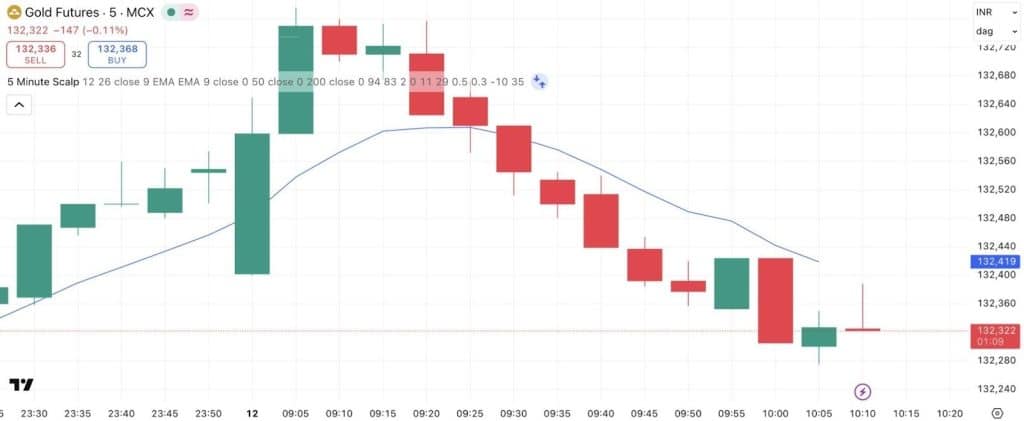
This example of the 12 Dec, 2025 Gold Futures (MCX) chart clearly displays the mechanics of the setup without human intervention. The timeframe is set to 5 minutes, where each bar represents five minutes of market activity on the 12th of the month. A specific technical tool labelled “5 Minute Scalp” (configured with settings 12, 26, 9) appears as a curved blue line overlaying the price action to define the trend.
The chart initially displays upward momentum with green bars peaking near 09:15 AM. The setup signal activates when the price reverses and crosses below the blue indicator line around 09:30 AM, marking a shift in momentum. Following this crossover, the price continued to decline, reaching 132,322 by 10:10 AM, demonstrating how the indicator visualised the trend reversal directly on the chart.
Best Indicators for 5 Minute Scalping
Market participants typically rely on specific technical tools to identify potential setups and confirm momentum which include:
- RSI Settings for Scalping
The Relative Strength Index (RSI) is a momentum indicator used to identify overbought or oversold conditions in the market. For a 5-minute scalping strategy, traders often adjust the RSI settings to be more sensitive than the standard configuration. A common setup involves using a short period, such as 7 or 9, rather than the default 14.
In this context, a reading above 70 is interpreted as an overbought signal, suggesting a potential sell opportunity, while a reading below 30 indicates oversold conditions, pointing toward a potential buy. These signals help traders spot momentary reversals in price.
- MACD Settings for Scalping
The MACD is employed to confirm the strength and direction of a trend. For scalping, traders generally use the default settings of 12, 26, and 9. The primary use of this indicator in a 5-minute setup is to validate momentum before entering a trade. A positive MACD settings reading confirms upward momentum, while a negative reading confirms downward momentum.
Traders specifically look for the MACD lines to cross within the last 25 minutes (or five bars) as a timely trigger. This ensures that the entry aligns with the most recent burst of market energy rather than old data.
- VWAP Scalping Setup
The Volume Weighted Average Price (VWAP) is an advanced tool often used by institutional traders that serves as a dynamic support and resistance level. On a 5-minute chart, the VWAP line represents the average price a security has traded at throughout the day, based on both volume and price.
In this strategy, the VWAP acts as a mean reversion tool. If the price moves significantly below the VWAP, it may signal a long entry as the price is expected to return up to the average. Conversely, price movement significantly above the VWAP can signal a short entry opportunity.
Moving Averages Strategy for 5‑Min Scalping
Moving averages smooth out price data to reveal the underlying trend direction and provide dynamic entry zones through specific setups such as:
- Trend identification: The slope of the moving average lines indicates the immediate market direction; an upward slope suggests buying opportunities, while a downward slope signals selling conditions, helping traders align with the dominant momentum.
- Exponential moving average (EMA) crossovers: A common setup involves using a faster EMA, such as the 20-period, crossing a slower EMA, like the 50-period; a cross of the 20 above the 50 signals an entry for a long position, while a cross below signals a short position.
- Effective support and resistance: During strong support and resistance trends, the price often retraces to touch the 20-period or 50-period EMA before continuing in the original direction, providing a low-risk entry point for scalpers joining an existing move.
- The ribbon method: Some strategies employ a “ribbon” of multiple short-term moving averages (e.g., 5, 8, 13 periods) to visualise trend strength; when these lines fan out and separate, it indicates a strong trend suitable for trading, whereas converging or twisting lines suggest a choppy market to avoid.
Scalping Entry & Exit Rules
A disciplined execution model requires strict adherence to specific trade parameters to ensure consistency such as:
- Long entry criteria: A buy position is initiated when the price closes above a key moving average (like the 20 EMA) and is confirmed by a secondary indicator, such as the RSI crossing above 50 or the MACD line crossing above its signal line.
- Short entry criteria: A sell position is triggered when the price closes below the reference moving average, accompanied by bearish confirmation from indicators, such as the RSI dropping below 50 or the stochastic oscillator crossing down from an overbought zone.
- Precise entry points: To avoid false breakouts, orders are often placed approximately 10 pips above or below the EMA, ensuring the market has sufficient momentum to sustain the move.
- Stop loss placement: Risk is managed by setting stop losses at the recent lowest low for long positions or the highest high for short positions, or alternatively using a fixed distance like 20 pips from the EMA.
- Take-profit targets: Profits are realised quickly using fixed targets, such as 10 to 15 pips, or by exiting when the price touches a support/resistance level or when a counter-signal appears, such as the price crossing back over the moving average.
Is 5‑Min Scalping Safe for Beginners?
While accessible, scalping presents significant challenges for novice traders due to the high-speed nature of execution and requires consideration of factors such as:
- High risk of execution errors: The requirement to make split-second decisions increases the likelihood of mistakes, such as entering the wrong lot size or misclicking buttons, which can be costly without experience.
- Impact of transaction costs: Since profits per trade are small, spreads and commissions can significantly eat into net earnings; beginners must understand how these costs accumulate and affect the overall profitability of a 5 minute scalping strategy.
- Market noise and false signals: Lower timeframes like the 5-minute chart are susceptible to “noise” or random price movements that do not represent a true trend, leading to false signals that can trap inexperienced traders in losing positions.
- Requirement for discipline: Unlike long-term investing, scalping requires intense focus and emotional stability; beginners often struggle with the psychological pressure of managing multiple open positions and accepting rapid losses without chasing the market.
Best Time Window for 5‑Min Scalping
In the Indian stock market, the best time frame for intraday trading for executing this strategy aligns with specific high-volume intervals such as:
- Morning rush (9:15 AM – 10:30 AM): The initial hour of trading provides the highest liquidity and sharpest moves as the market reacts to overnight global news and pre-market sentiment, making it the prime zone for quick entries.
- European market open (1:30 PM – 2:30 PM): A secondary surge in volatility often occurs when European markets open (around 1:30 PM IST), injecting fresh momentum into Indian indices like Nifty and Bank Nifty.
- Closing rush (2:30 PM – 3:15 PM): The final hour of the session sees institutional activity and intraday square-offs, creating distinct trend moves that 5-minute scalpers can capitalise on before the market closes.
- Mid-day avoidance: It is generally advisable to avoid the period between 11:00 AM and 1:00 PM, as volumes typically drop and price action becomes choppy or sideways, leading to a higher failure rate for trend-based setups.
Tools & Platforms Supporting Scalping
For executing a quick 5 minute scalping strategy effectively, traders require technology and advanced platforms that offer real-time data analysis and instant execution capabilities, which include:
Stoxo
As India’s first AI-powered stock market research engine, Stoxo is designed to empower retail investors by functioning as an intelligent “investing buddy” that simplifies complex market data. Instead of navigating multiple tabs or relying on scattered news, traders can use its natural language interface to ask direct questions about trends, momentum, or sector performance and receive instant, credible answers backed by SEBI-registered analysts. It combines technical analysis, sentiment tracking, and live market updates into a single conversational window, allowing scalpers to quickly validate setups and filter out noise without the delay of manual research, which is critical for making split-second decisions in the 5-minute timeframe.
Additionally, some other reliable tools which can be used for high-speed charting and order execution include TradingView, MetaTrader 4 (MT4), Zerodha Kite, and Upstox Pro, which provide essential technical indicators and low-latency trade placement.
Psychology Needed for High‑Speed Scalping
Maintaining a balanced trading psychology is important to manage rapid market changes and effectively execute trades by developing traits such as:
- Emotional detachment: Traders must view losses as a natural business expense rather than a personal failure, preventing the urge to “revenge trade” or increase position sizes impulsively to recover lost funds immediately.
- Unwavering focus: The fast pace of the 5-minute chart demands complete attention during trading sessions; distractions can lead to missed entry signals or delayed exits, turning potential winning trades into losses.
- Discipline to stick to the plan: Success relies on executing the strategy exactly as defined without hesitation; hesitation to take a valid signal due to fear, or jumping in early due to greed, disrupts the statistical edge of the system.
- Patience for high-quality setups: Despite the high frequency of potential trades, a scalper must possess the patience to wait for “A-plus” setups that meet all criteria, rather than forcing trades in choppy or unclear market conditions.
Conclusion
The 5-minute scalping strategy is designed to capture small, quick price movements using a structured plan. It relies on steady discipline and clear rules rather than luck. By sticking to simple entry and exit points, traders can manage risk effectively. This method works best when practised consistently, offering a focused approach to fast markets.
FAQs
It can be profitable when used with strict rules, fast execution, and strong discipline, because it targets many small moves in liquid markets. But noise, slippage, and costs make it risky and unsuitable for undisciplined or casual traders.
The blog recommends combining a fast RSI (7–9) for overbought/oversold spikes, MACD (12,26,9) to confirm fresh momentum, and VWAP or short EMAs as dynamic support‑resistance. This confluence works better than relying on a single indicator.
Beginners can attempt it but it is not ideal. Five‑minute scalping needs split‑second decisions, precise order placement, and emotional control. Execution errors and random noise on such low timeframes can quickly destroy a new trader’s small account.
The best windows mentioned are 9:15–10:30 AM, 1:30–2:30 PM, and 2:30–3:15 PM, when liquidity and volatility are highest. Mid‑day, around 11:00 AM–1:00 PM, is usually avoided due to choppy, low‑volume price action.
There is no fixed minimum, but only true risk‑capital should be used. You need enough to place several small trades, absorb transaction costs, and risk only a tiny percentage per trade so one loss never threatens your overall finances.