India now accounts for 84% of all equity options traded globally, yet most retail participants enter option trading without understanding the most basic directional strategy. The long call is where every serious options trader should begin. It is bullish, it is simple, and it caps your downside at exactly the premium you pay. This guide covers everything from the definition and example to entry, exit, risks, and how to trade it the market.
What is a long call?
A long call is a bullish options strategy where a trader buys a call option on an underlying asset, such as a stock or index, expecting its price to rise above a specific level before expiry.
Acquiring a call option provides the holder the privilege, though not the requirement, to obtain the security at a fixed price prior to the contract’s end. The premium paid is your total maximum risk.
Long call— example
A trader expects Nifty 50 to move higher from its current level of 24,000. A 30-day call is purchased at a strike of 24,200, carrying an individual unit cost of ₹150. Since one Nifty lot is 25 units, the total premium paid is ₹3,750.
- If Nifty rises to 24,500, the option is worth ₹300 per unit. Profit = (300 minus 150) × 25 = ₹3,750.
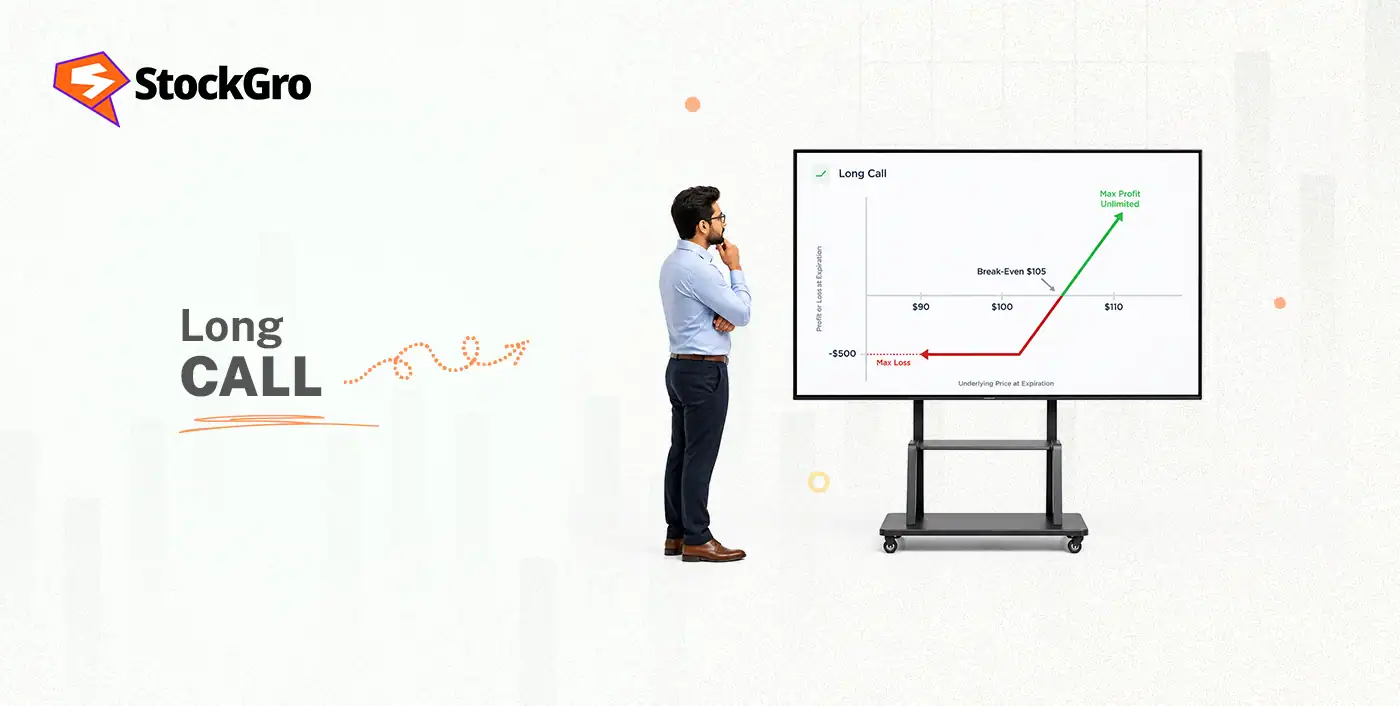
- If Nifty stays below 24,200 at expiry, the option expires worthless and the trader loses the entire premium of ₹3,750.
- Breakeven = 24,200 + 150 = 24,350.
Understanding the long call option strategy
The primary goal of a long call approach is to speculate on a price increase, specifically wagering that the asset will surpass its breakeven threshold before the deadline. It is the most direct way to participate in a bullish move using an option trading strategy, with downside capped at the premium paid.
Key components of a long call option
- Strike price: The set price used to buy the underlying asset through the option contract. Selecting an appropriate strike price is arguably the most critical step when executing a long call position.
- Expiry date: The final day a contract remains valid is referred to as its expiration date.As a contract nears its end date, its valuation typically decreases because of the natural erosion of time.
- Premium: The cost of buying the call option, paid upfront. This is your maximum possible loss.
- In-the-money (ITM): In-the-money describes a situation where the current market value of the asset exceeds the strike price. The option is trading with built-in value.
- At-the-money (ATM): At-the-money refers to an option where the asset’s price and the strike price are virtually identical.
- Out-of-the-money (OTM): The OTM option becomes worthless in real terms when the market price is under the strike price.
Implementing the long call option strategy
Implementing a long call involves three key decisions made before the trade:
- Choose the base asset: Select a stock or index you expect to rise meaningfully. Nifty 50, Bank Nifty, and highly liquid large-cap stocks are the most suitable choices for Indian traders due to their liquidity and tight bid-ask spreads.
- Choose the strike price: ATM or slightly OTM strikes are most commonly used. While contracts far out-of-the-money have lower entry costs, they necessitate a significant price swing in the security to generate a gain. While inexpensive, deep OTM contracts require larger upward movement to profit.
- Choose the expiry: Longer expiry gives the trade more time to work but costs more in premium. Shorter expiry is cheaper but gives less time for the price to move. Most traders balance this by choosing expiry one to two months out.
Long call payoff diagram
The long call payoff diagram in the image above shows how your money moves as the stock price changes. The bottom flat line shows that losses are capped at the premium amount paid. As the stock price passes the strike price (Point A) and covers your costs, the rising line shows your potential to earn unlimited profits.
Entering a long call
Enter a long call when you have a clear bullish view with a defined price target and time horizon. The best entry conditions are:
- The underlying asset is in an uptrend or showing signs of a breakout.
- A positive catalyst is expected such as earnings, a policy announcement, or sector tailwinds.
- When IV levels are depressed, the cost to enter a position is reduced, often providing a more favorable entry point for buyers.
- The risk-reward on the trade is at least 1:2, meaning you are targeting at least twice what you stand to lose.
Exiting a long call
Exiting a long call position can happen in three ways:
- Sell to close: The most common exit. You sell the call option in the market before expiry, booking the profit or cutting the loss based on current option price.
- Exercise the option: Activating the contract allows you to fulfill your privilege to purchase the security at the agreed-upon price. This is rarely done in India for index options since they are cash-settled, but is relevant for stock options.
- Let it expire: If the option is OTM at expiry, it expires worthless and you lose the full premium. This outcome is usually considered unfavorable.
Always set a mental stop-loss on the premium. If the option loses 40 to 50% of its value and the thesis has not played out, exiting and preserving capital is better than holding to zero.
Time decay impact on a long call
Time decay, also called theta, is the single biggest enemy of a long call buyer. Every day that passes without a meaningful price move in the underlying asset, the option loses a small portion of its value simply due to the passage of time.
This effect accelerates dramatically in the final two weeks before expiry. An option that cost Rs 150 three weeks before expiry might be worth Rs 60 with five days left, even if the underlying asset’s price has not changed at all.
For long call buyers, this means time is always working against you. The underlying asset must move up fast enough and far enough to overcome the daily erosion from time decay.
Implied volatility impact on a long call
Implied volatility (IV) represents the market’s estimate of upcoming price swings, which gets factored into the option price. High IV environments drive up the price of contracts, whereas low volatility periods lead to more affordable premiums. When it is low, options are cheap.
A long call benefits from rising implied volatility because it increases the option’s value even if the underlying asset price has not moved. Conversely, a fall in IV after you have bought the call, called a volatility crush, can reduce the value of your option even if the stock moves in the right direction.
This is why buying a long call just before a high-anticipated event like earnings, where IV is already elevated, can be risky. IV often collapses sharply after the event regardless of the outcome.
Adjusting a long call
If a long call trade moves against you, there are several adjustment options before accepting the full loss:
- Convert to a bull call spread: Sell a higher-strike call against your existing long call. This reduces your premium outlay and breakeven point but caps your upside.
- Roll to a later expiry: Buy back the current call and buy the same strike with a later expiry date. This gives the trade more time to work but costs additional premium.
- Reduce position size: If the trade is going wrong, partially exiting reduces exposure while keeping some position open if you still hold a bullish view.
Rolling a long call
Rolling a long call means closing the existing position and opening a new one with a different strike, different expiry, or both. Common rolling scenarios are as follows:
- Roll out: Move the same strike to a later expiry when the trade needs more time and the thesis is still intact.
- Roll up: Move to a higher strike after a profitable move to lock in some gains while staying long.
- Roll down: Move to a lower strike if the underlying has fallen, reducing the breakeven at the cost of additional premium.
Hedging a long call
A long call position can be hedged in the following ways:
- Buying a put: Purchasing a put option on the same underlying provides protection if the trade reverses sharply. This creates a long strangle structure.
- Partial exit: Selling a portion of the long call position after a profitable move locks in gains while the remaining position benefits if the rally continues.
- Bull call spread conversion: Selling a higher-strike call against the existing long call caps upside but significantly reduces the cost and risk of the position.
Synthetic long call
A synthetic long call is created using a combination of other instruments that replicates the payoff of a long call without directly buying a call option. The most common synthetic long call is built by combining a long put option with a long position in the underlying asset.
Synthetic Long Call = Long Underlying + Long Put
This structure behaves like a long call because the long put protects the downside while the long underlying captures the upside. It is used when direct call options are overpriced due to high implied volatility but the trader still wants a bullish position with limited downside.
How to buy a long call
Buying a long call on in India involves the following steps:
- Open a demat and trading account with a SEBI-registered broker that offers F&O trading.
- Activate the F&O segment on your account by completing the required income and net worth declarations.
- Log into your trading platform and navigate to the options chain for your chosen underlying, such as Nifty or Bank Nifty.
- Decide your preferred strike level and contract expiry.
- Choose ‘buy’ and select ‘call’ to enter a long call position.
- Set the quantity in lots and place the order at market price or a limit price.
- Monitor the position against your target and stop-loss levels.
Advantages of the long call option strategy
The key advantages of a long call are as follows:
- Limited and defined risk: Maximum loss is capped at the premium paid, regardless of how far the underlying falls.
- Unlimited profit potential: Gains can keep increasing as long as the asset price moves higher.
- Leverage: Gains can keep increasing as long as the asset price moves higher.
- No margin requirement: Unlike futures, buying a call option only requires upfront premium payment with no additional margin obligation.
- Simple to execute: The long call is one of the easiest options positions to initiate and manage.
Risks of the long call option strategy
The risks of a long call include the following:
- Full premium loss: If the underlying does not move above the breakeven by expiry, the entire premium is lost.
- Time decay works against you: Daily passage of time can weaken the option’s value before expiry.
- Volatility crush risk: A drop in implied volatility after entry can reduce the option’s value even if the underlying moves in the right direction.
- Requires correct timing: Even if the directional view is right, being right too early or too late can result in a loss due to expiry.
Long call vs. other strategies
The table below compares the long call strategy with other commonly used options trading strategies based on market view, risk, and profit potential.
| Strategy | What the strategy means | Market view | Maximum loss | Maximum profit | Common use |
| Long call | Buying a call option to benefit from a rise in stock price | Bullish | Limited to premium paid | Unlimited | Used when expecting the stock price to increase |
| Long put | Buying a put option to benefit from a fall in stock price | Bearish | Limited to premium paid | High as stock price declines | Applied when the market outlook is negative for the stock. |
| Covered call | Combining stock ownership with a call option sale. | Neutral to mildly bullish | Loss possible if stock price drops sharply | Limited | Used for earning premium income on existing holdings |
| Long straddle | Taking a call and putting position simultaneously using the same contract details. | Large price movement expected in either direction | Limited to total premiums paid | Unlimited | Used before major events or earnings announcements |
| Bull call spread | Taking a call position while offsetting it with another call at a higher strike. | Moderately bullish | Limited | Limited | Used to reduce premium cost while expecting a price rise |
| Protective put | Keeping the shares while purchasing a put option for added protection | Bullish with protection | Limited after hedge | Unlimited on upside | Used to reduce downside risk on existing investments |
| Short call | Selling a call despite not owning the related shares. | Bearish to neutral | Unlimited | Limited to premium received | Used when expecting prices to remain below the strike price |
Conclusion
The long call is the foundation of bullish options trading. It offers clearly defined downside and unlimited upside, making it the ideal first strategy for anyone entering the world of option trading. Time decay and implied volatility are the two forces working against you constantly, so entry timing and premium price matter as much as the directional view itself. Know how to excel the long call before moving to any multi-leg strategies.
FAQ‘s
A call option gives the buyer the right, but not the obligation, to purchase an underlying asset at a specified strike price on or before the expiration date, in exchange for a premium paid upfront.
Call options give exposure to an upside move. If the underlying rises above the strike price plus premium paid, the buyer profits. If it does not, the buyer loses only the premium.
Index options in India like Nifty are European-style and cash-settled automatically at expiry. Stock options are American-style and can be exercised on any trading day before expiry through your broker’s trading platform.
To calculate the profit from your long call option profit, apply formula: Profit = (Market Price at Expiry minus Strike Price minus Premium Paid) × Lot Size.