Buying at the top or selling at the bottom is a frequent pitfall when relying solely on price charts. The rate of change indicator solves this by providing objective data on momentum shifts, acting as a speedometer for price action. As algorithmic trading now accounts for over 60% of order flow, traders need helpful technical signals to keep pace with automated systems. This blog explains the mechanics, formula, and trading setups associated with this powerful oscillator.
What Is the Rate of Change Indicator?
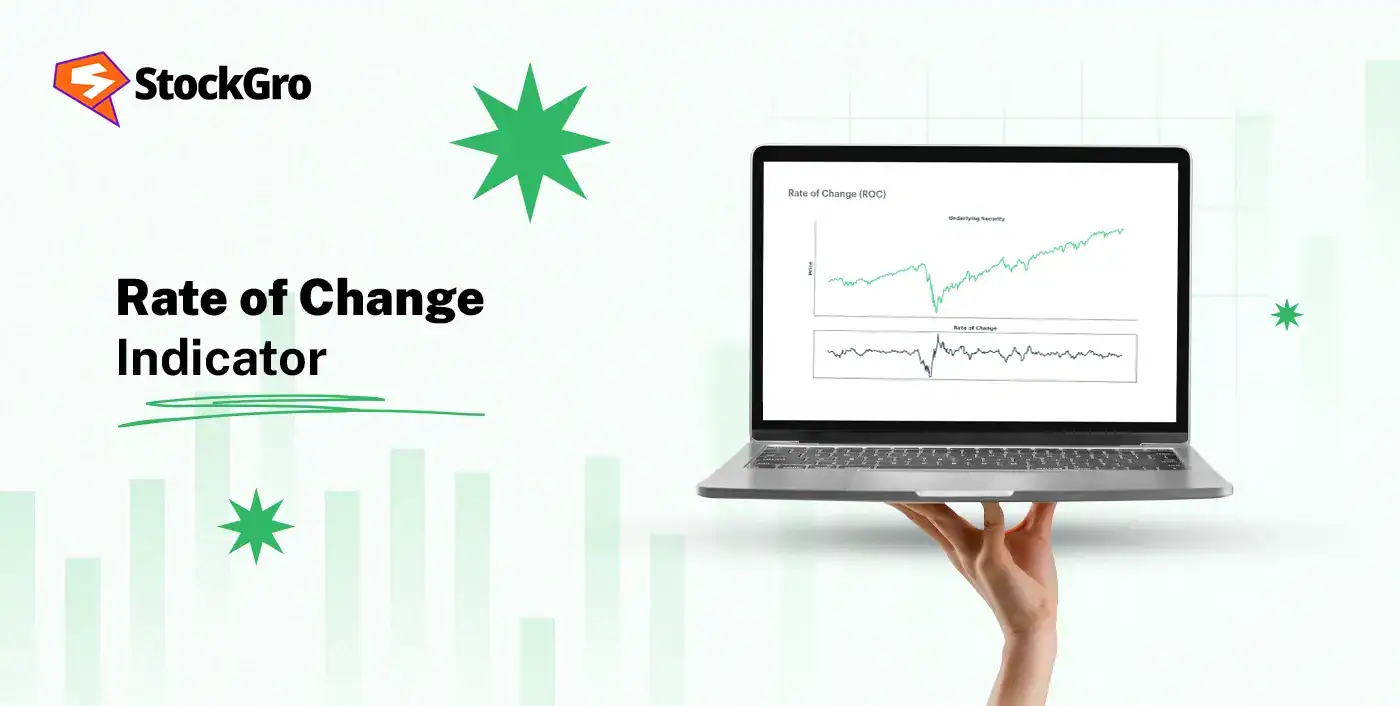
The rate of change (ROC) is a technical analysis tool classified as a momentum oscillator, which measures the percentage change in price between the current price and the price a certain number of periods ago. Unlike trend indicators that smooth out data, the ROC focuses purely on the speed of the trend. It oscillates around a zero line, with positive values indicating upward momentum and negative values suggesting downward pressure.
How Rate of Change Indicator Works
The mechanism of this momentum oscillator can be understood through its primary functions as follows:
- Momentum measurement: It compares the current closing price to a specific closing price from the past, typically defined by the user (e.g., 12 periods).
- Zero-line oscillation: The value fluctuates above and below a central zero line; movements above zero suggest bullish momentum, while those below indicate bearish momentum.
- Speed identification: The steeper the slope of the ROC line, the faster the price is changing in that direction, acting as a speedometer for the market.
- Trend confirmation: Sustained values in positive or negative territory confirm the durability of the current trend direction.
- Reversal signals: Extreme readings far from the zero line often suggest that the market is overextended (overbought or oversold) and may be due for a pause or reversal.
ROC Indicator Formula & Calculation
The Rate of Change (ROC) is calculated using a basic percentage change equation that compares the current price with the price from a selected past period.
ROC Formula:
ROC = (Current Closing Price − Closing Price n periods ago) / Closing Price n periods ago × 100
Where:
- Current Closing Price is the latest closing price.
- Closing Price n periods ago is the closing price from n periods earlier.
- n is the chosen lookback period, commonly 12 or 14.
Example:
A stock is trading at ₹2,500 today. To calculate the 10-day ROC, look at the closing price from 10 days earlier, which was ₹2,400.
- Step 1: Subtract the past price from the current price (2500 − 2400 = 100).
- Step 2: Divide this difference by the past price (100 / 2400 = 0.0416).
- Step 3: Multiply the result by 100 (0.0416 × 100 = 4.16).
The ROC value is 4.16, indicating the price has risen by 4.16% over the last 10 days.
Best ROC Settings for Intraday & Swing Trading
Selecting the correct lookback period is essential for aligning the indicator with specific trading goals and time horizons. Standard settings used by traders for intraday and swing trading include:
- Intraday scalping (n = 9): A 9-period setting offers high sensitivity, allowing intraday traders to capture short-term price bursts on 5 or 15-minute charts.
- Intraday trending (n = 14): This standard setting helps filter out minor market noise, providing a clearer view of the trend for day trading.
- Swing trading (n = 12 or 21): A 12 or 21-period ROC is preferred for swing trading on daily charts to identify multi-day momentum shifts.
- Long-term analysis (n = 200): For positional trading or investment analysis, a 200-period setting smooths out data to reveal major market cycles.
- Volatility adjustment: In highly volatile markets, increasing the period (e.g., to 25) can help reduce false signals and “whipsaws.”
How to Read ROC Indicator Signals
The primary methods for reading these technical signals are as follows:
- Zero-line crossover: A move from below zero to above zero signals a buying opportunity, while a move from above to below signals a selling opportunity.
- Positive territory: When the ROC is positive, it indicates that prices are higher than they were n periods ago, suggesting bullish sentiment.
- Negative territory: Values below zero indicate that prices are lower than they were in the past period, suggesting bearish sentiment.
- Overbought zones: If the ROC reaches a historically high level (e.g., +15 or higher, depending on the asset), the asset may be overbought.
- Oversold zones: Conversely, an extremely low reading (e.g., -15) suggests the asset is oversold, and a bounce might occur.
- Momentum slowdown: If the price is rising but the ROC line starts to flatten or drop while still above zero, the uptrend is losing speed.
ROC Crossover Strategy
The zero-line crossover is the fundamental signal used by traders to identify shifts in market momentum, acting as a primary trigger for entering or exiting positions. A bullish signal is generated when the ROC line crosses from below to above the zero line, indicating that the asset’s price is now higher than it was n periods ago and that upward velocity is increasing. Conversely, a bearish signal occurs when the line crosses from positive to negative territory, suggesting that selling pressure is accelerating and the trend may be turning downward.
For example, if the 14-day ROC for Reliance Industries is hovering at -2.00 and then crosses up to +0.50 while the stock price is ₹2,400, a trader might interpret this as a confirmation of a new uptrend and consider a long position. To avoid false alarms in choppy markets, it is common practice to wait for the daily candle to close, confirming the crossover before executing the trade.
ROC Divergence Strategy
Divergence analysis serves as an early warning system for potential trend reversals by highlighting discrepancies between price action and momentum. This phenomenon occurs when the price of an asset continues to move in one direction while the ROC indicator moves in the opposite direction, signalling that the current trend is losing strength. A bullish divergence appears when a stock makes a lower low on the chart, but the ROC makes a higher low, indicating that sellers are losing power even though the price is dropping. A bearish divergence is identified when the price hits a higher high, but the ROC peaks at a lower high, suggesting that buying enthusiasm is waning.
For example, if the Nifty 50 index climbs to a new high of 25,000 but the ROC indicator fails to surpass its previous peak and begins to slope downwards, a trader might view this as a signal to tighten stop-losses or prepare for a potential market correction.
ROC + RSI Strategy for Accuracy
Combining the rate of change indicator with the Relative Strength Index (RSI) creates a dual-momentum system that enhances signal reliability. The RSI indicator measures the magnitude of recent price changes to evaluate overbought or oversold conditions, while the ROC measures the velocity of the change.
In this strategy, a trader might wait for the RSI to exit an oversold zone (crossing above 30) while simultaneously looking for the ROC to cross above the zero line. This ensures that not only is the asset recovering from a low point, but the momentum behind the move is also accelerating, reducing the likelihood of entering a false breakout.
ROC + MACD Strategy for Trend Confirmation
Using the ROC alongside the Moving Average Convergence Divergence (MACD) helps traders distinguish between strong trends and weak fluctuations. The MACD provides trend direction and momentum through its signal lines and histogram, while the ROC adds a layer of velocity measurement.
A strong setup involves waiting for the MACD line to cross above its signal line (a bullish crossover) and confirming this with the ROC rising above zero. If the MACD signals a buy but the ROC remains flat or negative, it indicates a lack of momentum, prompting traders to avoid the trade until both indicators align.
ROC for Intraday Trading (With Chart Example)
Intraday traders generally use the ROC indicator with a shorter setting, such as 9 periods, to identify rapid momentum shifts within a single trading session.
A core strategy involves observing the zero-line crossover, where a move from negative to positive territory signals increasing buying pressure. This concept is shown in the chart of Persistent Systems Limited (NSE), currently trading at ₹6,463.00. In early October, the ROC (9) line crossed sharply above the zero line, marking a shift in momentum that preceded a significant price rally from approximately ₹5,000.
As of early December, the indicator reads 2.64, suggesting that positive velocity remains intact. While this specific example displays a daily view, intraday traders apply this exact logic to 5-minute or 15-minute charts to capture quick price bursts and exit before the market closes.

ROC for Swing & Positional Trading
For traders holding positions over days or weeks, the ROC acts as a filter to ascertain the sustainability of a move. Swing trading strategies typically use a longer lookback period, such as 21 or 50, to smooth out daily volatility and focus on the primary trend. The strategy involves entering when the longer-term ROC crosses the zero line and holding the position as long as the indicator remains on the correct side of the line.
For positional traders, checking the ROC on a weekly timeframe helps identify major cycle shifts, ensuring they stay in profitable trends while avoiding the noise of daily market fluctuations.
Ideal Timeframe & Settings for ROC Indicator
Recommended timeframe for trading styles is as follows:
- Short-term (5-15 min): A 9 to 12-period ROC helps intraday traders spot rapid momentum shifts suitable for quick scalp trades.
- Medium-term (1 hour – Daily): A 14 to 21-period ROC is standard for swing traders, offering a balance between signal frequency and reliability.
- Long-term (Weekly): A 26 or 52-period ROC is useful for investors analysing yearly trends or broader economic cycles.
- Asset specific: Volatile stocks often require longer settings to smooth out noise, while stable indices may work well with shorter settings.
Common Mistakes While Using ROC Indicator
Traders often encounter performance issues when they misinterpret the signals or use the tool in isolation. Frequent errors observed in the application of this indicator include:
- Ignoring trend: Taking a zero-line crossover signal against a strong prevailing trend often results in failed trades.
- Premature entries: Acting on divergence signals immediately without waiting for price confirmation can lead to entering too early.
- Lack of context: Using the ROC without support from volume data or other technical indicators reduces the probability of success.
- Over-optimisation: Constantly changing the “n” period to fit past data perfectly can lead to curve-fitting and poor real-time performance.
Pros & Cons of Rate of Change Indicator
While the ROC is a useful tool for measuring market speed, it possesses distinct characteristics that can be both advantageous and limiting depending on market conditions. The main advantages and disadvantages associated with using this momentum oscillator are as follows:
Pros
- Pure momentum measurement: It calculates the raw percentage change in price, offering a direct view of market velocity without the lag often found in moving averages.
- Trend strength confirmation: The indicator validates the durability of a trend; as long as the ROC remains consistently positive or negative, the trend is considered intact.
- Versatility: It is effective across various financial instruments, including Indian equities (stocks like HDFC Bank), commodities (Gold), and futures contracts.
- Divergence detection: It excels at spotting subtle shifts in internal momentum before they become apparent in the actual price action.
Cons
- Whipsaw susceptibility: In sideways or consolidating markets, the ROC line often fluctuates wildly around zero, generating frequent false buy and sell signals.
- Lack of timing precision: Although it indicates the speed of a move, it does not predict the duration of the trend, which can lead to premature exits.
- Calculation lag: Since the formula relies on a fixed lookback period (e.g., 12 days ago), sudden volatility from the past can distort current readings even if the market is currently calm.
- No fixed boundaries: Unlike the RSI, which is bound between 0 and 100, the ROC has no upper or lower limits, making “overbought” levels harder to define standardly.
ROC vs RSI vs MACD (Comparison Table)
Now, let’s look at this detailed technical indicators comparison between ROC, RSI, and MACD:
| Feature | Rate of change (ROC) | Relative strength index (RSI) | Moving average convergence divergence (MACD) |
| Type | Pure Momentum Oscillator | Momentum Oscillator (Bounded) | Trend-Following Momentum Oscillator |
| Primary measurement | Velocity of price change | Magnitude of recent gains vs. losses | Relationship between two moving averages |
| Value range | Unbounded (No fixed limits) | Bounded (0 to 100) | Unbounded (Centered around zero) |
| Key signal | Zero-line crossover | Overbought (>70) / Oversold (<30) | Signal line crossover & Histogram |
| Best used for | Measuring trend speed | Spotting reversal zones | Confirming trend direction |
Best ROC Stock Screener Tools
To effectively identify trading opportunities using the Rate of Change, traders use stock screener platforms that allow for filtering stocks based on momentum and volatility criteria.
For example, Stoxo by StockGro.This is India’s first AI-powered stock research engine that allows users to perform complex screening using simple natural language queries. Instead of manually setting filters for the Rate of Change, users can type prompts like “Show me stocks with a rising Rate of Change and strong bullish momentum” or “List IT stocks with a high ROC and positive sentiment”.
It aggregates real-time data, technical patterns, and SEBI-registered analyst insights to provide immediate, actionable stock lists, effectively replacing the need for traditional, complex query coding. By combining behavioural data from over 35 million users with live market feeds, it identifies high-velocity setups that might be missed by standard static screeners.
Apart from Stoxo, other helpful platforms widely used for technical screening include Chartink, TradingView, Trendlyne, and Tickertape.
Conclusion
Tracking the speed of price movements is essential for understanding market trends. The rate of change indicator acts as a simple speedometer to measure this strength. While it helps identify if a trend is speeding up or slowing down, it works best when paired with other tools to confirm the full market picture.
FAQ‘s
The ROC is a momentum oscillator measuring the percentage price change between the current price and a prior period. It shows trend speed and momentum by oscillating around zero, with positive values indicating upward momentum and negative for downward pressure.
ROC’s best timeframe depends on trading style: intraday traders use 9-12 periods on 5-15-minute charts, swing traders prefer 14-21 periods on daily charts, and long-term investors look at 26-52 weeks to identify major cycle trends and smooth noise effectively.
ROC is calculated by using this formula:
ROC = [(Current Closing Price – Closing Price n periods ago) / Closing Price n periods ago] × 100
This yields the percentage change over the specified period, quantifying momentum relative to a past price point.
Yes. Shorter ROC periods work well intraday for spotting rapid momentum shifts. Longer periods filter volatility for swing trading, helping confirm trend strength and reversals over several days or weeks, making ROC versatile across trading horizons.
Use 9 periods for intraday scalping and 14 periods for day trading. For swing trading, 12 to 21 periods smooth momentum signals. Volatile assets may require longer lookbacks (up to 25 or more) to reduce false signals.
ROC measures pure momentum velocity with zero-line crossovers, while RSI measures overbought/oversold zones (bounded 0-100), and MACD tracks moving average convergence. Each complements the other; none is universally better, but ROC excels in speed measurement and divergence detection.
Buy when ROC crosses from below zero to above zero, signaling rising price momentum. Sell when ROC dips from above zero to below zero, indicating accelerating selling pressure. Confirm signals with volume and price action to avoid false breakouts.