The stock price chart leaves its mark in terms of price movement, trade volume, and market sentiment. Commodities, in particular, tell their own stories, influenced by global events and domestic demand.
While the question is: Which commodity is best for trading in India? The participants are more focused on where momentum, liquidity, and price certainty are building. From the consistent appeal of gold to crude oil swing, each commodity behaves differently, and the traders read these movements through patterns and trends.
In the following sections, we will discuss which commodity is best for trading in India, the factors that influence selection, and how market conditions shift the advantage from one asset to another.
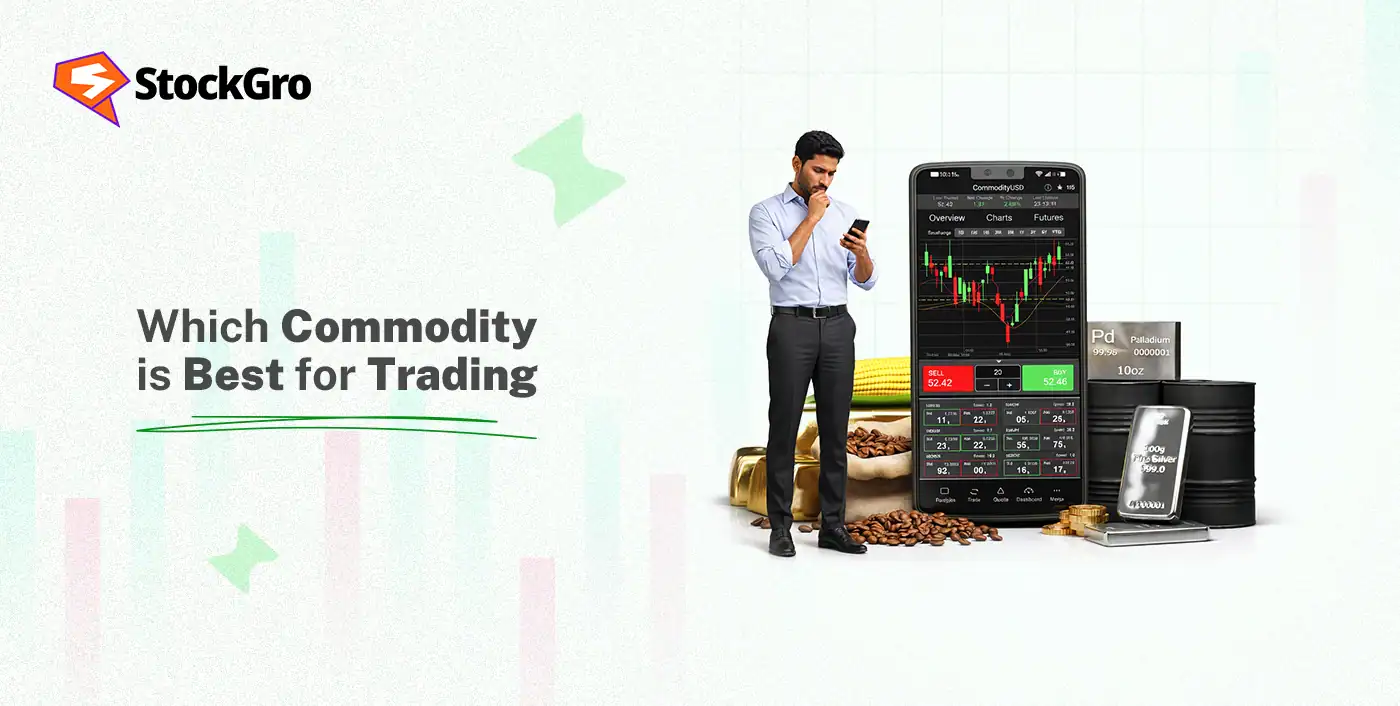
Which Commodity is Best for Trading?
In India, commodity trading shifts with market conditions, trader intent, and the strength of price trends. The best commodities for trading in India, as of 2026, include gold, crude oil, silver, natural gas, and agricultural commodities.
However, the most suitable choice is the one that presents directional strength, liquidity, and a pattern that can be consistently interpreted through technical analysis.
Factors to Choose the Best Commodity for Trading
The following factors explain the drivers of commodity price movement:
- Demand and supply: Commodity prices are influenced by imbalances between production and consumption levels across global and domestic markets.
- Global economic conditions: Economic expansion or slowdown directly impacts demand for industrial and energy commodities, influencing their overall price direction.
- Geopolitical developments: Events such as conflicts or trade restrictions can disrupt supply chains, especially for commodities like crude oil and metals.
- Government policies and regulations: The import-export rules, taxes, and policy interventions can significantly affect the price behaviour of commodities, particularly in agricultural markets.
Most Popular Commodities for Trading
As of April 2026, the overall commodity markets are experiencing high volatility driven by geopolitical tensions in the Middle East, with significant price movements observed on the Multi-Commodity Exchange of India (MCX).
Gold Trading
Gold futures have been showing significant activity, with June 2026 delivery contracts rising due to safe-haven demand amidst Middle East conflicts.
In April 2026, gold remained firm, trading near ₹1.53 lakh per 10 grams on MCX on Friday, 17 April, with prices marking multiple weekly gains supported by a weaker US dollar and easing geopolitical tensions.
Looking ahead to 2026, gold is expected to stay range-bound with upward bias, supported by central bank demand and inflation hedging. However, the upside may moderate if global tensions ease.
Crude Oil Trading
Crude oil has seen significant swings this year, recently cooling below the earlier highs of $120/barrel, as ceasefire talks and easing Middle East tensions reduced supply concerns.
For 2026, oil is expected to remain volatile, with prices influenced by demand slowdown warnings and OPEC+ supply actions, creating both upside and downside trading opportunities.
The key crude oil price drivers include geopolitical risk, global demand outlook, inventory data, and supply disruptions around critical routes like the Strait of Hormuz.
Silver Trading
In the recent sessions, silver has outperformed, rising by ₹1,458 to 0.5% on MCX, as of 17 April 2026, tracking gold’s rally but with stronger percentage gains due to higher volatility.
The 2026 outlook stays constructive, with expectations of continued strength driven by both investment demand and structural supply deficits in global markets.
Its movement is influenced by gold trends, industrial demand, dollar weakness, and long-term supply shortages, which make it attractive for momentum-based trades.
Natural Gas Trading
As of 17 April 2026, natural gas is trading near ₹248.50/MMBtu on MCX (IST 11:55 AM), reflecting a relatively range-bound movement despite intermittent spikes driven by supply concerns. On 16 April 2026, global LNG prices remained elevated in the $18/MMBtu to $20/MMBtu range due to Middle East disruptions, indicating a tight but uneven supply environment.
Looking ahead into 2026, while supply disruptions and geopolitical risks may support prices in phases, a well-supplied global market and policy-driven shifts toward piped gas expansion in India could keep prices volatile rather than strongly trending.
The key factors influencing natural gas include LNG supply disruptions, geopolitical tensions in West Asia, domestic policy push toward PNG infrastructure, and seasonal demand shifts.
Agricultural Commodity Trading
Agricultural commodities have shown stable but uneven performance, influenced by food inflation trends, which rose to around 3.40% in March 2026 from 3.21% in February 2026, indicating gradual price pressure building in the segment.
The 2026 outlook depends heavily on monsoon expectations and supply conditions, with potential volatility if weather disruptions affect crop output.
The primary drivers include rainfall patterns, government policies, export-import decisions, and seasonal harvest cycles, making timing critical in these trades.
Best Commodity for Beginners
Now, let us shift our focus to commodities that offer simplicity, stability, and easier learning curves for new traders entering the market.
Gold and silver usually stand out for the beginners due to their relatively stable price behaviour, strong liquidity, and safe-haven nature.
Silver adds slightly higher volatility while providing learning opportunities without extreme risk. Crude oil and natural gas provide sharp price swings and might feel overwhelming in the initial stage.
Additionally, agricultural commodities, though seasonal, can help beginners grasp how real-world factors influence price action.
Commodity Trading Based on Market Conditions
Commodity trading works in alignment with macroeconomic conditions. During the high inflation phases, metals and energy commodities tend to rise. Meanwhile, geopolitical instability can disrupt supply, lifting prices of oil and gold. Agricultural commodities, on the other hand, respond to weather changes, where disruptions in crop output can trigger sudden price movements.
Tips to Select the Right Commodity
With multiple commodities reacting differently to market forces, the selection process often revolves around aligning price behaviour with observable market signals and trading conditions. Proper commodity trading strategies need to get profitable trading.
- Trend alignment: Commodities that display sustained directional movement tend to reflect clear and consistent price behaviour over a period of time.
- Liquidity check: Commodities with higher trading volume are generally associated with smooth price movement and relatively efficient trade execution.
- Volatility awareness: Different commodities exhibit varying levels of price fluctuation, which influences how frequently prices change.
- Market trigger tracking: Commodity prices often respond to factors such as inflation trends, geopolitical developments, and shifts in demand cycles.
- Seasonal understanding: Agricultural commodities follow time-based patterns that are influenced by crop cycles, weather conditions, and supply changes.
Final thoughts
Commodity trading shifts with the rhythm of the market. At times, gold steadies the landscape, while at others, crude oil or silver takes the lead with sharper moves. The advantage lies in observing how price behaves under changing conditions and recognising when a commodity begins to move with intent rather than noise.
FAQs
The returns or profits from commodity trading depend on market conditions, volatility, and timing. Commodities such as crude oil and natural gas often show significant price movements, which can create higher profit potential in shorter periods, while gold and silver tend to offer more gradual price trends.
Gold is one of the most actively traded commodities due to its liquidity and response to global factors, such as inflation and currency movement. However, it may not always be the best choice, as its price behaviour can become range-bound during stable economic phases, limiting short-term trading opportunities.
In relative terms, gold and silver are considered more stable compared to other commodities. Their price movements tend to be less volatile, especially during uncertain economic conditions. However, no commodity is entirely risk-free, as all are influenced by external factors and market sentiment.
Gold and crude oil generally have the highest liquidity in the commodity market, particularly on exchanges like MCX. The high liquidity ensures tighter bid-ask spreads and smoother trade execution, making these commodities widely tracked and actively traded across different market conditions.