For many investors, the investment journey typically begins with equities or SIPs, but stability becomes a priority with time. This is where bonds come into effect, offering a structured entry into bond market basics.
If you are learning how to invest in bonds as a beginner, the idea is not just about earning fixed returns, but about building balance within your portfolio. Unlike market-linked instruments, the return from bonds is more predictable, which makes them relevant for income-focused investors.
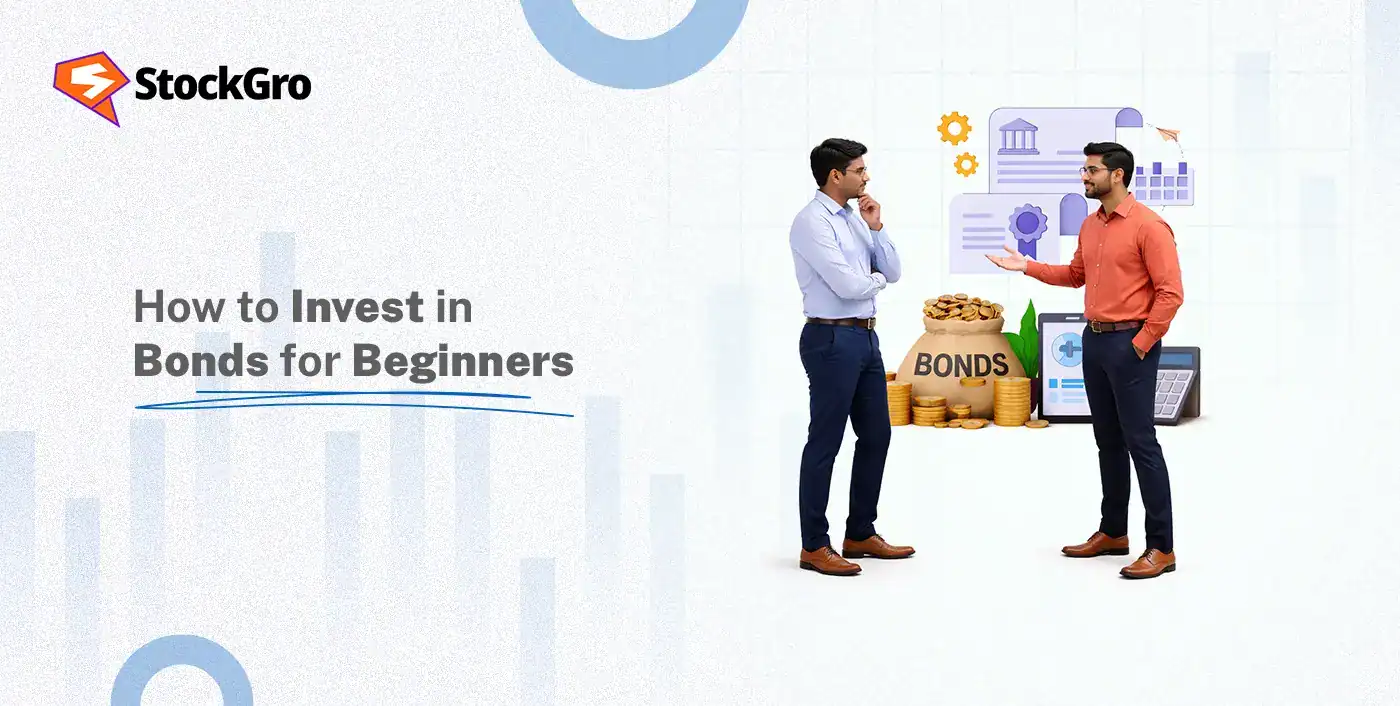
For this, the blog breaks down “How to invest in bonds for beginners?” from understanding types of bond to the investment process, while addressing risks, returns, and common mistakes that beginners might overlook.
What Are Bonds?
A bond is a fixed-income debt instrument, available through brokerage platforms or stock exchanges, in which an individual/investor lends money to the government or a company for a defined period at a predetermined rate of interest, say 9% per annum. In exchange, the issuer commits to making periodic interest payments and returning the invested amount to the investor upon maturity.
Organisations such as corporations, municipalities, state bodies, and central governments issue bonds to raise funds for projects and operational requirements. Each bond carries specific terms, including its maturity date, when the principal is repaid, along with details on whether the interest payments are fixed or may vary over time.
Types of Bonds for Beginners:
Understanding the types of bonds before allocating your capital to debt assets brings clarity, as each category differs in issuer strength, return structure, and taxation. The sections below explain how each works within the Indian market framework.
Government Bonds
Government bonds are issued by both the central and state governments to raise funds for their fiscal requirements. As outlined by the Reserve Bank of India, these securities are available across a wide maturity range, from short-term treasury bills to long-dated bonds extending up to 40 years.
The bond yield are influenced by existing market rates and the overall economic conditions of a country. For instance, the benchmark 6.48% 2035 bond yield moved close to the 6.9% range, with fluctuations driven by factors such as oil price volatility, geopolitical tensions, and large government borrowing programmes.
Corporate Bonds
Corporate bonds represent borrowings by companies from investors, structured through periodic interest payouts and repayment at maturity, with some variants allowing conversion into equity under defined conditions. Unlike government bonds, returns reflect the issuer’s credit strength and market conditions.
Corporate bonds in India offer higher yields compared to the government ones, which reflects credit risk and market conditions. As of 7 July 2025, AAA-rated short-term corporate bonds (2–3 years) yield were around 6.56% to 6.70%, with spreads of 75–85 basis points over government bonds.
Tax Free Bonds
Tax-free bonds are long-term debt instruments issued by government-backed entities like NHAI, PFC, and IRFC. The interest earned on these bonds is exempt from income tax, which improves the effective returns, particularly for investors in higher tax brackets. These bonds generally carry maturities of 10–15 years and are traded on exchanges such as NSE and BSE. However, since 2016, the market has not witnessed any new issuances of tax-free bonds, leaving investors to rely on previously issued securities.
For instance, NHAI tax-free bonds carried coupons of 7.34% to 8.75%, though current yields might be lower due to price premiums. Additionally, newer structures like Power Finance Corporation zero-coupon bonds offer 6.85% to 6.95% yields, with taxation applied as capital gains rather than interest, improving post-tax returns.
Step-by-Step Process to Invest in Bonds:
The following steps outline practical routes through which individuals can access bonds directly or indirectly, especially for first-time participants entering the fixed income market.
Open a Demat and Trading Account
To begin investing in bonds, you need to set up a demat and trading account with a registered broker, which allows you to hold and transact securities in electronic form. While the demat account serves as a digital repository for securities, the trading account enables their purchase and sale in the market. With this, the KYC verification, bank linkage, and basic documentation complete the onboarding process efficiently.
Buy Bonds Through the Exchange
You can purchase listed bonds directly through stock exchanges such as NSE or BSE, similar to equity transactions. These include government securities and corporate bonds available in the secondary market.
Bond prices tend to change with movements in interest rates and market demand, which in turn influences the overall yield. The bonds must be evaluated based on credit ratings, liquidity, and maturity before executing trades on the platform.
Invest Through Bond Mutual Funds
If you prefer diversification and professional management, bond mutual funds offer an indirect route. These funds accumulate capital from investors to allocate across various fixed income securities, including government and corporate bonds.
This approach reduces issuer-specific risk while allowing easier entry without requiring detailed bond-level analysis.
Risks and Returns in Bond Investment:
While, bonds offer predictable cash flows through scheduled interest payments and repayment of capital at maturity. However, the returns or coupon rates are linked to the existing market. When the rates rise, bond prices tend to fall, affecting market value for those exiting before maturity. This is called interest rate risk.
Credit risk also plays a role, particularly in corporate bonds, where weaker issuers may face repayment challenges. At the same time, higher risk often translates into higher yields, reflecting the risk vs return trade-off.
Liquidity risk may affect returns, as certain bonds can be difficult to buy or sell easily in the secondary market. In essence, while bonds offer relative stability compared to equities, their returns are sensitive to economic conditions and issuer reliability.
How to Choose Safe Bonds?
Choosing safe bonds involves prioritising high credit ratings (AAA or AA), focusing on government or top-tier corporate issuers, and matching bond maturity to your investment horizon.
Here is a guide to selecting safe bonds:
- Credit rating: Check whether the bond carries a high credit rating, such as AAA or AA, as this reflects stronger repayment capacity and lowers default risk.
- Issuer quality: Assess the credibility of the issuer, giving preference to government securities or financially stable public sector entities over weaker private issuers.
- Interest structure: Understand whether the bond offers fixed or floating interest, as this determines the stability and predictability of your income.
- Maturity alignment: Choosing bonds that match your investment horizon helps avoid losses from interest rate fluctuations in the secondary market.
- Liquidity consideration: Bonds listed on exchanges such as the NSE or the BSE are easier to buy and sell when required.
Common Mistakes Beginners Should Avoid:
Avoiding early missteps in bond investing is often more important than chasing the highest returns, as small oversights can materially affect long-term outcomes.
- Ignoring credit quality: Many beginners focus only on interest rates and overlook the issuer’s credit rating, which increases the risk of default or delayed payments.
- Chasing high yields: Higher yields might signal higher risk, especially in lower-rated corporate bonds, which may not align with conservative investment goals.
- Overlooking interest rate cycles: Entering long-term bonds during rising rate environments can lead to mark-to-market losses if sold before maturity.
- Lack of diversification: An over-concentration in a single issuer or bond segment can expose the portfolio to avoidable risk.
- Ignoring liquidity: Some bonds may have low trading volumes, which makes them difficult to exit without compromising on price.
Summary
Bond investing offers a way to earn a stable income while maintaining relative safety compared to equities. By understanding bond types, evaluating issuer strength, and aligning maturity with financial goals, investors can build a balanced portfolio.
However, risks such as interest rate changes, credit quality, and liquidity must be considered carefully. Therefore, an informed approach will rather play the key role in delivering consistent investment outcomes.
FAQs
The minimum investment in bonds varies depending on the type and platform. Exchange-listed bonds in India can often be purchased in small denominations, say around ₹1,000. However, certain corporate or primary issuances may require higher minimum amounts, depending on the issuer and structure of the bond offering.
Bonds are generally considered safer than stocks because they offer fixed income and priority in repayment over equity investors. However, they are not entirely risk-free. Government bonds carry minimal default risk, while corporate bonds depend on the issuer’s financial strength. Interest rate movements can also affect bond prices in the market.
Bonds generate returns primarily through periodic interest payments, known as coupons, and the repayment of principal at maturity. Additionally, investors may benefit from capital gains if bond prices rise in the secondary market due to falling interest rates or improved credit perception of the issuer.
Yes, beginners can buy bonds online through registered brokerage platforms that offer access to bond markets. With a demat and trading account, investors can purchase government and corporate bonds listed on exchanges, or invest indirectly through bond mutual funds using online investment platforms.
Government bonds, also known as Government Securities, are considered the safest in India due to sovereign backing. Bonds issued by financially strong public sector undertakings and highly rated corporations also offer relatively low risk. However, investors should always review credit ratings and issuer credibility before investing.