Summary
You should report F&O losses in your ITR to preserve carry-forward benefits and maintain compliance with income tax provisions.
Skipping the disclosure of F&O losses can result in the loss of tax benefits and may lead to inconsistencies in your tax records.
Filing the correct ITR form, reporting F&O income as business income, and following the applicable tax rules help you avoid the common filing mistakes.
Is it Mandatory to Show F&O Loss in ITR?
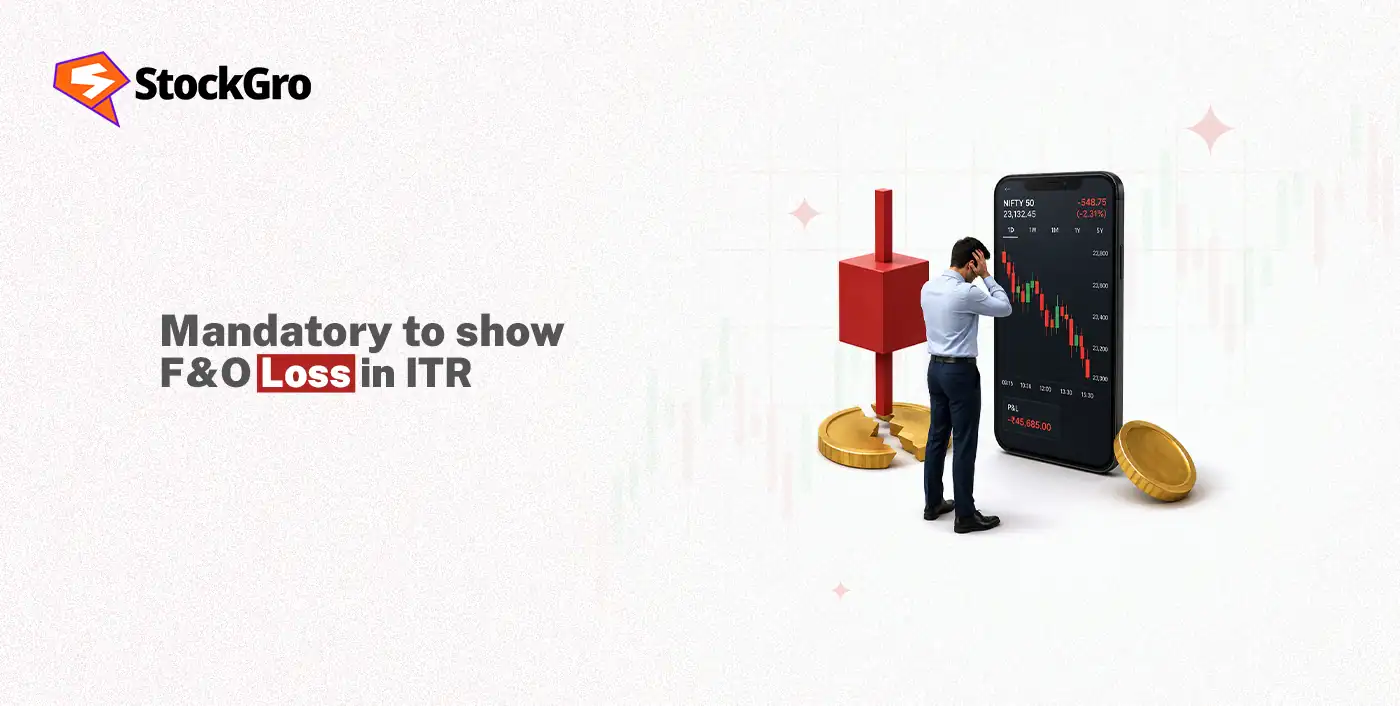
Yes, you must report a loss from Futures and Options (F&O) trading in your Income Tax Return, or ITR.
Since F&O trading is treated as a non-speculative business under ITA Section 43(5), the loss is considered a business loss. Therefore, you have to report it to carry the loss forward and claim set-off against future business income, provided that the return is filed before or on the due date, using ITR 3 for traders.
Consequences of Not Reporting F&O Loss
If you do not report an F&O loss in your ITR, it can create several disadvantages, which are as follows:
- Loss cannot be carried forward:
If the loss is not reported in a properly filed ITR within the prescribed due date, you may lose the benefit of carrying it forward to future years.
- Future tax-saving opportunity is lost:
F&O losses can be adjusted against eligible future business profits. If you don’t report the loss, it means you may end up paying higher taxes in profitable years. Understanding the tax implications of trading can help you avoid such situations.
- Income-tax records may become inconsistent:
The broker statements, AIS/TIS records, and exchange data show F&O transactions even if they are not reflected in your return. This can lead to notices or requests for clarification.
- No tax-payable does not mean no reporting:
Some traders might think that a loss need not be reported because there is no tax payable, which is also a common mistake. Reporting the loss could be beneficial for preserving future tax benefits.
Speculative vs Non-Speculative Income Explained
The table below discusses how speculative income varies from non-speculative income:
| Feature | Speculative Income | Non-Speculative Income |
| Definition | This refers to the earnings from activities with no actual delivery or transfer of the underlying asset. | This refers to the earnings from regular business operations, or trades settled with actual delivery. |
| Primary Example | Intraday equity trading. | Delivery-based shares, F&O trading, and physical goods businesses. |
| Loss Offset Rules | As per section 71 of Income Tax Act, the speculative losses can only be set off against speculative profits. | Non-speculative business losses, on the other hand, can be set off against any other income head (except salary). |
| Carry Forward Period | As per Section 72 of the Income Tax Act, unadjusted speculative losses can be carried forward for 4 years only. | While unadjusted non-speculative losses can be carried forward for up to 8 years. |
| Filing Requirement | Speculation business losses must be reported in the appropriate ITR and filed within the due date to claim carry forward. | Non-speculative business losses, including eligible F&O losses, must also be reported in the appropriate ITR and filed within the due date to claim carry forward. |
Why Reporting F&O Loss Is Important for Traders?
Reporting an F&O loss is more than just meeting a tax requirement, but also preserving valuable tax benefits that help traders in building a more organised financial record for future decisions.
Carry Forward and Set-Off Benefits
By reporting an eligible F&O loss in your Income Tax Return within the due date, you preserve the right to carry forward and set off the loss against eligible future business profits up to eight years, subject to the provisions of the Income-tax Act, 1961. This allows profitable years to benefit from losses incurred earlier.
Better Tax Planning for Active Traders
Every trade contributes to your financial record, whether it results in a profit or a loss. When you report F&O losses, it creates a complete history of your trading activity, which helps you in estimating future tax liability, organising your finances more effectively, and making informed decisions as your trading journey progresses.
Common Mistakes Traders Make While Filing ITR for F&O
Here are the mistakes and how you can avoid or fix them:
| Point | Mistake | How to Fix It? |
| Using the Wrong ITR Form | Filing the wrong ITR form for F&O income. | Report eligible F&O trading as business income using the appropriate ITR form, such as ITR-3 for individual traders. |
| Reporting F&O as Capital Gains | Treating F&O profits or losses as capital gains. | Report eligible F&O transactions under Profits and Gains from Business or Profession (PGBP). |
| Incorrect Turnover Calculation | Calculating turnover using only net profit or loss. | Compute F&O turnover using the prescribed method to determine tax audit applicability correctly. |
| Ignoring Eligible Business Expenses | Not claiming expenses incurred for trading activities. | Claim eligible expenses such as brokerage, internet charges, and trading software costs with proper records. |
| Incorrect Loss Reporting | Setting off losses incorrectly or missing the filing deadline. | Report eligible F&O trading as business income using the appropriate ITR form, such as ITR 3 for traders. |
| Ignoring AIS Reconciliation | Filing the ITR without matching broker statements with AIS and Form 26AS. | Reconcile all trading and income details before filing to avoid reporting mismatches. |
| Overlooking Tax Audit Rules | Missing tax audit requirements due to incorrect turnover assessment. | Check whether a tax audit applies and complete all compliance within the prescribed deadlines. |
How Beginners Can Learn Trading & Taxation Without Risk?
Beginners can develop trading skills and understand taxation by following the steps below:
| Step 1: | Learn the Basics | Start by understanding how the stock market works, equity and F&O, and the risks involved in trading. |
| Step 2: | Practise with Virtual Trading | Use a paper trading or virtual trading platform to place simulated trades and understand market movements without risking real money. |
| Step 3: | Maintain a Trading Record | Record every simulated trade to learn how profits, losses, and trading performance are calculated over time. |
| Step 4: | Learn Basic Tax Rules | Understand how trading income is classified, how profits and losses are reported, and when ITR 3 for traders is applicable. |
| Step 5: | Start Small with Real Trading | Once you are confident, begin trading with a small amount of capital while continuing to follow disciplined trading and tax reporting practices. |
Final Thoughts
Reporting an F&O loss in your Income Tax Return is an important part of tax compliance and financial planning. It helps you use the tax benefits and maintain a complete trading record.
If you are a trader or just starting out, knowing the tax rules and filing your ITR correctly can help you avoid problems and make smart trading decisions.
FAQs
Yes, filing your ITR is advisable even if you have only incurred F&O losses. When you report the loss, it helps you in preserving your eligibility to carry it forward and claim set-off against eligible future business income.
Yes, the eligible F&O losses are treated as non-speculative business losses and can generally be carried forward for up to eight assessment years, provided the Income Tax Return is filed on time.
While a tax audit is not required solely because you have incurred an F&O loss. The requirement depends on factors such as your turnover, declared profits, and the applicable provisions of the Income-tax Act.
If you do not report an F&O loss, you are not entitled to carry the loss forward and set it off against eligible future business profits. It may also result in inconsistencies between your ITR and tax records maintained by the Income Tax Department.
Individual traders generally report eligible F&O income under ITR-3, as it is treated as business income. The appropriate ITR form may vary depending on the taxpayer’s status and the nature of the business.
Yes, beginners can understand F&O taxation by learning the basic tax rules, maintaining proper trading records, and practising with virtual trading before entering the live market.