Speed is part of the appeal. The commodity market does not wait, and for intraday traders, that urgency is a feature rather than a flaw. Positions open and close within a single session. No overnight uncertainty, no waking up to a gap that erased last week’s gains. Done well, it is one of the cleaner formats in active trading. This guide covers the mechanics, the strategies, and the common mistakes you should avoid.
What Is Commodity Intraday Trading?
Commodity intraday trading is the practice of buying and selling commodity futures contracts within the same session. Every position is squared off before the market closes. Nothing carries into the next day.
In India, this activity is centred on the Multi-Commodity Exchange (MCX), which operates under the Securities and Exchange Board of India (SEBI) regulations.
Traders work with derivative contracts across gold, silver, crude oil, and natural gas. The objective is to capture price movement during the session itself, not to take a view on where prices head over weeks or months.
How Commodity Intraday Trading Works
The mechanics of intraday commodity trading are straightforward once you understand what happens at each stage.
- Trading Hours
On the MCX, agricultural commodities can be traded from 9:00 AM IST to 5:00 PM IST. The session for non-agri commodities runs until 11:30 PM IST. This window comfortably covers both domestic market activity and overlaps with international sessions. - Order Placement
Once a setup is identified, an order is placed through a SEBI-registered broker’s platform using a derivative – commodity options or commodity futures. The entry point, stop-loss, and target are ideally decided before the order goes in, not after. - Position Monitoring
After entry, the trade is tracked actively. Stop-loss levels may be adjusted as the price moves in the expected direction, but the core exit rules should not shift based on emotion or hope. - Squaring Off
Before the session closes, every position is compulsorily squared off. Profit or loss, nothing carries into the next day. This is what separates intraday trading from positional or swing approaches. - Margin Requirements
Margin requirements are only a small fraction of the contract value. That means traders can hold meaningful positions relative to their capital, though the leverage cuts both ways.
Why Traders Choose Intraday in Commodities
Traders gravitate toward this space due to the given benefits of intraday trading in the commodity:
- Lower capital barrier: The margin requirements in commodity derivatives are substantially lower than in equity markets, making entry more accessible with limited intraday capital.
- Clean overnight exit: All positions close within the session. What happens in Asian markets at 2:00 AM is not your problem after you have squared off.
- Global price exposure: Crude oil and gold are priced on international benchmarks. Trading them on MCX gives you indirect exposure to global macro forces without foreign exchange accounts.
- Longer trading window: The evening hours on MCX open up opportunities around US market movements and energy inventory reports, which are useful for traders unavailable during morning hours.
How to Start Commodity Intraday Trading
How you start matters more than most people appreciate. The following steps will help you learn how to start intraday trading.
Step 1: Open a commodity trading account
You need a trading account with MCX access with a SEBI-registered broker. The requirements include KYC documentation, a PAN card, and a linked bank account.
Step 2: Understand contract specifications
Each commodity has distinct lot sizes, tick values, and margin requirements. A standard gold contract on MCX represents 1 kg; crude oil contracts are for 100 barrels. Getting these numbers wrong is where many beginner trading errors start.
Step 3: Build a chart reading foundation
Candlestick patterns, support and resistance zones, RSI, and MACD are the starting points for most intraday analysis. Going deeper into commodity technical analysis will sharpen your ability to spot and act on meaningful price setups.
Step 4: Fix your daily capital limit
Decide exactly how much you are prepared to lose in a session before a single order is placed. This structure prevents impulsive decisions when the market moves unexpectedly.
Step 5: Start with smaller positions and record everything
A trade journal is more valuable than most traders realise. Entry, exit, reasoning, outcome – written down consistently, it becomes an honest record of what is actually working and what is not.
Simple Strategies for Beginners
Intraday trading strategies in commodities are best learned by starting simple. Complex setups can wait until you have some experience and consistent observation behind you.
Trend Following
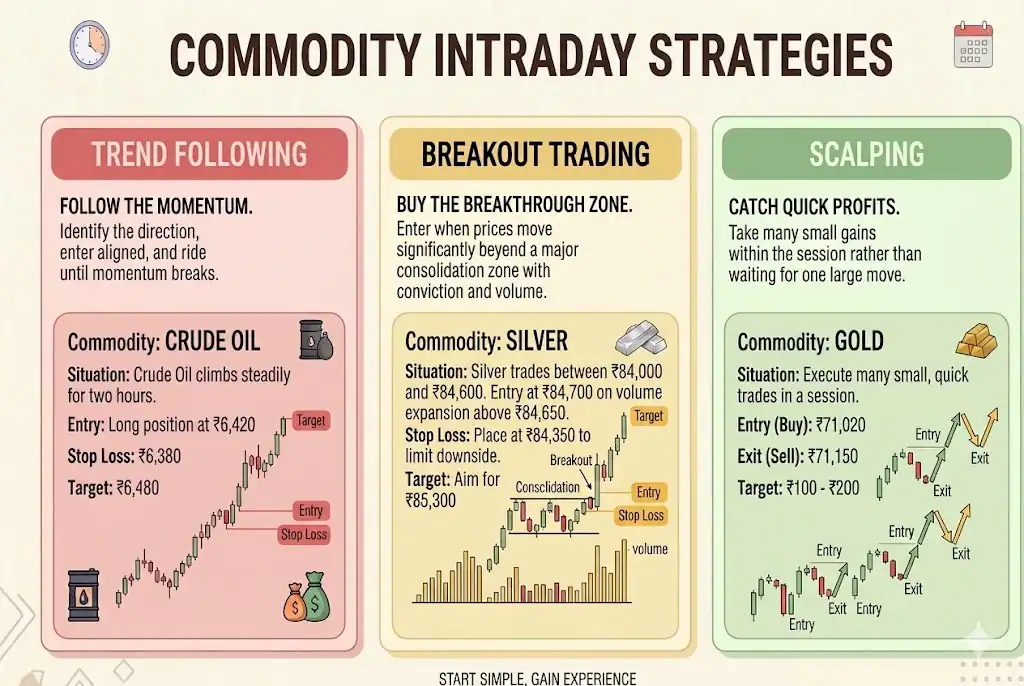
A trend following approach says that if something is moving in one direction, it is more likely to continue than to reverse. Trend traders identify the direction, enter in alignment with it, and ride the move until it breaks.
For example, in a session where crude oil opens at ₹6,400 per barrel. It climbs steadily in the first two hours. A trend follower takes a long position around ₹6,420, setting a stop-loss at ₹6,380, with a target of ₹6,480.
If the trend holds, the trade closes in profit. If it reverses sharply, the stop contains the damage. The discipline is in not second-guessing the exit rules once they are set.
Breakout Trading
A breakout happens when the prices move significantly beyond a major consolidation zone. Breakout trading is focused on entering a position once the price clears the boundary with conviction, usually confirmed by a spike in trading volume.
As an example, suppose that silver on MCX trades between ₹84,000 and ₹84,600 for the first ninety minutes of a session. It then breaks above ₹84,650 with visible volume expansion. A breakout trader will enter at ₹84,700, setting the target of ₹85,300 with a stop-loss placed at ₹84,350.
What trips up beginners here is entering on the hint of a breakout rather than waiting for it to be confirmed. Patience is the whole edge in this setup.
Scalping
Scalping is not for everyone, but for traders who can stay focused across multiple short trades, it is a viable intraday approach. The idea is to make many small gains within the session rather than waiting for one large move. The risk here is that brokerage costs and slippage add up quickly if trade frequency is not matched by a meaningful win rate.
For instance, a gold scalper targets moves of ₹100 to ₹200 per 10 grams. He enters and exits several times across the session. If gold is at ₹71,000, the scalper might buy at ₹71,020, quickly exit at ₹71,150, and then look for similar opportunities for the next setup.
Managing Risk and Avoiding Common Mistakes
Most consistent losses in intraday trading trace back not to wrong market calls but to risk management failures. A few common ones are:
- Trading without a stop-loss
Many traders skip the stop-loss, hoping prices recover. This damaging habit can make the losses severe. Every entry requires a pre-decided stop, placed the moment the trade goes live. - Overtrading to recover losses
A bad morning does not improve by adding more trades. Step away when your daily loss limit is hit. Trying to chase recovery in the same session can turn manageable losses into serious ones. - Ignoring global context
International factors like Organisation of the Petroleum Exporting Countries (OPEC) statements, US Federal Reserve rate decisions, or geopolitical unrest can sharply move commodity prices. Your analysis is incomplete if you focus only on the chart while ignoring the global cues. - Excessive leverage
The low margin requirements can be inviting. But, they also mean an adverse move can wipe out the full value. Beginners should treat available leverage as a ceiling until they have found a consistently working approach to trading risk.
Commodities vs Stocks: What Should You Choose?
Both markets offer genuine intraday opportunities. The question is which one suits the way you actually work.
| Parameter | Commodity Trading | Stock Trading |
| Exchange | MCX, NCDEX | NSE, BSE |
| Trading Hours | 9:00 AM to 11:30 PM | 9:15 AM to 3:30 PM |
| Price Drivers | Global supply, weather, geopolitics | Company earnings, domestic economy |
| Instruments | Futures, Options | Shares, Futures, Options |
- Exchange: Commodities trade primarily on MCX, with the National Commodity & Derivatives Exchange (NCDEX) also playing a role for certain agricultural commodities. Stocks, on the other hand, are traded on the National Stock Exchange (NSE) and Bombay Stock Exchange( BSE).
- Trading hours: Commodities offer a significantly longer window, including evening sessions that track US market movements.
- Price drivers: Stock prices are shaped primarily by company earnings and domestic economic data. Commodity prices respond to global forces, including weather patterns, geopolitics, and supply chain developments.
- Instruments: The trading instruments in commodities markets are futures and options. Stock trading involves these two, along with equity shares.
If you are comfortable tracking global news, available to trade during evening sessions, and prefer lower margin requirements, commodities may be the more natural starting point. If company analysis interests you and standard market hours suit your schedule, equities may feel more intuitive.
Neither market is inherently better. Both reward structured thinking and punish impulsiveness at roughly equal rates.
Practice Without Risk First
Before any real capital is committed, use commodity trading online platforms to simulate trades in live market conditions. Most brokers provide demo accounts for this purpose. A few weeks of consistent paper trading is a reasonable minimum before going live.
These simulation sessions reveal how quickly prices move, how margin works under pressure, and how your decision-making shifts when a trade starts going the wrong way. The lessons learned in this phase are far cheaper than the ones taught by the live market.
Final Thoughts
Commodity intraday trading rewards those who approach it like a craft rather than a gamble. Pick one commodity. Learn how it moves, what drives it, and when it tends to be most active. Build one strategy around it before thinking about anything else. The market does not reward those who know the most. It rewards those who execute what they know with discipline, day after day.
Frequently Asked Questions
Yes, beginners can start, but it is advisable to paper trade for a few weeks first, keep capital small, and focus on one commodity at a time before expanding.
The capital required depends on the commodity, margin requirements, and trading style. Many beginners start with smaller amounts and gradually increase exposure as experience improves.
Gold is considered easier to trade because of its strong liquidity and relatively steady reaction to global events, currency movements, and interest rate expectations.
All intraday trading carries risk. In commodities, leverage amplifies both gains and losses. Using stop-losses, limiting position sizes, and not overtrading are the core ways to keep that risk manageable.