
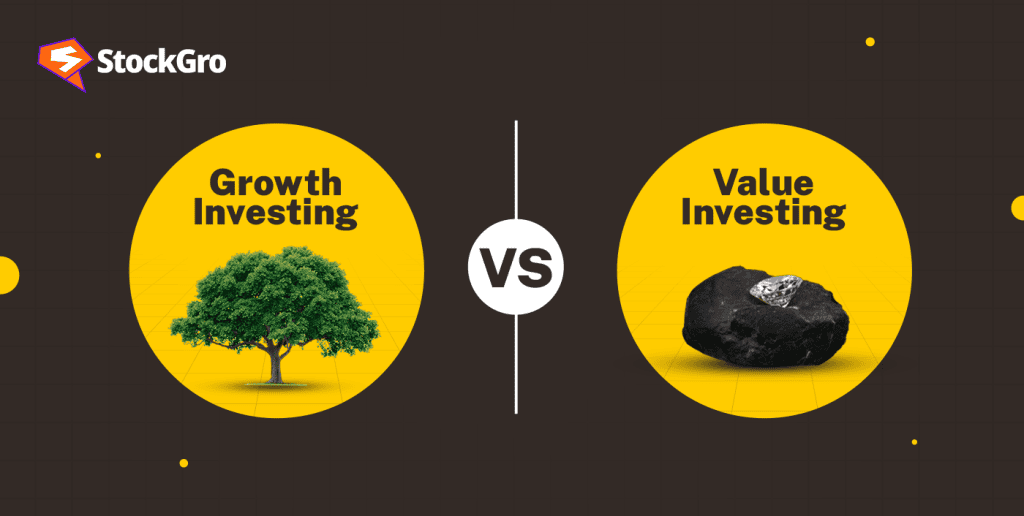
- Summary
- Growth investing focuses on companies expected to deliver strong revenue and earnings growth, while value investing looks for fundamentally sound stocks trading below their estimated intrinsic value.
- Growth investors often accept higher valuations and greater uncertainty about future earnings. Value investors focus more on valuation measures such as P/E, P/B and the margin of safety.
- Neither approach consistently outperforms in every market cycle, and both involve the risk of losses.
- Investors can choose between the two based on their goals, risk tolerance and investment horizon, or combine both approaches through GARP or suitable mutual funds.
Growth and value investing are commonly used techniques for building wealth in the long run. Growth investments involve companies expected to grow their income and revenue at a rate above the market average. Such companies tend to use their profits to invest in themselves. They are usually valued highly and pose a higher risk.
The growth technique is ideal for investors with a high risk tolerance and a long investment horizon. Value investing is suitable for patient investors looking to invest in well-established firms. What is right for you depends on your financial objective and other variables.
What is Growth investing?
Growth Investing is a type of investment that focuses on companies expected to deliver above-industry-average growth in revenue, earnings, or market share. Growth investors invest in companies with significant growth potential, even if their stocks may look overvalued relative to current earnings.
To explain what growth investing is all about, one needs to know that these are companies that reinvest their profits back into the business rather than paying high dividends to investors.
Metrics growth investors use
Growth investors assess a company’s ability to grow its business and earn profits. These growth investing metrics are used to evaluate financial performance, growth opportunities, and stock valuation.
- Revenue Growth: This metric measures the rate at which the company grows its revenues. The reason for the growth could be high demand, business growth, or a competitive advantage in the market. In addition, investors will assess the sustainability of revenue growth in relation to the firm’s business strategy.
- Earnings Growth: It is an indicator of how much the company’s profits have increased over a particular period. Investors will look at EPS and profit margins to see whether the company’s growth results in improved profits.
- Why is a High P/E Acceptable? Growth stocks tend to have high P/E ratios because there are high expectations for their future earnings. A high P/E may be justified when growth prospects are convincing, but investors must consider valuation and also check whether performance can meet expectations.
What is Value investing?
Value investing is a type of investment that involves buying stocks at prices below their intrinsic value. This implies that the investor must search for firms that are profitable, have strong fundamentals, and have growth prospects.
To understand what value investing is all about, one should recognize that the market price may not reflect a firm’s true financial value. It involves examining the firm’s financials by analysing its financial statements, earnings, liabilities, assets, and valuation ratios.
This is with a view to finding the stock’s true intrinsic value and then profiting from the difference between the market price and that value.
Metrics value investors use
Value investing involves analyzing a company’s financial and valuation position to identify undervalued securities. Value investing metrics can help an investor determine whether stocks are appropriately valued.
- Price-to-Earnings Ratio: It involves analyzing the relationship between a business’s price per share and its earnings per share. A P/E ratio lower than that of other businesses in the same industry indicates undervalued stocks, although other factors, such as the quality of earnings, the business’s risks, and future opportunities, should also be considered.
- Price-to-Book Ratio: It compares the share price to the book value per share. It can be used to identify undervalued firms, particularly in capital-intensive industries, although it may not apply when a firm derives value from intangible assets.
- Margin of Safety: the difference between intrinsic value and market price. Buying at a discount can provide a buffer against valuation errors and unexpected business challenges.
Growth investing vs Value investing
Growth and value investing differ mainly in how investors identify opportunities. Growth investors prioritise companies with strong future growth prospects, while value investors look for stocks trading below their estimated intrinsic value.
| Comparison | Growth investing | Value investing |
| Core focus | Companies expected to deliver above-average business or earnings growth | Stocks trading below their estimated intrinsic value |
| Market valuation | Often trades at relatively high valuation multiples | Often trades at relatively low valuation multiples |
| Key metrics | Revenue growth, earnings growth, margins and valuation relative to growth | P/E, P/B, cash flow, financial strength and margin of safety |
| Typical business profile | Companies with strong expansion opportunities | Companies that appear undervalued relative to their fundamentals |
| Main risk | Growth may disappoint while the valuation remains high | A cheap-looking stock may be a value trap |
| Time horizon | Generally suited to investors willing to hold through earnings and valuation volatility | Requires patience because mispricing may take time to correct |
Neither approach guarantees better returns. Their relative performance can change across companies and market cycles.
Growth vs Value in the Indian Market
Growth vs. value investing in India are better identified through stock-level characteristics than through fixed sector labels. NSE’s Nifty500 Growth 50 and Nifty500 Value 50 provide useful benchmarks for comparing the two styles.
| Comparison | Growth style | Value style |
| Indian index | Nifty500 Growth 50 | Nifty500 Value 50 |
| Selection approach | Three-year profit-after-tax growth, three-year sales growth and one-year risk-adjusted return | Earnings-to-price, book-value-to-price, sales-to-price and dividend yield |
| Major sector exposures as of 30 Sep 2026 | Capital goods and financial services | Oil & gas, financial services, metals & mining and power |
| 1-year total return as of 30 Sep 2026 | 9.42% | 6.89% |
| 5-year CAGR as of 30 Sep 2026 | 15.89% | 22.26% |
Note: Nifty500 Growth 50 was launched in August 2026, so its longer-period figures include historical index performance from before launch.
The comparison shows why neither style consistently leads across every period. Growth was ahead over the one-year period to September 2026, while value delivered the higher five-year CAGR. Sector exposure can also change as index constituents and their weights change.
When Each Approach Struggles
There are shortcomings in both growth and value investments that investors need to be aware of before engaging in either. Different market conditions, different business performance, and different expectations will affect gains.
- Disadvantages of Growth Investing
Among the main disadvantages of growth investing are overvaluation and sensitivity to changes in market expectations. If a company does not perform as expected and does not earn as much as the public anticipated, its stock price will plummet.
High interest rates will hurt growth stocks because their future earnings might be discounted at a lower rate. Fast-growing companies tend to prioritize growth above profitability, making future returns less predictable.
- Disadvantages of Value Investing
Value investing will not work if a stock remains undervalued for too long. Just because the stock is cheap does not necessarily mean it is undervalued; the share price might be low due to falling profits, poor management, or structural issues in the business.
These are called value traps. Another problem with value investing is the slowdown in industries such as metals and banking.
Can You Combine Both?
Certainly, investors can merge growth and value strategies in order to create a successful investment approach. This approach presupposes selecting growth stocks with high earnings potential and reasonable prices.
- Look for Sustainable Growth
Look for companies with sustainable income and earnings growth and with the appropriate business model. One should try to determine whether this growth is driven by real demand and operational efficiency or is merely temporary. Sustainable growth might become the indicator of future business success.
- Evaluate the Valuation of the Company
It is necessary to compare the company’s P/E ratio with its earnings growth rate, peer group companies valuations, and the company’s historical valuations. It will become obvious whether the company has good prospects at the current price. Do not consider the company with good potential to be a definitely good buy.
- Determine Financial Stability
Assess debts, cash flows, margins, and management prior to making any investment decisions. Businesses with moderate debt levels and strong cash flows are more likely to finance expansion under tough economic conditions. Good financial stability can also mitigate some of the risks associated with business operations.
- Diversify Your Investment Portfolio
Invest in companies across various industries and business cycles rather than focusing on a single industry. Diversification could help mitigate the negative impact of poor performance in a particular company or industry.
However, it does not eliminate market risk or ensure profitability. The goal of growth at a reasonable price should be to focus on finding businesses with good growth potential that are not overvalued.
Which strategy is right for you?
Selecting between growth and value investing will largely hinge on your investment time frame and risk tolerance. So, should you wonder whether growth investing or value investing suits you more? Here is an answer for you below:
- For Long-Term Investors with a High Degree of Risk Tolerance
So, if you have a high risk tolerance and a long investment time frame, you should give growth investing a shot. Growth investing involves investing in those companies that display consistent growth and profitability. But since growth-investing stocks are usually highly valued, they are also prone to losses.
- Investment Time Frame: More than five years.
- Degree of Risk Tolerance: High.
- Major Focus: Revenue Growth, Earnings Growth & Business Potential.
- For Investors focused on valuation
Are you interested in learning about the basic characteristics of the company and buying undervalued stocks? Then, this value investment strategy is what you need. You have to be ready to wait until the market recognizes the stock as undervalued, since undervalued stocks can remain so for a long time.
- Duration of investment: Could be from three to five years or even longer.
- Tolerance for risks: Could differ, depending on the stock, since undervalued stocks are also risky.
- Key factors: P/E ratio, P/B ratio, financial stability, and margin of safety.
Ultimately, determining growth or value investing for me depends on assessing your financial objectives, risk tolerance, and ability to invest. Neither approach is guaranteed to make profits; hence, diversification remains key.
Growth and Value Through Mutual Funds
Investors who do not wish to analyze individual shares can consider mutual funds that offer growth or value strategies. Mutual funds collect money from various investors and invest it in various securities under professional management.
Understanding Value funds vs. growth funds can help investors to compare the investment styles before selecting a suitable option.
- Growth Funds: The objective of growth-oriented mutual funds is usually to invest in companies with strong earnings potential, that are growing, and that offer capital appreciation potential. Growth-oriented mutual funds can invest in various sectors, including technology, consumer, and healthcare.
- Value Funds: These are equity funds that hold stocks priced low relative to their intrinsic value. These stocks could belong to mature companies in different industries, including banks and oil firms. Value funds are usually slow to perform, and these stocks can continue to underperform for an extended period.
- Advice on Selecting: Verify whether the investment objective, asset allocation, costs, risk profile, and performance of the fund are aligned with your goals and risk tolerance. Remember that there is always risk involved in investing in mutual funds, and past performance is no indication of future performance.
Conclusion
There are two ways to make wealth through investing. Growth investors seek out stocks of firms with strong growth prospects, while value investors look for undervalued securities. The best way of doing things depends on your goals, time horizon, and tolerance to risk.
If you do not like picking specific stocks, you can try mutual funds that use one of the two methods. You can also combine both methods to diversify across different market situations. It is important to note that neither method will provide you with assured profits because all investments carry risks.
FAQs
The major growth investing disadvantages consist of high stock prices, volatility, and the impact of changes in earnings projections. Shares tend to drop significantly when firms miss their expected growth rates. For further information about these aspects, see the When Each Investment Strategy Fails section.
The decision will depend on the market phase, the valuation level, and the time period in question. It is important to analyze growth vs. value India returns to answer this question properly, using relevant NSE indices. Past performance is not a guarantee of future performance.
It is possible that a firm has growth potential despite being undervalued. The GARP (Growth at a Reasonable Price) investing approach represents such a combination, in which investors search for promising firms that are reasonably priced. However, research is required to evaluate both aspects.