

In the world of finance, where everyone wants big returns without investing too much time, it’s hardly a surprise that there’s an entire trading strategy aimed at doing just that. Swing trading is a game of intricacies, quick decisions, and of course, possibly big rewards.
At its core, swing trading takes advantage of short-term to medium-term price fluctuations in the market. While it does offer something without taking much, it’s not everyone’s cup of tea and is far from being a one-size-fits-all endeavour. Swing trading takes time, effort, and experience to master.
In this article, we’re going to delve into what is swing trading, explore what it is, how the strategies work, and whether you can actually make money from it. Whether you’re a beginner trader looking to learn new things or a professional looking to brush up on your skills, this article has something for everyone.
What is Swing trading
Swing trading uses technical analysis (and sometimes fundamental analysis) to profit from short to medium-term price movements. This means that swing traders only pick stocks that they predict will show significant appreciation or dips in the next few weeks. Traders lose money if they invest more than they can afford.
Swing Trading Working
Swing trading involves entering either a long or short position, typically for a few weeks or a couple of months. While this is the general time frame for such trades, some may last more in exceptional circumstances. The objective of a swing trade is not to wait necessarily for this time period to see profits.
Rather, it is to capture and profit from a bulk price movement in a stock no matter when it occurs.
This could be done in two ways – either by taking multiple trades in volatile stocks that move a lot during the time frame, or secondly, by identifying a significant movement well in advance, entering the position, and hoping that the move materialises.
Most swing experts advise traders not to stay invested in a position for too long hoping to capture the entire movement. Since it is very hard to accurately time the market, it is a good practice to use stop losses appropriately and have return goals to make sure you’re not getting greedy.
Example of Swing Trading
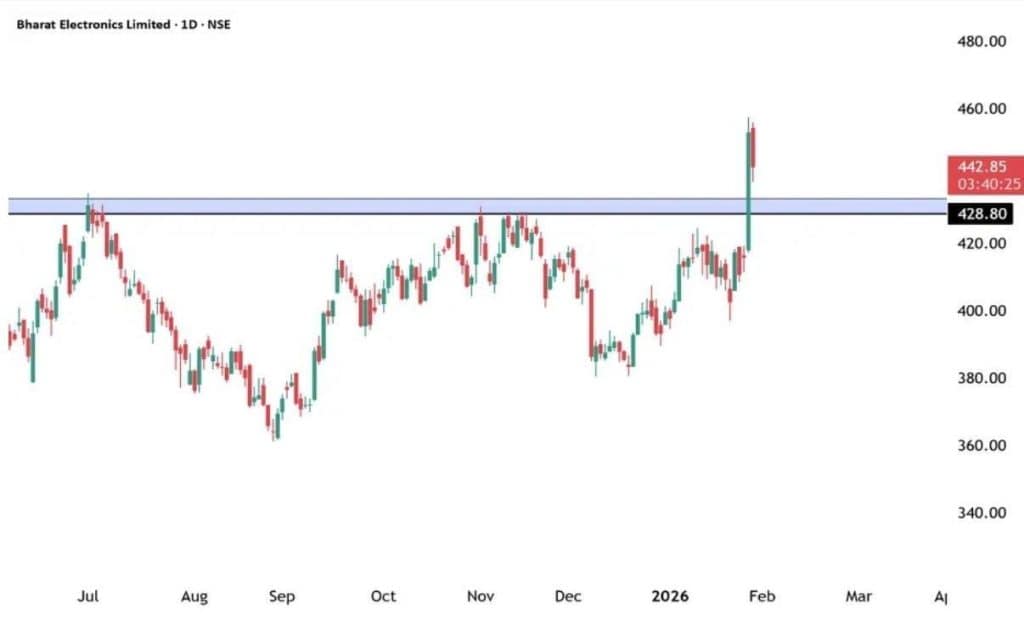
To showcase these concepts, consider the price action of Bharat Electronics Limited (BEL). After months of trading sideways and hitting a ceiling at ₹430, the stock finally surged above this resistance in late January. This bullish structure breakout was confirmed by a strong price close and high trading volume, signaling a change in momentum.
A swing trader would enter the trade near ₹442, placing a protective stop-loss at ₹428 to manage risk. The goal is to hold the position for several days to capture the ensuing upward swing as the market adjusts to this new price level.
Key Principles of Swing Trading
Swing trading operates on several foundational principles that distinguish it from other trading approaches which include the following elements/
- Time period: The time period of the trading strategy requires two days to multiple weeks which enables traders to observe price movements without committing to a three-year investment period.
- Technical analysis: The technical analysis focus of the trading strategy relies on chart patterns and moving averages and momentum indicators to guide decision-making.
- Trend identification: Traders study past price patterns to determine which future price movements are most likely to occur. The market direction assessment process requires traders to identify established patterns which include higher highs and lower lows to determine the market’s primary movement direction.
- Entry and exit planning: Capital protection requires traders to establish technical signal-based entry points and exit strategies which serve as their predetermined entry and exit points. Traders establish profit targets and stop-loss levels before initiating any position.
- Position sizing discipline: Swing traders use position sizing discipline to limit their risk by dedicating specific portions of their capital to multiple trades instead of risking their entire capital on one trade.
- Market context understanding: The understanding of market context requires traders to assess how stock movements are affected by broader market trends and sector performance and economic indicators. Successful traders use both macro factors and technical analysis to guide their trading decisions.
- Profit targets: Swing traders seek to achieve mid-sized price movements which have a high probability of success instead of waiting for significant gains which investors typically pursue.
Common Strategies in Swing Trading
Swing traders employ various approaches to capture price movements, with three predominant methodologies being:
- Pullback Strategy
Pullback strategy consists of entering a trade during a temporary dip in an existing uptrend. Traders wait for the price to pull back to a support level or a moving average before buying, betting that the primary trend will resume.
- Breakout Strategy
Breakout strategy involves entering a position when the price moves above a defined resistance level or below a support level. The goal is to catch the surge in volume and momentum that often follows such a breach.
- Reversal Strategy
The reversal strategy focuses on identifying when a trend is losing steam and about to change direction. By using oscillators to spot overbought or oversold conditions, traders position themselves to profit from the upcoming trend shift.
Ideal Assets for Swing Trading
The best instruments for this style offer sufficient liquidity and price movement, which include:
- Stocks
Large-cap and mid-cap equities are preferred because they have enough volume to ensure easy entry and exit, alongside predictable price patterns driven by earnings or sector news.
- Futures & Options (F&O)
These derivatives allow for significant leverage and the ability to profit from both rising and falling markets. F&O contracts are ideal for swing trading due to their defined expiry periods and high unpredictability.
Tools Used in Swing Trading
- Technical Indicators
Swing trading is a great way to take advantage of short- to medium-term price changes in the market. In order to succeed with this strategy, it is important to utilise the appropriate indicators. We start by listing some of the indicators that are best suited for enhancing your swing trading skills:
- Moving Averages
Both simple moving averages (SMA) and exponential moving averages (EMA) assist traders in trend and reversal identification. Crossovers between shorter-term and greater-term MAs can suggest possible entry or exit points.
- Relative Strength Index
Relative strength index (RSI) is used to ascertain the velocity and the change in price trends. A high RSI level of 70 shows overbought conditions while a low level below 30 suggests oversold conditions thus indicating possible reversals.
- MACD
This indicator shows the relationship between two moving averages of a security’s price. MACD crossovers, along with divergence from price action, can provide insights into potential trend changes
- Bollinger Bands
Bollinger bands encompass a middle band (SMA) and two outer bands that represent price volatility. Prices touching the upper band may indicate overbought conditions, while those hitting the lower band may suggest oversold conditions.
- Chart Patterns
Familiarise yourself with common chart patterns such as head and shoulders or triangles. These patterns can signal potential price movements, providing opportunities for entering or exiting trades.
- Volume Analysis
Volume analysis tracks the number of shares traded to confirm price movement strength. Higher volume supports breakouts or reversals, while low volume suggests weak participation, helping traders judge the reliability of short- to medium-term price moves.
Advantages of Swing Trading
- You could make decent money: Since swing trading involves capitalising on short-term trades, you could make a decent return without holding up your capital for too long.
- Reduced transaction costs and brokerage: Compared to day trading, swing trading usually involves lower transaction costs and brokerage, since traders don’t execute several trades within the same trading session.
- Time efficient: Swing traders can work outside trading hours to research and manage their positions, which gives them more time to conduct due diligence than day traders who mostly have to analyse and place bets in real time.
- Low stress: This variety of trading is usually low stress, which means that it is suitable for full-time professionals who don’t have too much time.
Disadvantages of Swing Trading
- Exposed to market risks: Stocks in the short and long-term are exposed to extra market risks like price dips due to negative events, or action on the weekends.
- Low diversification: By focusing solely on one swing trade for a period of 6-8 weeks likely leads to low diversification. A portfolio consisting only of swing trades could be overexposed to market volatility.
- Limited exit potential: Since swing trades predict specific price action and account for losses only through stop loss orders, traders can oftentimes find it hard to exit without having to bear losses.
Risk Management in Swing Trading
Protecting your money matters more than making fast profits, because one bad trade should never be able to wipe out your account. The following strategies work to help you manage swing trading risks during your trading activities.
- The 1% rule: Keep losses minimal by risking only a tiny part of your total capital on one trade, so even if it goes wrong, your account stays safe.
- Stop-loss orders: Decide beforehand your exit point for losing trades before entering the market rather than waiting for a market reversal to happen.
- Position sizing: Work out how many shares to buy based on how much you’re willing to lose, rather than guessing or trading based on emotion.
- Diversify: Investing in multiple assets requires you to avoid putting all your assets into a single stock or sector, because one poor decision should not endanger the entire investment portfolio you hold.
- Risk-to-reward ratio: Take trades where the possible gain is clearly bigger than the possible loss, so a few good trades can cover the bad ones.
How to Get Started with Swing Trading
To begin swing trading correctly, you need to create a trading plan together with the appropriate market conditions before you start executing your first trade.
- Learn the basics and open an account: Understand fundamental concepts like technical analysis, chart patterns, indicators, and risk management, then open a brokerage account with good charting and tools.
- Develop a trading plan: You need to establish your market selection process together with your entry and exit requirements and your risk management approach and position sizing methods, which you should record before you start trading live.
- Practice with a demo account: You can test your trading strategies through a demo account while learning to use different trading platforms without spending actual money.
- Choose assets and strategies: Select high-volume stocks or instruments as your main focus while you utilise pullback and breakout and indicator confirmation strategies.
- Use risk controls: Investors should establish stop-loss orders together with profit targets to safeguard their investment capital while they proceed with trade management.
How to Select Stocks for Swing Trading?
Filtering through thousands of available stocks requires a systematic approach to find the ones most likely to move. You should look for specific criteria in your screening process for choosing stocks for swing trading such as:
- High volume: Only trade stocks where millions of shares change hands daily so you can exit whenever you want.
- Relative strength: Look for stocks that are performing better than the overall market index.
- Clear trends: Stick to stocks that are making higher highs and higher lows on a daily chart.
- Catalysts: Keep an eye on earnings reports or product launches that might trigger a significant price swing.
- Sector momentum: Identify which industries are currently in favor with big institutional investors.
Conclusion
Success in the markets depends on finding a balance between active trading and long-term holding. Now that you understand what is swing trading, you can use these strategies to grow your capital without being glued to a screen. By focusing on risk management and choosing the right assets, you can turn short-term price movements into a consistent and disciplined financial habit.
FAQ
The best time frame for swing trading is typically the daily chart, which provides a balanced view of trends. Traders often supplement this with weekly charts for broader context and 4-hour charts to fine-tune specific entry and exit points.