Crude Oil Market Timing
Crude oil market timing refers to the practice of entering and exiting trades during specific windows when prices are most likely to move in a direction, with liquidity, and at a favourable risk-reward. It is not about predicting oil prices; it is about knowing which hours carry the most useful price information and which carry mostly noise.
Crude oil is one of the most volatile commodities. Its price can shift within a single session based on where global markets are at that moment. For crude oil trading, only picking a direction is not enough. One needs to get the timing right for a profitable trade.
In India, crude oil is traded primarily on the Multi-Commodity Exchange of India (MCX). Each session has a distinct character, and the trading opportunity shifts based on the session you are in.
- Morning Session (9:00 AM to 5:00 PM India Standard Time – IST)
Asian hours. Liquidity is thinner, spreads are wider, and prices mostly absorb whatever happened overnight in the US. Suitable for directional bias assessment, less so for active intraday trading. - Evening Session (5:00 PM to 11:30/11:55 PM IST)
As the US markets open, the institutional order flow jumps, and the spreads tighten. Most of the session’s meaningful moves happen here. The window between 7:00 PM and 11:00 PM IST is the best time for crude oil trading in India. This session witnesses higher volatility since it overlaps with international markets.
Apart from these two, there exists a special time for trading crude oil.
- EIA Window (On Wednesdays)
The Energy Information Administration (EIA) releases US crude oil inventory data on Wednesday after 10:30 AM Eastern Standard Time (EST) which is 8:00 PM or 9:00 PM IST, depending on daylight savings). Prices can move significantly in minutes. Enter this window with a plan or not at all.
How the Crude Oil Market Works
When you trade crude oil on MCX, you are not buying physical oil. You are dealing in a derivatives contract, which is a standardised agreement to execute a transaction at a set price on a future date. This forms the basis of crude oil technical analysis.
Each lot of MCX crude oil futures has 100 barrels, and the value of a contract is ₹100 times the crude oil price at a given time. A mini contract of 10 barrels is also available. It makes this segment accessible for retail traders.
Two prices run the world’s crude oil markets. They are Brent crude, the international benchmark and West Texas Intermediate (WTI), the US benchmark. MCX contracts are largely priced against WTI. You trade in rupees, but the underlying reference is in dollars.
Key Factors That Influence Oil Price Timing
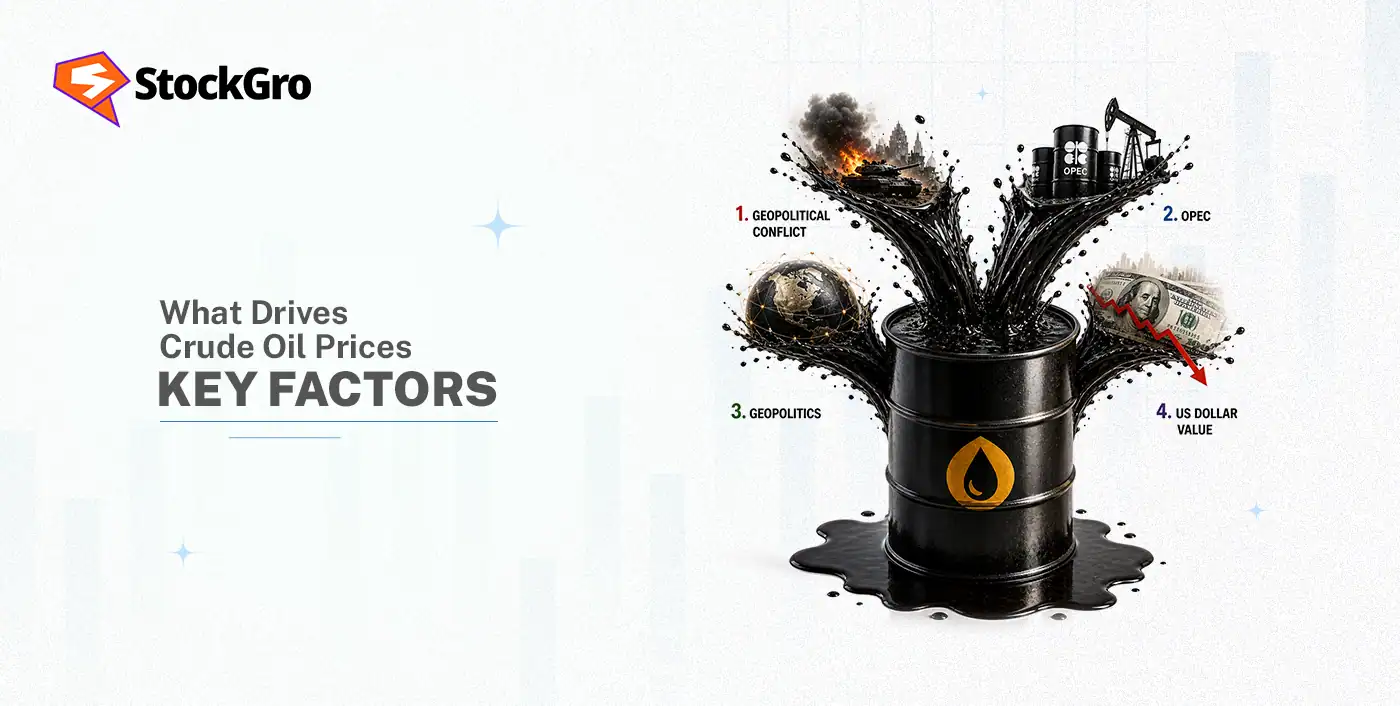
Price moves in crude oil are rarely spontaneous. Most cluster around identifiable triggers, which also shape any crude oil trading strategy.
- OPEC+ Decision
Every time the supply is expanded or trimmed by the Organisation of the Petroleum Exporting Countries Plus (OPEC+), crude markets also move. India imports most of its crude requirements, so what gets decided abroad lands directly on MCX screens and is reflected in domestic fuel costs. - EIA Inventory Data
Weekly stockpile data from the US can cause short-term price swings. A drawdown larger than expected lifts prices; a surprise build does the opposite. The EIA releases information every Wednesday night.
- Geopolitical Events
When a conflict or supply disruption dominates the news, crude oil moves first and asks questions later. A single headline can rapidly shift the prices. The market prices in fear long before it prices in fact. Overnight positions carry substantial gap risk. - INR/USD Rate
Since crude is globally priced in dollars, rupee depreciation raises the effective import cost and feeds directly into MCX futures pricing, independent of any change in the international crude price.
Best Strategies for Crude Oil Market Timing
The commonly used strategies in crude oil trading are:
Trend Following
Trend following means identifying the dominant direction over several weeks and placing trades only in that direction. Use the moving averages as your reference. When price pulls back to the average and holds, that is your entry signal, not when price is already running. Patience is the entire strategy.
For example, suppose that MCX crude is in an uptrend. It has a pullback from ₹7,500 to ₹7,050, before finding support close to the 20-day simple moving average. A viable setup is to take a long entry at ₹7,060 with ₹7,450 as the target and placing a stop loss at ₹6,950.
Breakout Strategy
A breakout trade looks for crude oil consolidating in a narrow range over several sessions, then enters when the price exits that range decisively on strong volume. Confirmation matters here; a breakout on thin volume is usually a trap. Keep stop-losses tight and defined before entry.
As an example, assume MCX crude ranges between ₹6,800 and ₹7,000 for eight sessions before breaking higher. An entry at ₹7,020 with a stop at ₹6,950 and a target at ₹7,280 captures ₹260 per barrel while risking only ₹70.
Swing Trading
Swing trading aims to capture one complete price move, ranging from days to weeks, without overstaying into the next reversal. Using tools like the Relative Strength Index (RSI) with clear support and resistance levels will do most of the analytical work. Enter when RSI signals oversold conditions near a known support level, exit near the next resistance.
For instance, Crude has pulled back to ₹7,920 from ₹8,400 with RSI at 33 near a support zone. A long position with a stop at ₹7,780 and a target near ₹8,300 offers ₹380 per barrel upside against ₹140.
News-Based Trading
This strategy times entries around scheduled data releases, primarily the EIA inventory report, or around unscheduled supply disruptions. The non-negotiable rule is having entry levels, targets, and stops defined before the data hits. Reacting in real time to a number you did not prepare for is not news trading; it is an impulsive decision.
Let’s take an example. A barrel draw of 1.5 million barrels was expected from the EIA. The actual figure comes in at 4.2 million. MCX crude moves from ₹7,450 to ₹7,610 in four minutes. A pre-placed buy stop at ₹7,480 gets triggered, and the target at ₹7,600 is reached twelve minutes later.
Common Mistakes in Crude Oil Market Timing
Most timing errors are not about strategy. They are about process.
- Treating MCX like a daytime market
Most of the significant crude oil action happens after 7:00 PM IST. Closing out before the US opens and then watching the real move from the sidelines is a frustrating and avoidable pattern. - Entering the EIA window without a plan
Walking into the Wednesday night release without predefined levels is a risky move. Slippage is severe, moves whipsaw, and the trader who hesitates pays the worst price. - Chasing the initial geopolitical spike
A headline causes the crude to surge in one session. The instinct is to buy. But markets often partially reverse soon, once traders assess the actual supply impact. The spike is usually not the entry; the pullback that follows is. - Ignoring the rupee
Two traders can look at the same international crude chart and arrive at opposite conclusions about where MCX will open, purely because one accounted for the overnight INR/USD move and the other did not.
Real-World Examples of Oil Market Timing
On January 3, 2026, the United States launched military operations in Venezuela. Analysts flagged an immediate opening across energy commodities. MCX Crude had a directional move played out almost entirely within the 7:30 PM to 10:00 PM IST window once New York opened that evening.
Traders positioned ahead of the evening session on January 3 captured the move cleanly. The momentum was already fading after 9:30 PM IST, and those entering late had few opportunities left.
India had reduced its Venezuelan crude imports from 108 million barrels in 2019 to around 25 million barrels in 2024. So, the direct supply shock was limited, but the sentiment impact was clearly visible on MCX prices that January night.
How Beginners Can Practice Crude Oil Market Timing Safely
For new traders, taking a step-wise approach will help them easily enter and navigate the crude oil trading space.
Step 1: Commodity Account Setup
A separate commodity account linked to MCX is needed for trading crude oil. Approach a broker registered with SEBI, complete the requirements and open your account.
Step 2: Paper Trading or Mini Contract
Before risking meaningful capital, trade the mini contract or simulate trades on paper using platform currency. The goal at this stage is pattern recognition, not profit.
Step 3: Focus On One Session
Pick the evening overlap window and study it adequately before touching the morning session. Depth in one window beats shallow exposure across all of them.
Step 4: Mark the EIA Calendar
Every Wednesday night IST, the EIA releases weekly crude inventory data. As a beginner, avoid holding active positions through this release until you have watched it play out many times.
Step 5: Cap The Risk Per Trade
Do not commit more than 1 to 2% of your capital on a single trade. A small position that teaches something is worth far more than a large one that wipes out a week’s effort in a single session.
Step 6: Keep a Trade Journal
Maintain a trading log. Daily review catches individual mistakes. Weekly review reveals timing patterns. This structured feedback turns practice into skill.
Final Thoughts
Timing the crude oil market requires understanding that not all hours are equal, and not all moves deserve a trade. The best session is a combination of liquidity and directional clarity for traders. Pair that with strict risk management, and timing becomes a repeatable edge.
The traders who last in this market are not the ones who trade the most. They are the ones who wait the best.
FAQs
It refers to identifying specific windows during the trading day when crude oil prices move most predictably, allowing traders to plan entries and exits with better precision.
Crude oil responds to global events across time zones. The right session window improves execution quality and the risk-reward outcome of a trade considerably.
Yes, using the MCX mini contract and paper trading helps beginners develop timing awareness without excessive exposure, allowing them to trade crude oil effectively.
Timing improves the probability of a trade working. Profitability over time depends equally on strategy and disciplined risk management.
Reacting impulsively to price spikes or headlines without a predefined plan is one of the most consistent causes of loss in crude oil trading.