Crude oil is among the actively traded, foundational commodities that yield a significant impact on overall economic trends. Factors like production cut of crude, conflict in oil-rich countries, surging dollar index, etc., impact crude oil price movements. Changes in crude oil markets have a wider economic impact that not only influences investments but also basic living.
This blog decodes the factors that impact crude oil prices to help investors gauge early trends. This can enable informed investment decisions for crude oil trading, and also for investments in other asset classes.
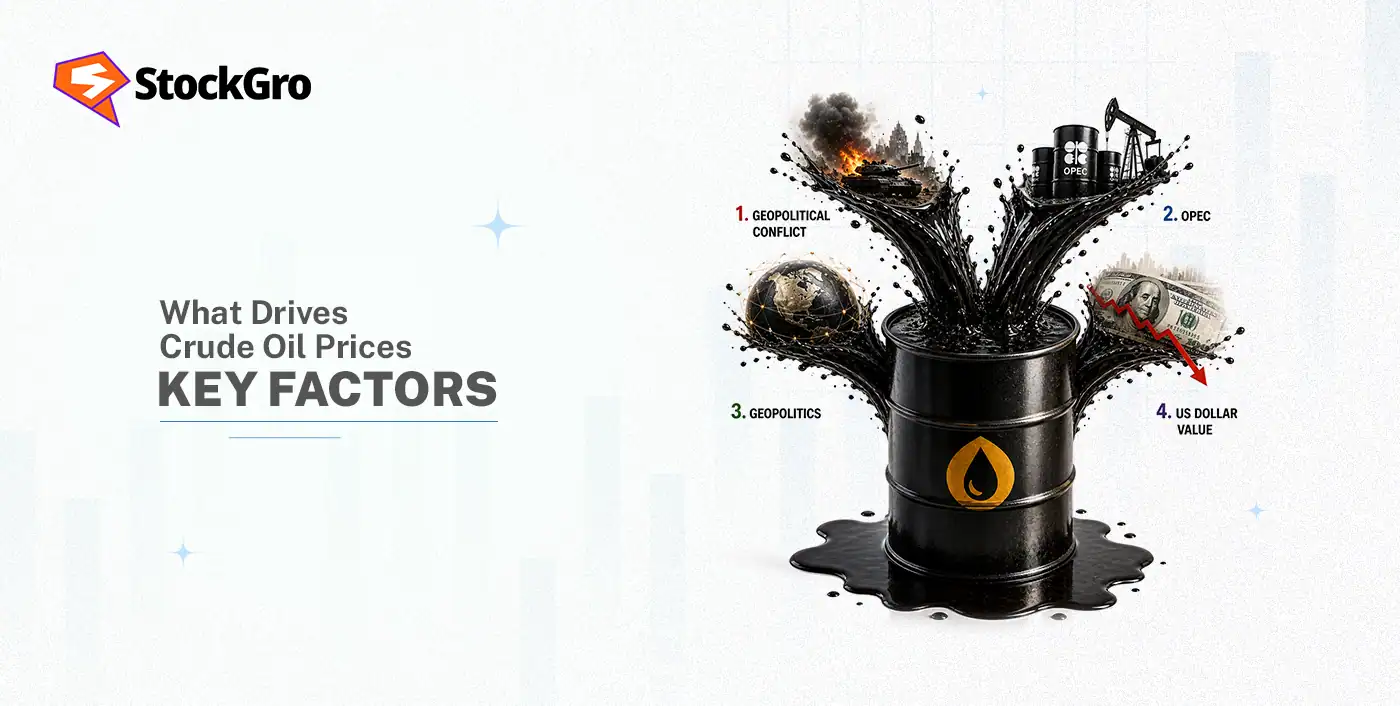
What drives crude oil prices?
The price of crude oil is influenced by several factors, none of which work alone. A successful crude oil trading strategy begins with determining which of these forces is dominating at any given time and how they are likely to interact with other components in the near future.
Fundamentally, supply and demand determine the price of oil. Prices increase when there is a greater demand for oil worldwide than there is supply. Prices decrease when supply exceeds demand. However, in the near term, a variety of macro and geopolitical factors might magnify or supersede these principles. Each of these drivers is thoroughly examined in the sections that follow.
Global Supply and Demand Dynamics
The foundation of changes in oil prices is supply and demand. Growth in the world economy is the main factor driving demand.
- Understanding demand side impact: The demand for crude oil increases as transportation volumes, industrial activity, and energy use rise. On the other hand, a recession or slowdown in the economy lowers travel and industrial output, which weakens demand and drives down prices.
These macro demand cycles are frequently reflected in crude oil technical analysis through identifiable trends in price charts, especially during times of GDP boom or recession.
- Understanding the supply side impact: The amount of oil that reaches the market depends on a number of factors, including the amount of oil produced by major exporters, the effectiveness of the infrastructure used for refining, and the accessibility of alternative energy sources.
If the supply of oil increases and exceeds the demand, the price of oil reduces. Similarly, the price of oil increases if supply shrinks.
Role of OPEC and Oil-Producing Nations
OPEC is a 12-member intergovernmental organisation, headquartered in Vienna, that coordinates petroleum policies to stabilise global oil markets and ensure fair returns for producers. OPEC+ is a broader alliance formed that includes other oil-producing members that are non-OPEC members.
Their decisions regarding output quotas have a direct impact on supply volumes and, consequently, pricing. When the group decides to limit output, less oil is accessible on international markets, which usually results in higher pricing. On the other hand, if the production is increased, supply increases and prices often decrease.
Understanding crude oil market timing frequently entails watching OPEC meeting dates and monitoring member compliance with agreed-upon output levels. Traders pay close attention to the compliance statistics provided following each OPEC meeting to understand supply trends and resulting price movements.
Geopolitical Events and Global Conflicts
Geopolitical risk has a significant impact on oil markets, especially when it originates in or is close to significant oil-producing regions. Crude oil prices have historically fluctuated sharply due to conflicts, sanctions, regime changes, and political instability in nations like Iran, Iraq, Libya, Nigeria, and Venezuela.
For instance, as the war in the Middle East, which began with US and Israel strikes in Iran, gathered new momentum on 4 May 2026, the oil markets recorded reactions. Iran attacked oil ports of the UAE and ships in the Strait of Hormuz, resulting in a 6% jump in oil prices.
Macroeconomic Indicators and Currency Movements
The macroeconomic indicators of different countries can also cause reactions in the oil market. Discussed below are some of these indications.
- US dollar impact: Since crude oil is traded in US dollars on international markets, the value of the dollar has a direct impact on how much oil costs to consumers who use other currencies.
Even if the price of oil does not change, it becomes more expensive for non-dollar economies as the dollar appreciates, compared to local currency. This may reduce demand and drive down prices.
The same barrel of oil becomes more affordable for overseas consumers when the dollar depreciates, which may boost demand and maintain prices.
- Overall economic performance: As industries, transportation, and commerce grow, the use of crude oil rises. A general growth in the national economy, reflected through GDP, employment figures, etc., creates an anticipation for greater oil demand. Given the supply, growth in demand implies a rise in prices.
The opposite happens if the economy reflects a slowdown. It usually leads to a fall in crude demand, resulting in a fall in prices.
Crude Oil Inventory Data and Market Sentiment
Among the most carefully awaited data releases in the oil markets are weekly inventory reports, especially those released by the American Petroleum Institute (API) and the US Energy Information Administration (EIA). These reports explain the crude holdings of countries.
More oil coming into storage than going out indicates an oversupply, which usually drives down prices. A decrease in inventory tends to support or increase prices and indicates tighter supply circumstances.
Although less apparent than inventory data, market sentiment is just as significant in short-term price fluctuations. The speculative stance of hedge funds and institutional traders can magnify changes beyond what the fundamentals would support on their own.
Data, news flow, analyst commentary, and general market circumstances all influence sentiment, which may fluctuate quickly enough to cause severe short-term volatility during times of high uncertainty.
How Traders and Investors Use Oil Price Drivers
Traders closely follow the developments in different parameters that impact crude oil price movements. Based on current trends, they make investment decisions.
- Traders frequently go long or purchase oil futures in anticipation of price increases when OPEC announces output reductions. Investors take the opposite stance if they anticipate an OPEC output rise.
- Strong economic performance leads to bullish trends, while economic slowdown causes bearish trends. Based on the macroeconomic forecast, portfolio managers modify their exposure to the energy industry.
- Oil prices are increased by a “risk premium” due to geopolitical conflict. In order to protect themselves against supply disruptions, traders may purchase oil.
- If the US Dollar goes stronger, bearish investments prevail, but a weakening Dollar causes bullish trends.
Final Thoughts
A complicated network of interrelated factors influences the price of crude oil. The basic orientation is determined by the dynamics of supply and demand. From OPEC decisions, geopolitical tensions, and Dollar movements to supply-demand trends, various factors impact crude oil trends. Investors must analyse these factors closely to take optimal investment decisions.
FAQs
The main factors that impact crude oil price movements include global supply and demand, OPEC production decisions, geopolitical events in oil-producing regions, macroeconomic indicators such as GDP and PMI data, US dollar movements, and weekly crude oil inventory reports. Their relative influence shifts constantly depending on broader market conditions.
Crude oil is traded around the clock in futures markets, so new information, whether supply data, economic figures, or geopolitical developments, gets priced in almost immediately. Speculative positioning by institutional traders adds another layer of volatility, causing prices to move even when the underlying fundamentals have not materially changed.
OPEC uses production quotas to manage global oil supply. Cutting output restricts available supply and pushes prices higher; increasing output does the opposite. The group’s influence has limits. However, the non-member producers and compliance gaps among members can dilute the real-world impact of any announced decision.
Geopolitical tensions in or near oil-producing regions raise the risk of supply disruption, prompting traders to add a risk premium to prices. Conflicts, sanctions, and political instability in key exporters like Iran, Iraq, or Nigeria have historically caused sharp price moves, even when no actual supply disruption has yet occurred.
Yes, Beginners can access crude oil markets through futures, CFDs, or ETFs. However, oil’s volatility demands preparation require understanding price drivers, practising on a demo account, and setting clear risk limits, which are essential steps before trading with real capital.
Investors can learn crude oil trading by prioritising education over returns in the early years. Investors can study how the key price drivers work, learn to read oil price charts, and understand leverage and margin. Practising on a demo account before going live is strongly recommended. Once ready, start with small position sizes and scale up gradually as experience and confidence develop.