Summary
You can offset Short-Term Capital Gains with F&O losses under ITA.
The unadjusted F&O losses can be carried forward for 8 years if ITR is filed within the due date.
The ITR filing and accurate reporting help traders in claiming lawful tax benefits while staying compliant.
Can F&O Loss Be Set Off Against STCG?
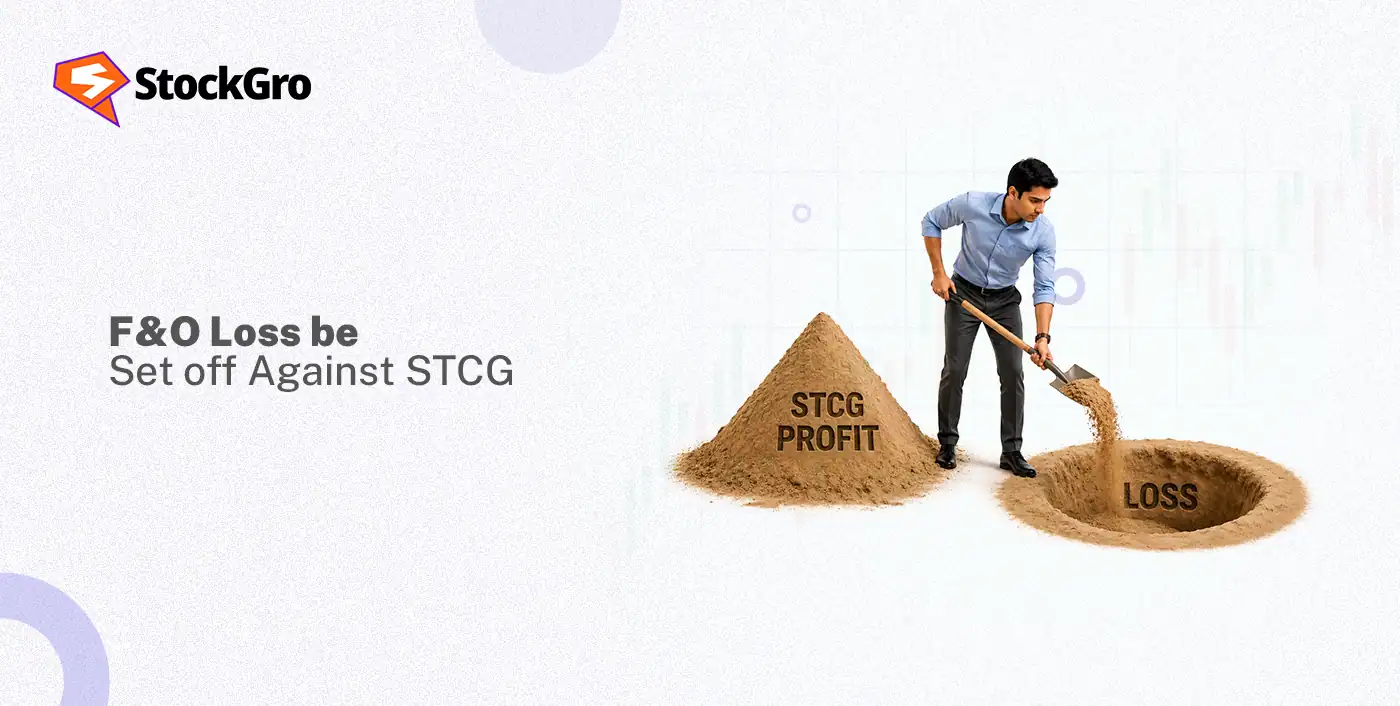
Yes, you can set off F&O loss against Short-Term Capital Gains or STCG in India.
Under ITA Section 43(5), if you carry Futures and Options trading on the stock exchanges is treated as a non-speculative business. This means the loss is seen as a non-speculative business loss.
According to Section 71, these business losses can be adjusted against income under any speculative and non-speculative income head, except for Salary.
So when you make Short-Term Capital Gains (STCG) on shares, mutual funds, or other assets, you can use the F&O loss to set off against those gains.
Why Does This Rule Exist?
The gains earned through different activities do not always receive the same tax treatment. The Income-tax Act separates income into different heads because each activity carries a different economic character.
As per the law, F&O trading is considered a business activity rather than an investment activity. Since it involves frequent transactions, market participation, delivery, and business risk, the law treats its profits and losses as business income.
The objective is fairness. If business profits are taxable, genuine business losses should also reduce the overall taxable income wherever the law permits. This prevents taxpayers from being taxed on income that does not represent their actual economic gain.
At the same time, the Act places reasonable boundaries on these adjustments to prevent misuse of losses and preserve the integrity of the tax system.
How Set-Off Works: Rules Every Trader Must Know
Here is how the set-off rules apply when you report your income and losses:
- Eligible classification: F&O losses qualify as non-speculative business losses only when transactions satisfy Section 43(5) conditions.
- Permitted adjustment: Non-speculative business losses may be adjusted against STCG, LTCG, house property income, and income from other sources, but not salary income.
- Same-year priority: Current-year business losses should first be adjusted against income during the same assessment year.
- Accurate reporting: The loss must be correctly reported in the appropriate ITR to claim the adjustment lawfully.
Carry Forward Rules for F&O Loss
If your loss cannot be completely adjusted during the current financial year, the Income-tax Act allows you to carry forward the unutilised balance for future use, subject to prescribed conditions.
The rules are:
- Under Section 72, unadjusted non-speculative business losses can be carried forward for up to eight assessment years.
- The carried-forward loss can be adjusted only against business income in future years.
- The taxpayer must file the ITR within the due date mentioned in Section 139(1) to have the right to carry forward the loss.
- If the return is filed after the due date, the carry-forward benefit may not be available.
- The taxpayer must also maintain proper books, trading records, and supporting documents to substantiate the reported loss.
Why Tax Planning Matters in Trading?
A profitable trader is not someone who earns more. A wise trader also understands how taxes influence the final outcome. Every legitimate deduction and permitted adjustment helps in preserving capital for future opportunities.
Know why it matters:
- Correct tax calculation: Proper set-off prevents paying tax on income that is legally adjustable.
- Loss preservation: Filing the return on time protects your right to carry forward business losses.
- Better financial decisions: Understanding tax consequences helps in evaluating trading performance more accurately.
- Regulatory compliance: Correct reporting reduces the possibility of notices, disputes, and unnecessary penalties.
Final Thoughts
A trading loss does not necessarily reduce your wealth. When the Income-tax Act permits, it can also reduce your tax burden. The F&O losses can be set off against Short-Term Capital Gains and, if unadjusted, carried forward according to the prescribed rules.
Understanding these provisions, maintaining proper records, and filing your ITR within the due date can help you make informed trading decisions while staying fully compliant with tax laws.
FAQs
No, although F&O loss is treated as a non-speculative business loss, Section 71 does not permit business losses to be set off against salary income. However, such losses may be adjusted against other heads of income, subject to the provisions of the Income-tax Act.
No, the Futures and Options transactions carried out on a recognised stock exchange are excluded from speculative transactions under Section 43(5). Therefore, profits and losses from F&O trading are treated as non-speculative business income or loss.
The non-speculative F&O business losses can be carried forward for up to eight assessment years under Section 72. The carried-forward loss can be adjusted only against business income, provided the applicable conditions under the Income-tax Act are satisfied.
Yes, if you want to carry forward an F&O business loss, you must file your Income Tax Return (ITR) within the due date prescribed under Section 139(1). Timely filing is essential to preserve the carry-forward benefit.
No, intraday equity trading is treated as a speculative business. Under Section 73, speculative business losses can be set off only against speculative business profits and cannot be adjusted against Short-Term Capital Gains.
A tax audit may be required depending on your turnover, declared profits, and the provisions of Sections 44AB and 44AD of the Income-tax Act. The applicability should be determined after considering your trading turnover and overall tax position for the financial year.