Summary
BSE is Asia’s oldest stock exchange, where investors buy and sell shares of listed companies through registered brokers.
Beginners should understand trading, settlement, Sensex and applicable charges before investing in the stock market.
What is BSE?
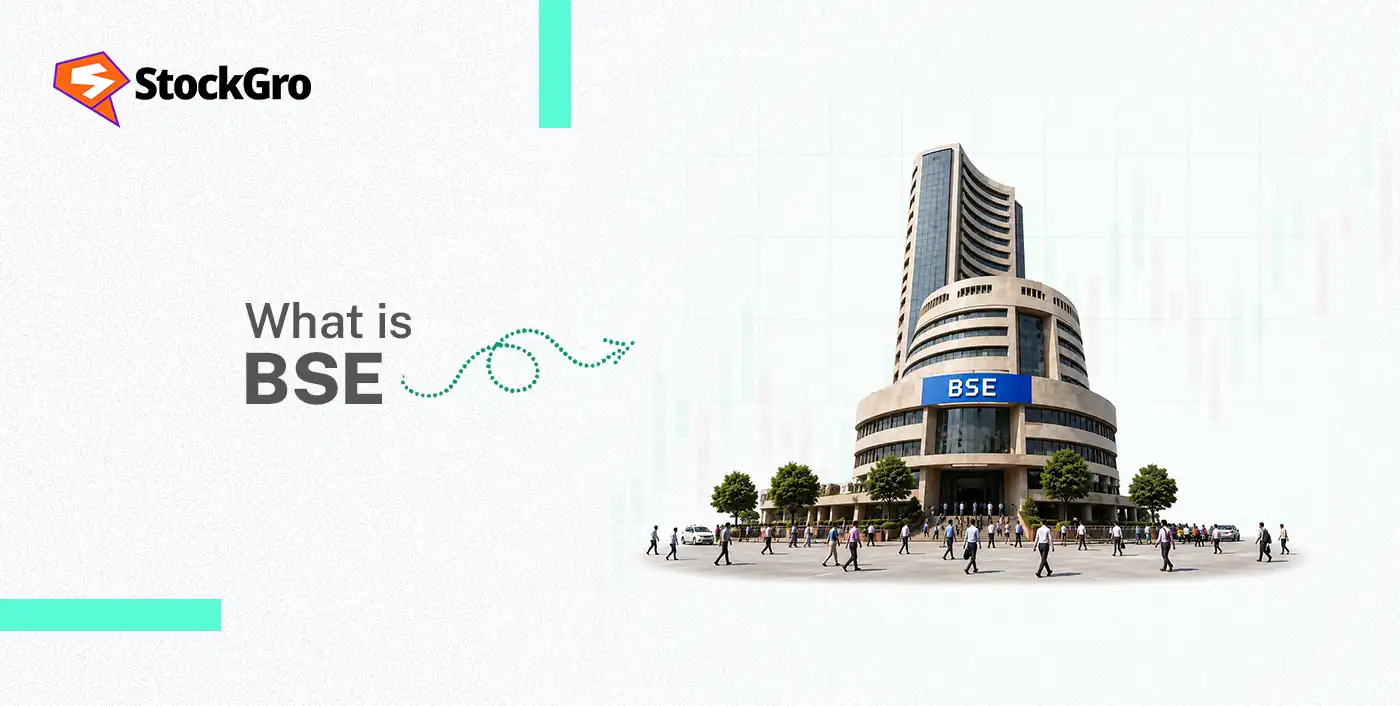
Established in 1875, BSE Limited, formerly known as the Bombay Stock Exchange, is Asia’s oldest stock exchange and one of India’s leading securities exchanges.
BSE is the stock exchange market where all the investors and traders come to buy and sell securities from the companies listed there. BSE includes a huge number of listed companies, which makes it a diverse stock exchange.
How does the BSE work?
- Step 1 – Company Listing: A company that wants to raise money from the public goes through an Initial Public Offering. Gets listed on the Bombay Stock Exchange. Once listed, its shares are available for anyone to buy or sell.
- Step 2 – Placing an Order: An investor opens a demat and trading account, as per requirement, with a registered broker. When they want to trade shares, they place an order through their broker’s platform. The order is then sent to the Bombay Stock Exchange’s trading system.
- Step 3 – Matching Orders: The Bombay Stock Exchange’s trading engine matches. Sell orders based on price and time. When a match is found, the trade happens automatically.
- Step 4 – Settlement: After the trade, the settlement process begins. In India, most equity trades follow a T+1 settlement cycle. This means the exchange of shares and money is completed by the working day.
- Step 5 – Clearing and Confirmation: The clearing house checks that both parties do their part. The investor’s Demat account is updated accordingly.
BSE VS NSE: Key differences every investor should know
The key differences between BSE and NSE are:
| Basis | BSE | NSE |
| Establishment | Bombay Stock Exchange, 1875 | National Stock Exchange, 1992 |
| Standard Index | Sensex (top 30 companies) | Nifty 50 (top 50 companies) |
| Derivatives Market | Less active derivative market | India’s largest derivative market |
| Turnover volume | Low | High |
| Listed companies | Has a larger number of listed companies | Has fewer listed companies but generally higher trading turnover |
Why BSE matters for Investors and Traders
The BSE is important for India’s economy. Here is why the BSE matters to you as an investor or trader:
- Price Discovery: The BSE is a place where people can buy and sell shares in an open market. The BSE helps figure out the price of a company’s shares based on how many people want to buy or sell them.
- Liquidity: Always, a lot of people are buying and selling shares on the BSE. This allows shares to be bought or sold easily without significantly affecting their market price.
- Investor Protection: The BSE is watched over by the SEBI. The SEBI makes sure everyone follows the rules so investors are not cheated or treated unfairly.
- Economic Indicator: The Sensex is the measure of the health of India’s economy. When the Sensex is going up, it often means investors are feeling good about the economy, and it is growing. When the Sensex is going down, it can mean people are not sure what is going to happen. The BSE is important for India’s economy and for investors, like you.
Real World Example: How a Beginner Uses BSE
Suhana, a 26-year-old professional in Bangalore, wants to start investing. She opens a Demat and trading account with a broker that is registered under the SEBI. After doing some research, she decides to buy shares of a well-known company that is listed on the Bombay Stock Exchange.
She logs into her broker’s app, searches for the company, checks what the current share price is on the Bombay Stock Exchange, and then places an order to buy 10 shares of the company. Within seconds, her order is matched with someone who wants to sell shares of the company, and the deal is done. The next business day, her Demat account shows that she now owns 10 shares of the company.
Over the next few months, Suhana keeps an eye on the Sensex to see how the market is doing in general, and she also checks how her shares of the company are doing.
Common Mistakes Beginners Make While Understanding BSE
Beginning your investment journey can be exciting. New investors often face these common problems. Here are a few things to watch out for:
1. Do not confuse trading on BSE with investing in BSE Limited. BSE operates the exchange, while BSE Limited is also a listed company whose shares can be purchased separately.
2. Some people think the Sensex is the overall market, but that is not true. The Sensex only looks at 30 companies, so it is not a good idea to judge the whole market based on the Sensex alone.
3. New investors often get upset when the market goes down or get too excited when it goes up. The Sensex will always change, so it is important to make decisions instead of reacting emotionally.
4. When you buy or sell stocks, you have to pay some fees like brokerage fees and Securities Transaction Tax, and some other charges. These fees can add up and accumulate to how much money you actually make.
5. It is not preferred to buy a stock solely based on its popularity. Before investing, investors need to study what the company does and its financial performance.
How to Start Learning and Practicing Stock Market Skills
To build confidence before investing your money, you need to learn and practice in a very systematic way. Here are a few ways you can practice and learn to polish your stock market skills:
- Start with the basics: Learn the concepts. What a stock is, how the markets work, what these indices are, and how to read a balance sheet.
- Use paper trading: Simulated trading can help beginners understand how buying and selling stocks works before they use their own money. Apps such as StockGro allow users to practise placing trades with platform currency, track their decisions and become familiar with market movements. However, practice results may differ from actual trading outcomes.
- Follow the market every day: Spend a minute each day, maybe 10 to 15 minutes checking the market news and trying to understand why the Sensex is moving up or down. With time and experience, you will start understanding market patterns easily.
- Start small: Once you feel confident to invest your money, start with a small amount in companies that are strong and have been well-established. Starting with a small investment can help you learn and build confidence gradually.
Final Thoughts
The Bombay Stock Exchange, or BSE, is more than a financial institution. It plays a role in India’s capital market, helping create wealth for investors. Investing is all about patience and consistency.
If you are new to investing and want to learn more, understanding the BSE and similar platforms is a good place to start. It is an investment of your time. You should do it before you even think about investing a single rupee in the stock market. The BSE and stock market may appear difficult to understand. With practice, it becomes easier to understand.
FAQs
BSE originally stood for Bombay Stock Exchange. The exchange now operates under the legal name BSE Limited and is Asia’s oldest stock exchange.
The BSE is the place where people buy and sell shares. The Sensex is the score that indicates how well the top 30 companies on the BSE are doing. The BSE has companies and the Sensex tracks the top 30 companies on the BSE. The BSE is important. The sensex is a part of the BSE that shows the performance of the top companies on the BSE.
Neither exchange is automatically better for beginners. Both operate under SEBI’s regulatory framework. When a share is traded on both exchanges, investors may compare the available price, liquidity and bid-ask spread before placing an order.
To invest in the Bombay Stock Exchange, you need to open a Demat account and a trading account. You need to open these accounts with a stockbroker that is registered with the SEBI. Once you have set up your accounts, you can buy/sell shares listed on the BSE through your broker’s platform.
BSE lists thousands of companies across sectors such as banking, technology, energy, healthcare and consumer goods. These include Reliance Industries, Tata Consultancy Services, HDFC Bank, ICICI Bank and Infosys. BSE also operates the BSE SME platform for eligible small and medium-sized enterprises. The number of listed and actively traded companies changes as businesses list, delist or face trading suspensions.
Yes. Many brokers have something called paper trading or virtual trading. This is where you can practice buying and selling shares with money and learn how to trade without risking your money.