Summary
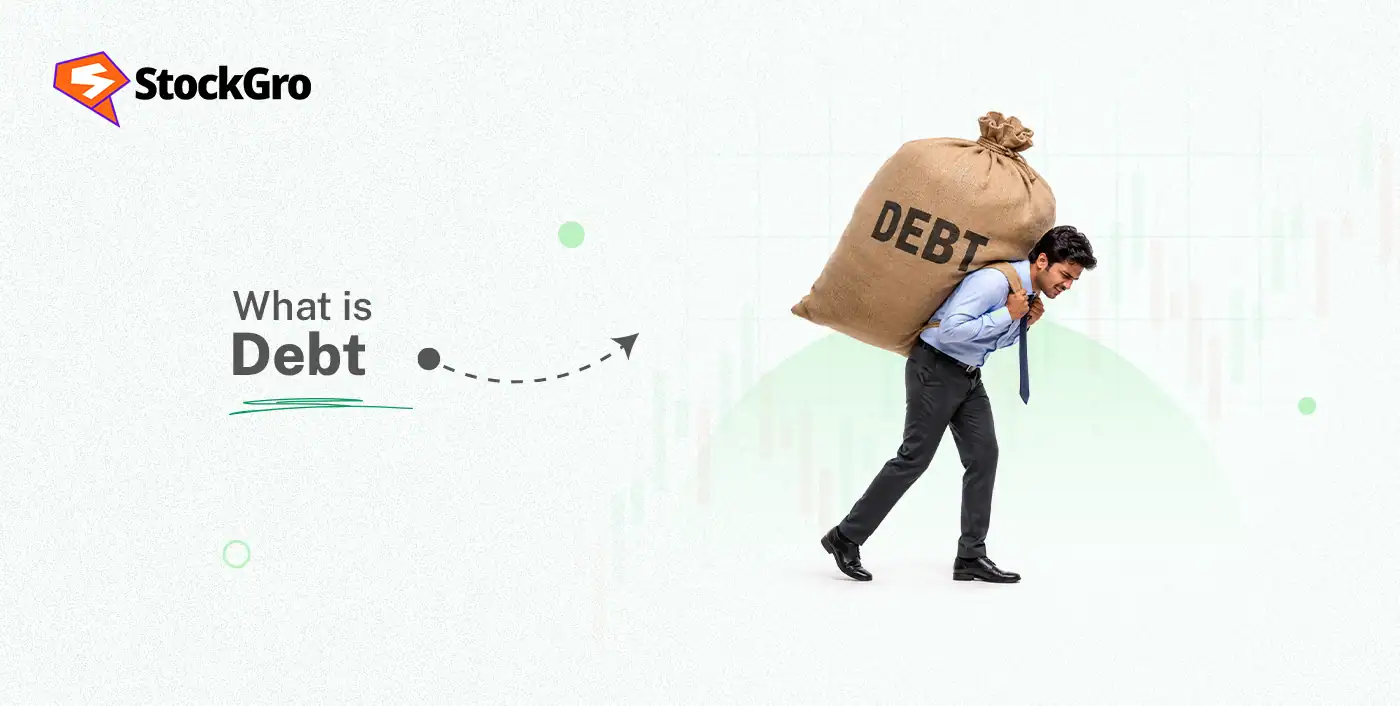
Debt is money borrowed that must be repaid with interest over a predetermined period.
Borrowers can include individuals, companies, or governments, and lenders may be banks, institutions, or bond investors.
Proper understanding of debt is essential to manage repayments, interest, and leverage effectively.
What is Debt?
Debt is a financial obligation where a borrower is obliged to repay the lender over a predetermined time, along with a surplus amount. When a lender offers debt to a borrower, then the borrower is liable to repay the debt amount along with a percentage of interest on it. It is a loan borrowed for a reason, and it is required to be repaid later with an extra payment called interest.
Types of Debt in Personal Finance and the Market
There are a few types of debt in personal finance. They are mentioned below:
- Secured Debt: Secured debt refers to the debt which is protected by collateral or an asset. In case of non-repayment, the lender is entitled to claim the collateral. For example, Gold loans.
- Unsecured Debt: Unsecured debt means a debt which is not secured by any asset and carries high risk. Due to the degree of risk, the lender imposes higher interest rates than normal. For example, a medical loan or a student loan.
- Revolving Debt: Revolving debt is a line of credit, where the borrower can borrow money without having a fixed repayment amount up to a set limit. It allows you to borrow, as long as you are repaying it. It is a series of borrowing and repaying money, and then again borrowing, under a given limit. For example, a credit card facility.
- Instalment Debt: Instalment debt refers to the debts where the repayment is scheduled in installments for a fixed period. For example, a car loan EMI.
The debt issued by companies and the government to raise their capital is called a Debt Instrument. Just like shares trade on the stock market, many of these debt investments also trade in their secondary market. A few of them are mentioned below:
- Corporate Bond: Corporate debt refers to the securities offered or issued by companies. For example, mutual funds.
- Government Bond: Government bond refers to the bonds issued by the local government bodies to raise funds for infrastructure projects. For example, government bonds.
- Debentures: The debenture refers to an unsecured instrument issued by governments and companies to raise funds for their capital.
- Treasury Bond: The Treasury Bond is issued by the U.S. Government to raise capital from the public for the government treasury. If the debt period is till 52stillrs, then they issue treasury bills; if it is between 1year to 10 years, then they issue notes. And if the debt period is between 20 and 30 years, then they issue bonds.
How Debt Works: Interest, EMIs, and Leverage
Interest
Interest refers to the cost of borrowing. The percentage of interest is decided on an annual basis. For example, A person took a home loan of ₹1,00,000 for 3 years at the rate of 5% per annum.
There are two ways to calculate interest. They are simple interests and compound interests.
Simple interest calculates the interest paid on an amount over a period of time. To calculate simple interest, the formula is
SI = (P × R × T)÷100
Where,
P = Principal or initial amount
R = Rate of interest
T = Time or number of years
Compound interest calculates the interest on the initial amount, along with the accumulated interest paid on it. It simply means interest calculated on accumulated interest. To calculate compound interest, the formula is
CI = P[(1 + r/n)nt – 1]
Where,
P = Principal or initial amount
r = rate of interest
n = frequency of interest calculated or compounded
t = time or number of years
EMIs
Equated Monthly Instalments (EMIs) are the fixed amount that is scheduled for repayment on a loan for a period of time. Each instalment includes a fraction of both principal money and interest. For example, A two-wheeler bought at ₹1,50,000 at the rate of 20% in EMI for 5 years. So, the buyer will pay instalments of ₹3974 every month. Therefore, the buyer will pay a portion of the initial amount as well as the interest every month.
Leverage
Leverage refers to borrowing money in order to earn a profit on the borrowed money more than the interest paid, by investing somewhere else. It means using the borrowed funds from someone else and taking advantage of them by earning a profit. For example, a person took out a home loan and bought a house, which he turned into a homestay. The homestay allows him to earn enough profit for him to save even after paying the instalments of the home loan.
Debt vs Equity: Why it matters to Investors
Equity and debt are both traded in the secondary market.
| Basis | Debt | Equity |
| Meaning | Borrowed fund | Ownership of a company |
| Payment | To be paid with interest | No compulsory repayment |
| Control | No involvement in company decisions | Right to vote on company decisions |
| Time | Fixed for a period | Permanent |
| Returns | Payment of interest | Receiving dividends |
For the investors, it is essential to analyse and understand the debt scenario of a company. If the company has already borrowed funds and they are not regular with interest payments. The company might not have a healthy financial performance, so it will be a riskier choice for the investors. On the other hand, if a company has debts and is growing at a good rate, it will be less risky for investors to invest.
Therefore, the debt scenario of a business matters a lot for investors. It influences their decision-making for future investments. Investors prefer companies that can utilise their debts and leverage them wisely.
Debt in Trading and Investing Strategies
Debt is used as a trading strategy. A few of them are mentioned below:
- Marginal trading: Marginal trading is a trading method where the investor borrows a fraction of funds from the broker to invest, and later sells it, and earns potential profit when the value decreases. The investor invests a small amount of capital and borrows funds from the broker, and takes over a bigger investment.
- Short Selling: Short selling is a trading strategy where the investor borrows securities from the broker and sells them immediately, hoping for a drop in the value of the stock. Later, when the price drops, again buy the securities and return them to the broker, and keep the remaining revenue as profit.
- Leverage ETFs: Leverage exchanged-traded funds (ETFs) is a method of trading where investors borrow funds to invest in ETFs to amplify their investment in a short period of time. It allows amplifying returns by 2 or 3 times more than a regular one. This method is preferred for experienced investors because the profit and loss percentage is equal. Therefore, if the funds are not used wisely, the investor might incur a huge loss.
Benefits, Risks, and Common Mistakes in Managing Debt
There are various benefits of Debt. Some are given below:
- Acquiring assets: Debt helps you to buy property or assets without having enough personal capital.
- Build Business: Debts allow you to open a business without having to use all your savings as capital.
- Increases your profits: Debts provide the advantage of earning more than your debt interest when you borrow to invest. So, if you earn more than the interest you pay, the debt increases your profit. For example, Mr K borrows ₹2 lakh to invest. His loan interest is 8%, while he made a 12% gain. Therefore, the margin becomes his profit.
- Helps you act fast: Stock markets move quickly. Sometimes a great opportunity shows up. You don’t have enough money. Using borrowed money or leverage lets you act away without waiting to save more.
- Spread your investments: A personal pool might be limited. Borrowed money helps you invest in different assets or sectors at once. This way, you diversify instead of investing everything in a single investment.
The risks involved in Debts are:
- Strain your budget: Too much interest and less income can strain or hamper your budget.
- Accumulated interest: Accumulated interest on high-rate loans is unsafe. Try to repay your loan regularly.
- Interests over profits: If, as a company, your profits are not enough, your interests will acquire most of the profit, and you will end up with very little income.
- Poor investment decisions: When you trade with borrowed funds, you feel more pressure than when trading with your own funds. And this results in poor timing of trading or taking irrational investment decisions.
Common mistakes to avoid
- Excessive debt: When you take on more debts than you earn, it creates an imbalance in your finances.
- High-rated debts on low returns: If you borrow funds at high rates and invest in securities that will provide low returns, it will result in huge losses.
- Holding a leveraged position: If you keep your leveraged tool for too long, after it has not traded well, your interest keeps stacking up.
- Continue trading in losing trades: If you borrow funds to invest in a trade that is already falling, then that will accumulate losses whose recovery seems uncertain.
Real World Examples and Practical Scenarios
Example 1: Arjun earns ₹80,000 per month. He buys a ₹40,00,000 apartment. He pays ₹8,00,000 as a down payment. Then he takes a ₹32,00,000 home loan at 8.5% for 20 years.
His monthly EMI is ₹27,800. Over 20 years, he has paid around ₹66,00,000 in total. By then, his apartment is likely worth ₹1.2 crore or more. The home loan helps Arjun turn ₹8,00,000 of savings into a long-term asset that will increase in value. He also gets tax benefits on the interest he pays.
This is how a home loan like Arjun’s home loan works, at its best. It is purposeful, planned and productive. Arjun’s home loan is an example of how debt can be helpful.
Example 2: Vikram is a trader in Hyderabad. He thinks the ABC stock will drop because of earnings and negative news. He borrows 200 shares from his broker at ₹300 each. And sells the shares at ₹60,000 in the market. He plans to wait for the price to drop. Then he will buy the shares back cheaper. After that, he will hand back the shares to the broker and retain the profit from the difference.
After two weeks, the price of the stock dropped to ₹240. So, he purchases 200 shares for ₹48,000 and returns the stock to the broker. After paying a broker fee, he gets a profit of ₹11,200.
He makes this profit without owning a single share of ABC. He borrowed the shares, sold them at the current price, waited for the value to drop, and then bought them back. The difference is the profit earned.
Final Thoughts
Debt is money borrowed for a fixed tenure, which you have to pay back with some extra money added to it over time. There are kinds of debt like home loans, credit cards and bonds. Each one of these is used for something. If you want to make decisions about borrowing money, you need to understand how the extra money you pay, i.e. interest, works and how you can pay back the money you borrowed.
Leverage increases the amount of capital you can use to invest. Furthermore, different debt instruments also allow investors to earn fixed returns. The important thing to remember about debt is to borrow money when you have a good reason to know how much it is going to cost you and how you are going to pay it back. Debt can be helpful if used efficiently.
FAQs
No. Debt is not always bad. Debt can be good when you use it for something like buying a house or paying for school. Debt is bad when you get it without knowing how you will pay it back or when you use it for things you do not really need.
Yes. When you pay back debt on time, it helps your credit score. A good credit score makes it easier for you to borrow money in the future. It will cost you less.
Yes. It can be risky. When you borrow money to invest, you can gain or lose. This is something that only experienced investors should do because they know the risks.
No. Debt is not all the same. Some debt is for a short time, and some is for a long time. Some debt has low interest, and some has high interest. Some are riskier than others. You should always know what you are getting into before you borrow money.
Yes. Much debt can hurt you. It can reduce the money you have each month. It can hurt your credit score. It can make you feel stressed about money. Sometimes it can even cause bankruptcy.
Yes. When you use leverage to trade, you are borrowing money from your broker. This is a kind of short-term debt that you have to pay back whether you make money or not.