
The Indian stock market extended its winning streak on 5 November 2026, as the Sensex and Nifty 50 continued to gain for the 6th consecutive trading session. The rally followed easing geopolitical concerns, falling crude oil prices and renewed buying by foreign institutional investors (FIIs).
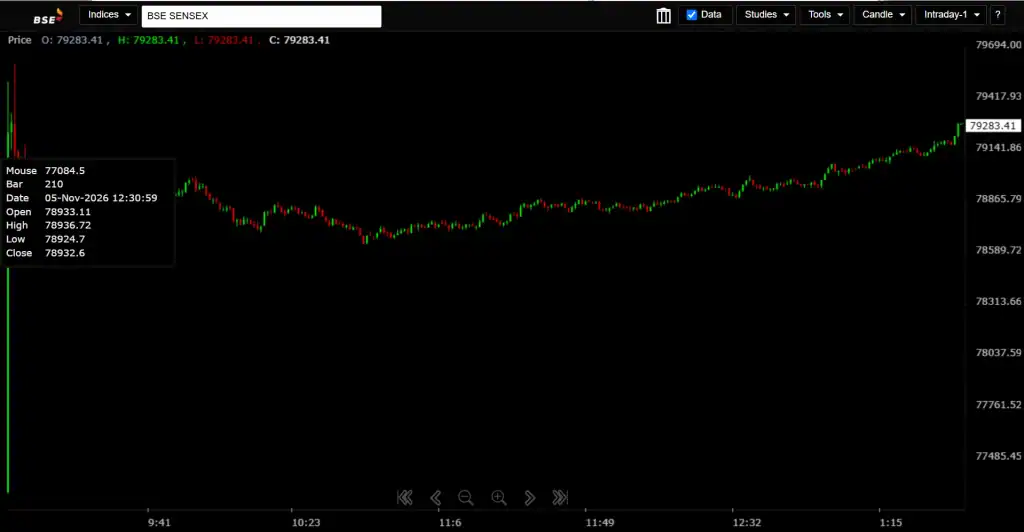
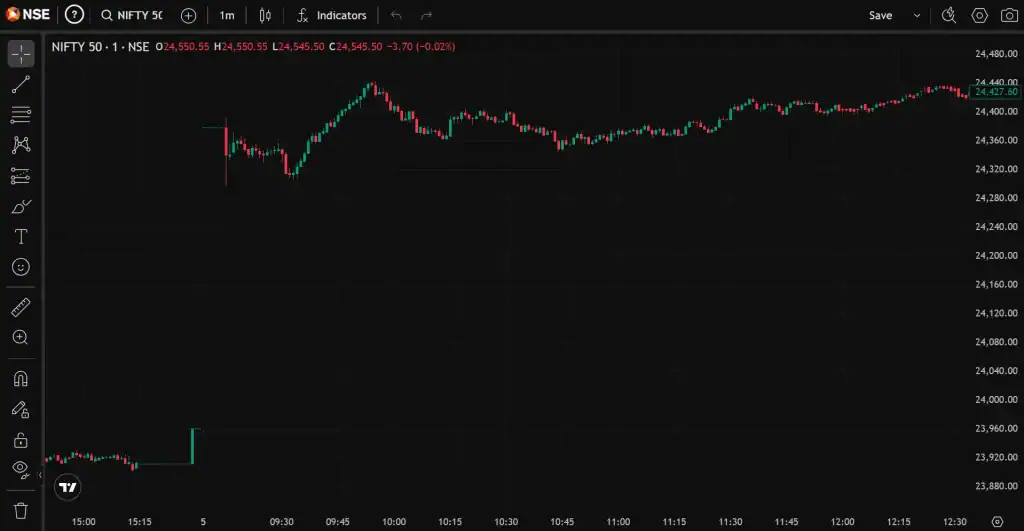
The Sensex jumped 1,433.60 points or 1.85% to 78,735, while the Nifty 50 gained 383.60 points or 1.60% to 24,343.55 during the session’s morning trade.
Several factors, including the US midterm election results, improving technical indicators and expectations of a possible long-term capital gains (LTCG) tax review, have supported market sentiment, as discussed ahead.
Why Indian Stock Market Is Rising Today?
Here are the 6 major factors supporting the upward movement:
1. US Midterm Election Results & Fall In Crude Oil Prices
The US midterm election results have improved investor sentiment. The Democratic Party’s strong performance in Congress has raised expectations that the US administration may work towards reducing tensions in the Middle East, particularly the US-Iran conflict.
This development has eased concerns about possible disruptions to global oil supplies. As a result, crude oil prices have declined sharply.
The international benchmark Brent crude fell more than 8% in the previous trading session. Further, it declined to around USD 93.72/barrel, while US West Texas Intermediate (WTI) crude traded at USD 86.82/barrel.
The lower crude oil prices are positive for India as the country imports a large share of its oil requirements. Affordable oil can reduce import costs, ease inflationary pressure and support the rupee.
2. FII Buying
Foreign institutional investors turned to buying Indian equities, which provided significant support to the stock market rally.
On 4 November 2026, FIIs purchased Indian equities worth ₹7,284.03 crore. This was their highest single-day net buying since 28 October 2025.
Foreign investors have remained net buyers for 4 consecutive trading sessions. Their total buying in November has crossed ₹17,000 crore.
This turnaround comes after selling worth nearly ₹90,000 crore during September and October. The return of foreign capital has improved market confidence and supported large-cap stocks.
3. Technicals
The improving technical indicators have further supported the upward movement in benchmark indices.
The Nifty 50 opened with a gap-up near 24,378 on 5 November. It moved above its 20-day, 50-day, 100-day and 200-day exponential moving averages (EMAs). The index also opened decisively above its 200-day simple moving average (SMA), near 24,003.
The immediate resistance level stands around 24,400. A sustained move above this level could take the index towards the next resistance zone of 24,600.
On the downside, the 24,000–23,950 range is an immediate support zone. A fall below this range could bring the next support level of 23,750–23,700 into focus.
The Relative Strength Index (RSI) is hovering around 73. This indicates strong buying momentum, although it also suggests that the index is entering overbought territory.
4. Expectations on Tax Reviews
The hopes of a possible review of the long-term capital gains (LTCG) tax structure have also improved investor sentiment.
Finance Minister Nirmala Sitharaman on 2 November 2026 said that the government would consider foreign investors’ requests to review the existing tax structure.
The foreign investors have raised concerns about India’s capital gains tax burden. A possible reduction in LTCG tax could make Indian equities more attractive and encourage foreign investors to increase their investments.
Brokerage firm Jefferies has also indicated that a potential reduction in LTCG tax could support the return of foreign capital to the Indian market.
These expectations have added to the positive sentiment surrounding Indian equities.
5. Sectoral Gains
The buying has spread across several sectors, supporting the broad market rally.
On 5 November, all sectoral indices were trading in positive territory. Nifty IT, Nifty Auto, Nifty Realty, Nifty Private Bank, Nifty Metal and Nifty FMCG were among the leading gainers.
The broad market also participated in the rally, with both the Nifty Midcap 100 and Nifty Smallcap 100 gaining over 1% each.
The participation of mid-cap, small-cap and sectoral indices indicates that buying interest is not limited to a few large-cap stocks.
6. AI-related trade loses momentum
The slowdown in AI-related stock momentum has also supported interest in Indian equities.
Concerns about rising artificial intelligence-related expenses and their impact on corporate profit margins have affected investor sentiment towards some global technology stocks.
Apple, for instance, reported higher expenses related to AI development and rising memory costs. Its management also indicated that gross margins could moderate to 45-46% in the final part of the year, compared with 47.9% in the September quarter.
This has raised questions about the profitability of heavy AI investments.
Indian equities are increasingly being viewed as an alternative to the AI-driven investment theme. As some investors reassess their positions in global technology stocks, Indian markets could benefit from changing investment preferences.
However, the slowdown represents a correction in the AI trade rather than a complete collapse in the sector.
FAQs
Why the sudden increase in the stock market?
The sudden stock market rally is supported by falling crude oil prices, easing geopolitical concerns, renewed FII buying and expectations of an LTCG tax review. Additionally, stronger technical indicators and broad-based sectoral gains have further improved investor sentiment.
Is this the right time to invest in Nifty 50?
The decision specifically depends on your investment horizon, risk tolerance and financial goals. Although market momentum has improved, the Nifty 50 RSI near 73 indicates overbought conditions. Long-term investors might consider investing in smaller amounts over time rather than making decisions based only on a short-term rally.