5 hours ago · SEBI Registration INH000024295
SEBI Registration INH000024295 · 5 hours ago
Pricol Falls 17%: What's Behind the Sharp Sell-off?
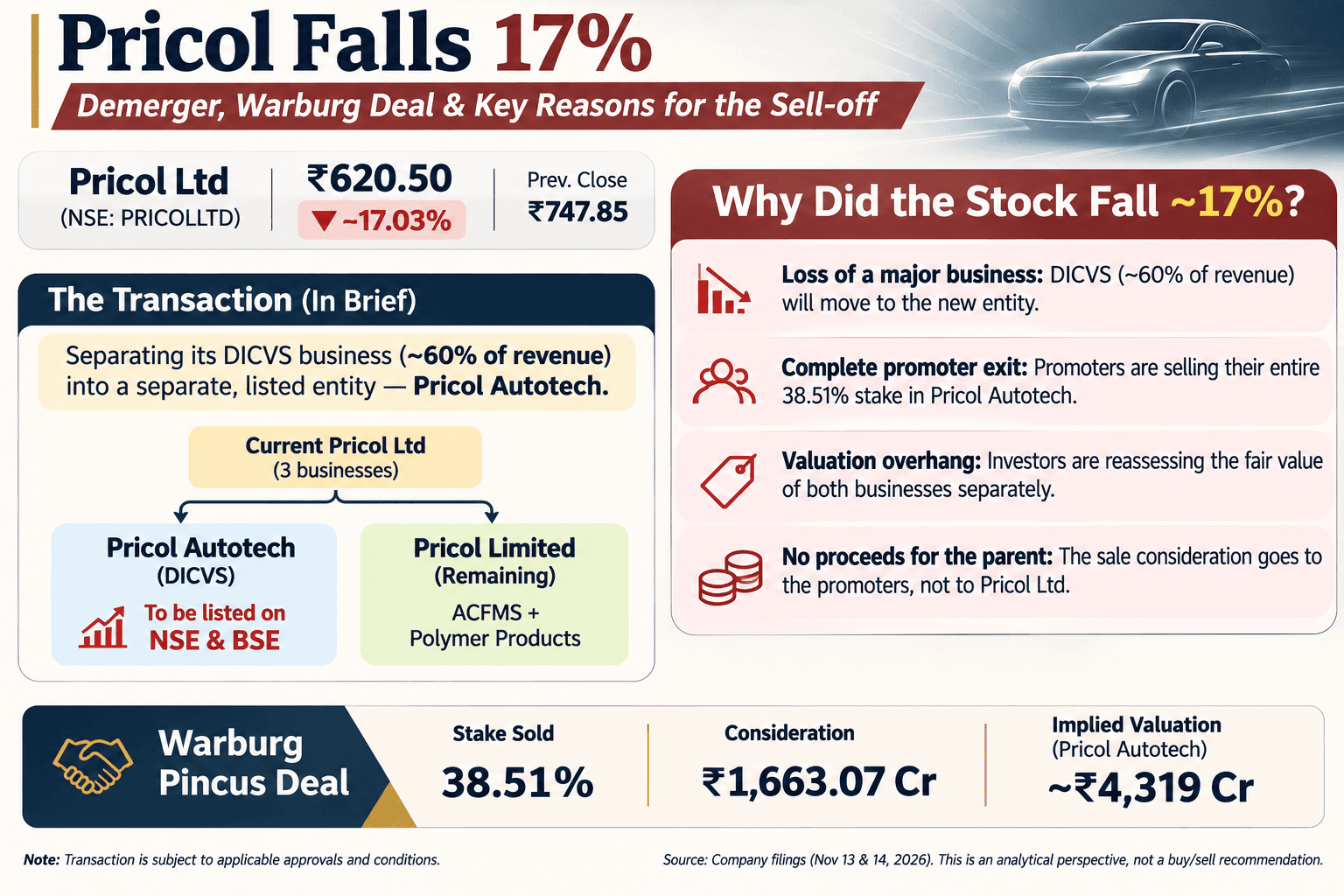
PRICOLLTD is separating its Driver Information & Connected Vehicle Solutions (DICVS) business, contributing ~60% of consolidated revenue, into a separately listed entity, Pricol Autotech. Why the split? Management has indicated three reasons: 1. Technology transition: Moving beyond instrument clusters into connected vehicles, telematics, sensors and e-cockpit solutions requires greater investment in technology and R&D. 2. Capital requirements: Competing globally requires substantial capital, technology partnerships and international expansion. Management does not want to fund the entire journey through borrowings. 3. Focused businesses: DICVS, ACFMS and Polymer have different growth drivers and capital needs. Separate entities could attract investors aligned with each business. Why Warburg Pincus? Warburg will acquire the promoters' entire 38.51% stake in Pricol Autotech for up to ₹1,663.07 crore, implying an equity valuation of ~₹4,319 crore. Importantly, this is a secondary stake sale. The proceeds go to the selling promoters, not Pricol Limited or Pricol Autotech. Why did the stock fall ~17%? • Pricol Limited will lose its largest revenue contributor after the demerger. • The complete promoter exit raises questions about future confidence and participation. • Investors are reassessing both businesses' valuations. • The parent receives no sale proceeds and faces a significantly different earnings profile. Investor takeaway: The demerger has a strategic rationale, but value creation is not guaranteed. The key is whether Pricol Autotech can grow with the required capital and partnerships, and whether the remaining Pricol can sustain earnings growth independently. Track standalone EBITDA/PAT, margins, debt, capex, demerger approvals and open-offer terms. Key question: Are shareholders receiving fair value for the separated business, and what is the remaining Pricol worth independently?